

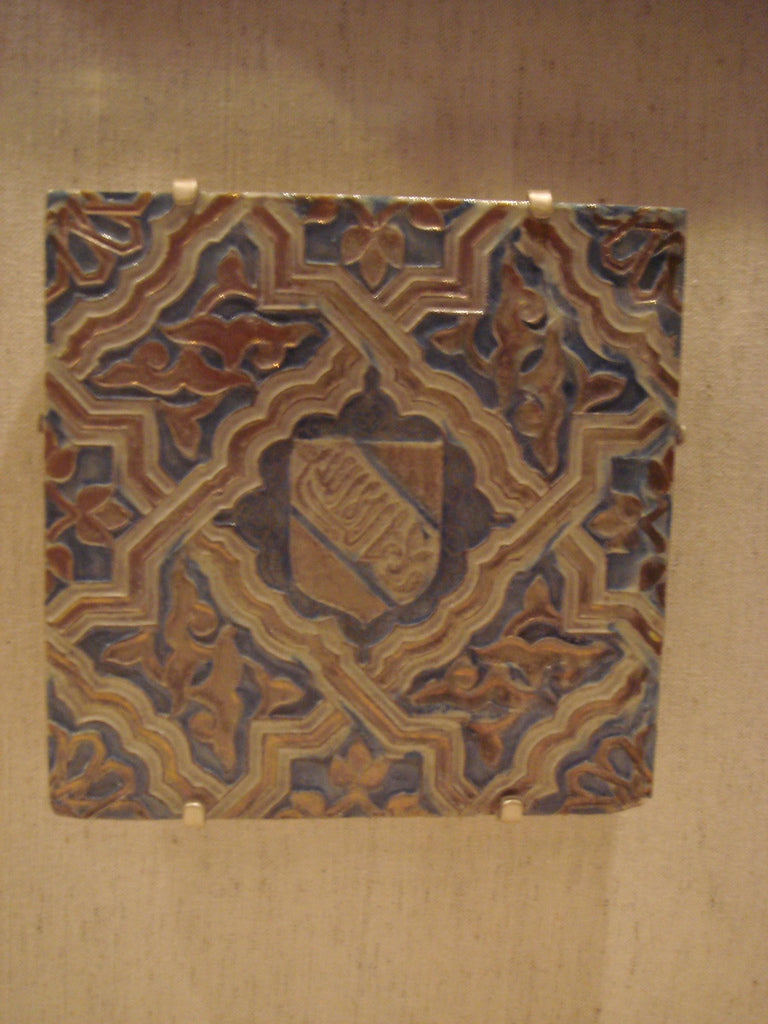
A common misconception is that Islam forbids all images. The Quran does not. What it forbids is idolatry: the worship of images. From this prohibition, early Islamic religious authorities developed a tradition that avoided depicting humans and animals in mosques, on Qurans, and on objects intended for religious use. The avoidance was not absolute (Persian and Mughal court painting routinely showed human figures) but it was strong enough in religious contexts to push artists toward other solutions.
The other solutions were geometry, vegetation, and writing. Together they produced one of the most distinctive visual traditions in world art, spanning fourteen centuries and running from Spain to Indonesia.
The Mathematics of Pattern
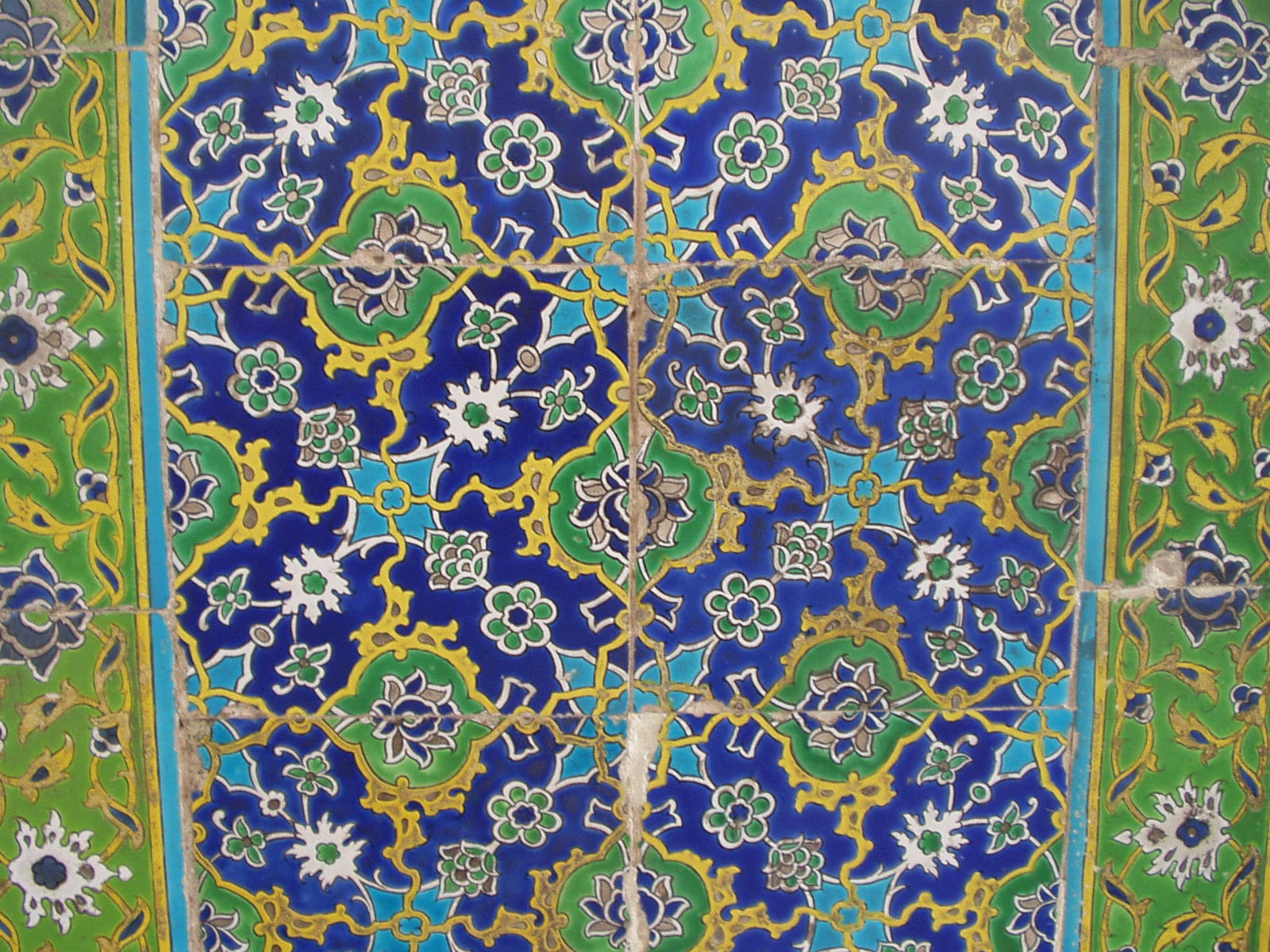
Islamic geometric ornament is built from compass-and-straightedge constructions that any working mathematician would recognise. Circles are divided into 6, 8, 10, 12, or 16 equal parts. Lines are drawn between the divisions to create star polygons. The polygons are extended outward into tessellating patterns that can cover infinite surfaces without repetition or with controlled repetition.
The mathematics involved is not trivial. The five-fold and ten-fold symmetries that appear in Iranian and Andalusian tilework are now known to involve quasi-periodic Penrose tiling, a structure not formally described in the West until the 1970s. Medieval Islamic craftsmen had been producing it for at least 500 years.
The Alhambra
The most famous showcase of Islamic geometry is the Alhambra in Granada, the palace complex of the Nasrid dynasty built between the mid-thirteenth and late-fourteenth centuries. The Court of the Lions, the Hall of the Two Sisters, and the Hall of the Ambassadors are covered floor to ceiling in tile and carved stucco patterns of extraordinary complexity.
The geometric programme is not random decoration. The Court of the Lions has a fountain at its centre with twelve marble lions arranged in a circle. The geometry of the surrounding patterns is calibrated to the cardinal directions and the path of the sun. The carved stucco vaults overhead use muqarnas: small carved units arranged into honeycomb patterns that catch and break up light.
The mathematician M. C. Escher visited the Alhambra in 1922 and again in 1936. His later prints of tessellating patterns were a direct response to what he had seen. He noted in his journals that the Moors had reached a level of pattern design that he could only imitate.
Calligraphy as Art
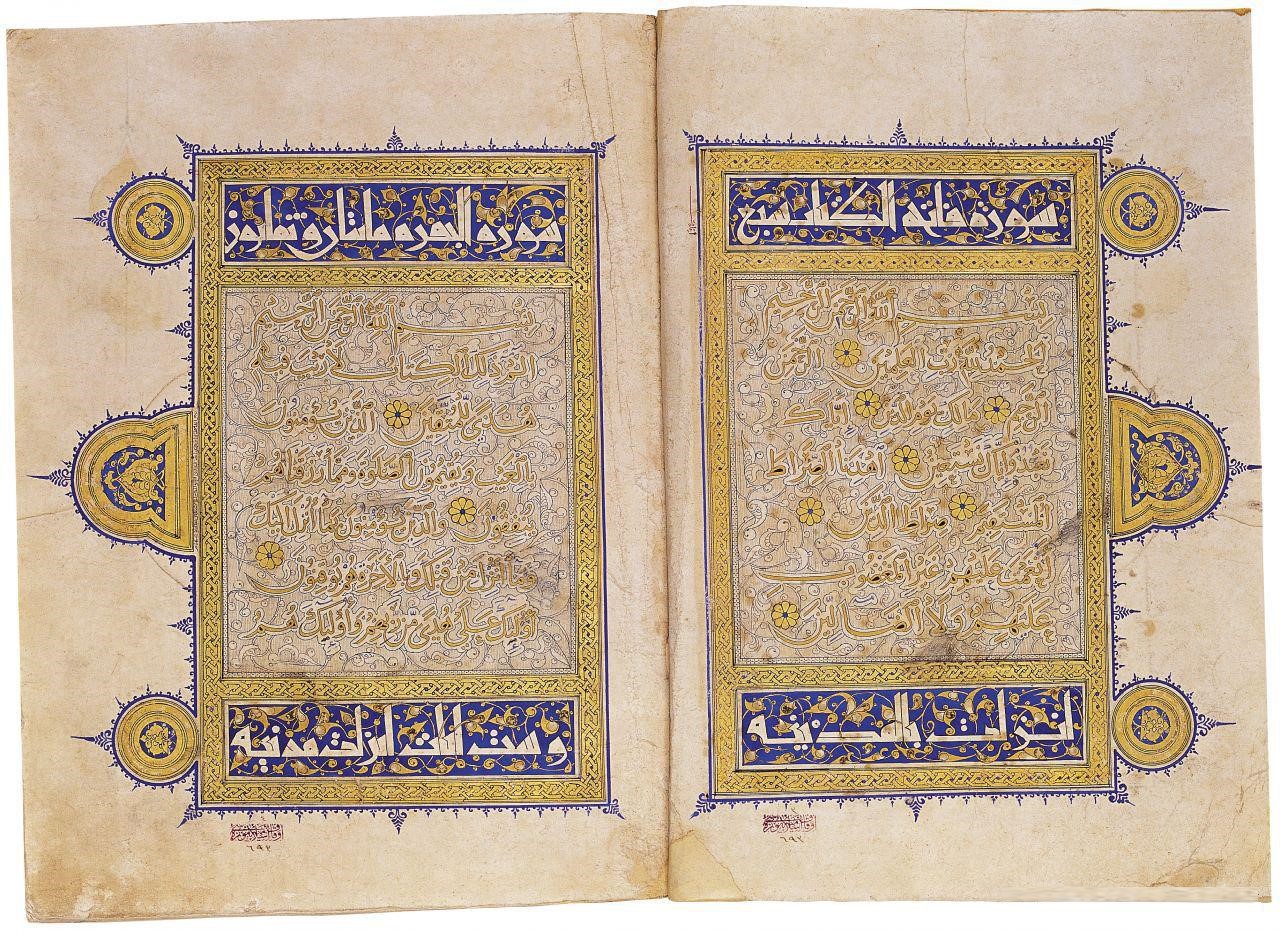
The other major Islamic visual tradition is calligraphy. Because the Quran was understood as the literal word of God revealed in Arabic, the act of writing it took on religious significance. Skilled calligraphers were celebrated as artists in a way no Western Christian scribe was.
The script styles developed over centuries: Kufic (angular, used on early Qurans and architectural inscriptions), Naskh (more flowing, used for daily writing and book hands), Thuluth (large, monumental, used for mosque inscriptions), and dozens of others. The same Quranic verse, written by different masters in different styles, becomes a different work of art each time.
The Vegetal Pattern
Alongside geometry and calligraphy, the third major decorative element in Islamic art is the arabesque: a stylised vegetal pattern of intertwining stems, leaves, and flowers. Like the geometry, it is highly disciplined: each curve is calculated, each leaf placed according to a system. Unlike the geometry, it grows organically across surfaces, suggesting infinite extension without strict repetition.
The arabesque appears on metalwork, ceramics, manuscript illumination, carpets, and architectural decoration. The technical mastery is staggering. A sixteenth-century Iranian carpet may contain six million individual knots, each one placed by hand to follow a pattern designed by a separate cartoon-maker.
Where Figures Appear
Islamic art is not without figures. Persian miniature painting, particularly the schools of Tabriz, Herat, and Isfahan from the fourteenth to seventeenth centuries, produced book illustrations of breathtaking detail showing courtly hunts, romantic scenes, and battles. Mughal portrait painting in India produced individual likenesses of emperors and nobles. Ottoman Turkish painting included historical scenes with named participants.
These figural traditions developed in court contexts, for secular patrons, and on objects (manuscript pages, album leaves) intended for private viewing rather than public worship. The distinction between religious and secular contexts allowed both traditions to coexist within the same culture.
The Modern Echo
Twentieth-century abstraction, particularly the geometric abstraction of artists like Frank Stella in his Protractor Series, owes a direct debt to Islamic patternmaking. Stella visited Iran in 1963 and the structures of his subsequent paintings reproduce the radial symmetries he saw in mosque tilework.
The lesson Islamic art preserves better than most traditions is that ornament can be intelligent. The patterns are not decoration applied to objects. They are the objects' reason for existing.


