

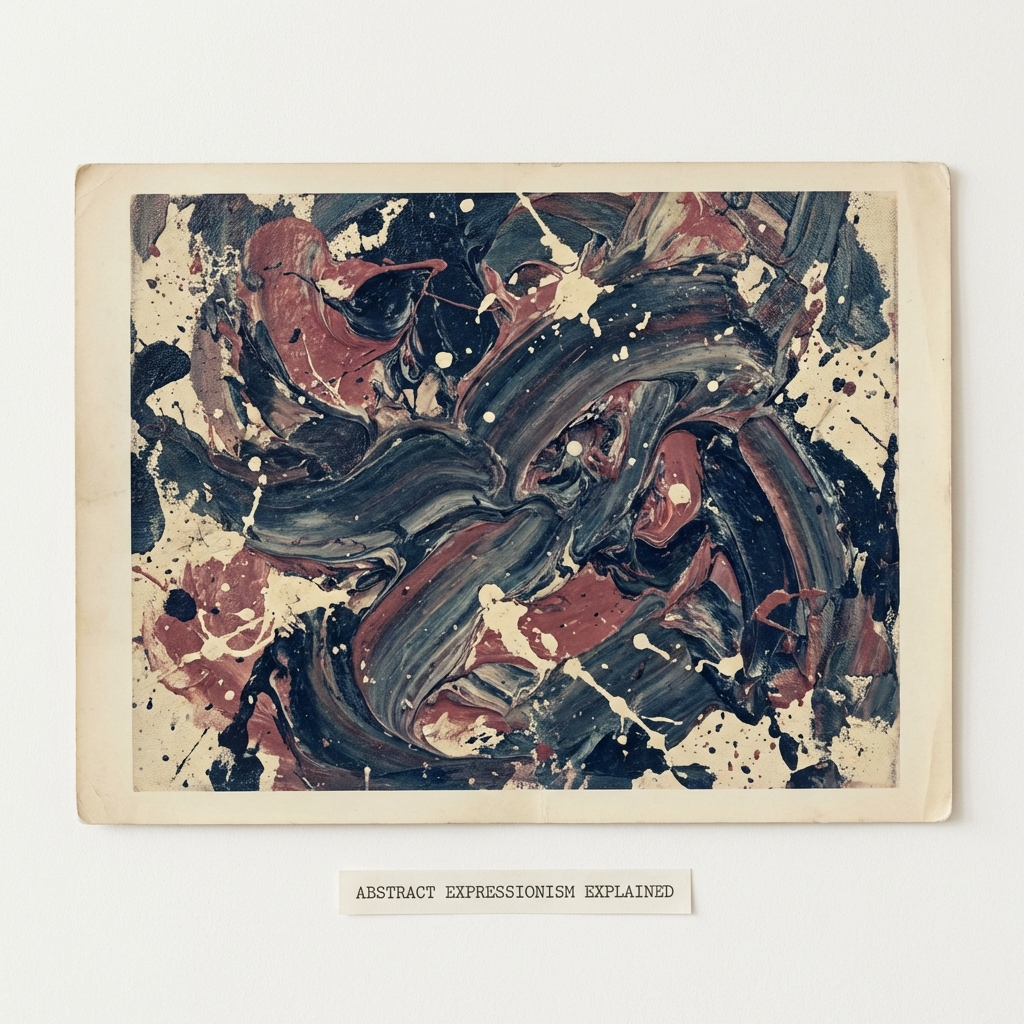
In the quiet chaos of post-war New York, a group of artists began to dismantle the rules of painting. They turned away from the realistic depictions of the world and looked inward, seeking to capture the raw, unedited energy of the human psyche. This was the birth of Abstract Expressionism, a movement that would shift the centre of the art world from Paris to New York and change the course of modern art forever.
Often characterized by large-scale canvases, vigorous brushstrokes, and a lack of representational subject matter, Abstract Expressionism was never a single style. It was a shared attitude—a belief that art should be an event, a direct transfer of emotion from the artist to the canvas. Whether through the drip paintings of Jackson Pollock or the sweeping colour fields of Mark Rothko, the movement championed the act of creation itself as the ultimate subject.
The Roots of Abstraction
While the movement formally coalesced in the 1940s, its roots dig deep into the European avant-garde. The path to pure abstraction was paved by pioneers like Wassily Kandinsky and Paul Klee, who had already begun to divorce colour and form from physical reality in the early 20th century. These artists, many of whom taught at the influential Bauhaus school, brought their theories of spiritual and emotional art to the United States as they fled wartime Europe.
Kandinsky’s work, such as the iconic Composition 8, demonstrated that lines, shapes, and colours could vibrate with musical intensity, independent of any recognized object. This freedom was essential for the American artists who would later push these ideas to their physical extremes.
The Bridge: Surrealism to Expressionism
Before the full explosion of the New York School, there was a crucial transitional period. Artists like Arshile Gorky served as a vital bridge between the dream-like automatism of the Surrealists and the physical vigor of the Abstract Expressionists. Gorky’s work blended the biomorphic shapes of Joan Miró with a new, looser application of paint that anticipated the drip techniques to come.
Gorky believed that the artist’s hand should be moved by an inner spirit, a concept that resonated deeply with the younger generation. His painting The Artist and His Mother remains a haunting example of how personal memory and trauma could be processed into simplified, flattened forms, setting the stage for the complete dissolution of the figure.
Action Painting vs. Color Field
As the movement matured, it bifurcated into two distinct yet related streams: Action Painting and Color Field painting.
Action Painting is perhaps the most famous face of the movement, defined by the physical engagement of the artist with the work. Jackson Pollock, often photographed flinging paint onto canvases spread across his studio floor, famously stated, "The painting has a life of its own. I try to let it come through." This method made the canvas an arena for action, recording the gestures, rhythm, and energy of the artist’s body.
In contrast, Color Field painters like Mark Rothko and Clyfford Still sought a more meditative, spiritual experience. They filled vast expanses of canvas with solid or staining blocks of colour, intended to envelop the viewer and evoke a sense of the sublime. While less chaotic than the action painters, their work shared the same goal: to express complex human emotion without the crutch of imagery.
Styling Abstract Art in Modern Interiors
Integrating the energy of Abstract Expressionism into a modern home requires a balance of boldness and restraint. Because these works are often visually demanding, they work best as focal points in a room.
- The Statement Piece: A large-scale abstract print can anchor a living room. Look for pieces with dynamic movement to contrast with the clean lines of mid-century furniture.
- Colour Echoes: Pull secondary colours from the artwork into your soft furnishings—cushions, throws, or rugs—to create a cohesive scheme without competing with the art.
- Gallery Walls: For a more eclectic look, mix smaller abstract pieces with geometric Bauhaus prints or even playful Pop Art to show the evolution of modern style.
Whether you are drawn to the chaotic energy of action painting or the serene depth of colour fields, Abstract Expressionism offers a timeless way to inject personality and emotion into your space. It invites you not just to look, but to feel.
Explore our full range of expressive and modern works in our All Prints collection.


