

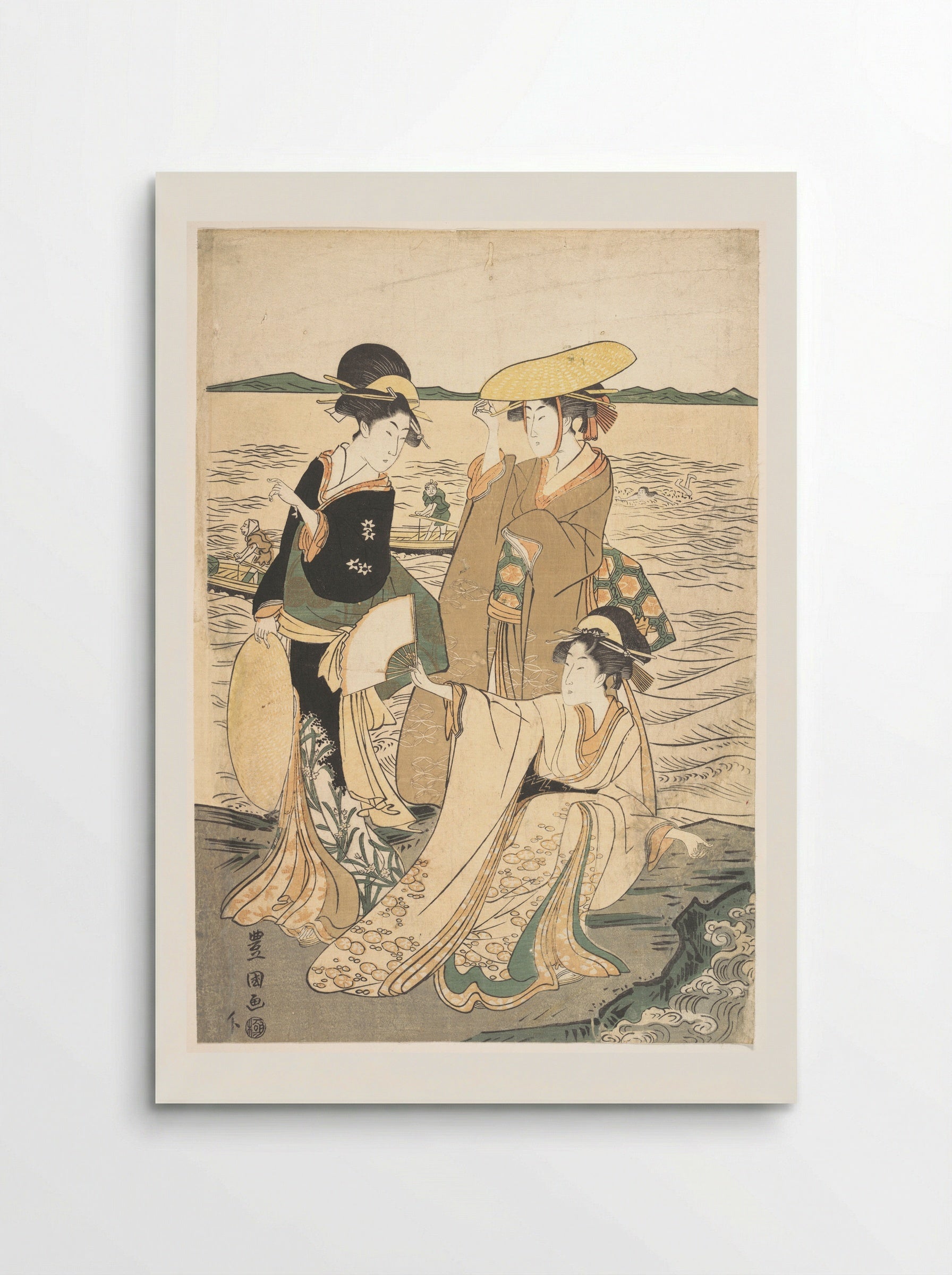
Three Young Ladies by the Seashore - Utagawa Toyokuni I
Archival giclée
Frames arrive ready to hang
Secure checkout
Made to order
Description
This woodblock print by Utagawa Toyokuni I, 'Three Young Ladies by the Seashore', depicts three elegantly dressed women enjoying a tranquil moment by the water, showcasing the artist's mastery of line and composition within the Ukiyo-e tradition.
Utagawa Toyokuni I (1769-1825) was a prominent Japanese ukiyo-e artist, known for his depictions of kabuki actors and beautiful women. He headed the Utagawa school for almost 30 years and greatly influenced the development of ukiyo-e. His prints are characterised by their expressive lines and attention to detail. 'Three Young Ladies by the Seashore' exemplifies Toyokuni's skill in portraying elegant figures within a serene setting. The composition features three women in fashionable attire, positioned along a shoreline. The artist uses delicate lines and muted colours to create a tranquil atmosphere. The women's kimonos display varied patterns, showing the contemporary textile designs. In the background, figures in boats and a distant shoreline add depth to the scene. The print captures a moment of leisure and social interaction, reflecting the cultural interests of the Edo period.
Return policy
Because every print is made to order, we don't offer change-of-mind returns, refunds or exchanges. If your order arrives faulty, damaged or incorrect, we'll replace it free of charge — just contact us within 48 hours of delivery. See our refunds page for full details.
Shipping
We ship worldwide, printing at the production hub nearest to your delivery address. Delivery times and costs vary by destination — you'll see the options available to you at checkout.
Manufacturing
Each print is produced to order using 12-colour giclée printing on FSC-certified archival paper. Designed in Britain and printed at your nearest production hub to reduce waste and speed up delivery.
Care and materials
Specific Features
Every Solis piece is made to order with archival, gallery-quality materials built to last.
- Museum-grade giclée printing for rich, fade-resistant colour
- Archival matte fine-art paper, FSC-certified
- Multiple sizes and framing options available
- Frames in black, natural wood, dark wood or white
- Framed prints arrive ready to hang
Care & Cleaning
To keep your artwork looking its best:
- Dust gently with a soft, dry cloth
- Avoid prolonged direct sunlight
- Never use liquid cleaners on the print or canvas surface
- Keep in a dry, room-temperature space
- Handle prints with clean, dry hands
Materials & Sizing
Museum-grade giclée on FSC-certified archival matte paper, with framed and canvas options.
- Paper sizes: A4, A3, A2, A1, A0 and B2 (50×70 cm)
- Canvas: XS (20×30 cm) to Large (60×90 cm)
- Frames: black, natural wood, dark wood or white
Three Young Ladies by the Seashore - Utagawa Toyokuni I

Artist Biography
Utagawa Toyokuni I
He was born in 1769, the son of a puppet maker. He studied under Utagawa Toyoharu, founder of the Utagawa school, and followed convention by taking one syllable of his master's name. His early work synthesised the styles of Utamaro, Eishi and Choki through close study and relentless practice. By the mid-1790s he had found his own voice. Yakusha Butai no Sugatae (Portraits of Actors in Their Various Roles), a series of large polychrome prints produced between 1794 and 1796, showed kabuki actors costumed and posed on stage rather than seated in formal dress. The series was a commercial triumph and set the standard for actor portraiture for the next generation.
He also excelled at bijin-ga, pictures of beautiful women, establishing compositions that ukiyo-e artists followed for decades. His innovations extended to format: he pioneered the use of diptych, triptych and polyptych arrangements that allowed more complex narrative compositions than the single sheet could hold.
As demand surged, Toyokuni's studio expanded until his personal involvement in each print became nominal. The quality of his later work declined, but the school he built survived him. His two most gifted pupils, Kunisada and Kuniyoshi, became major figures in their own right, and the Utagawa school dominated ukiyo-e production through the final decades of the Edo period. He died in 1825.
Why Choose Us ?
Damage-free delivery guarantee
Fast Shipping
Museum-Quality Materials
You May Also Like