

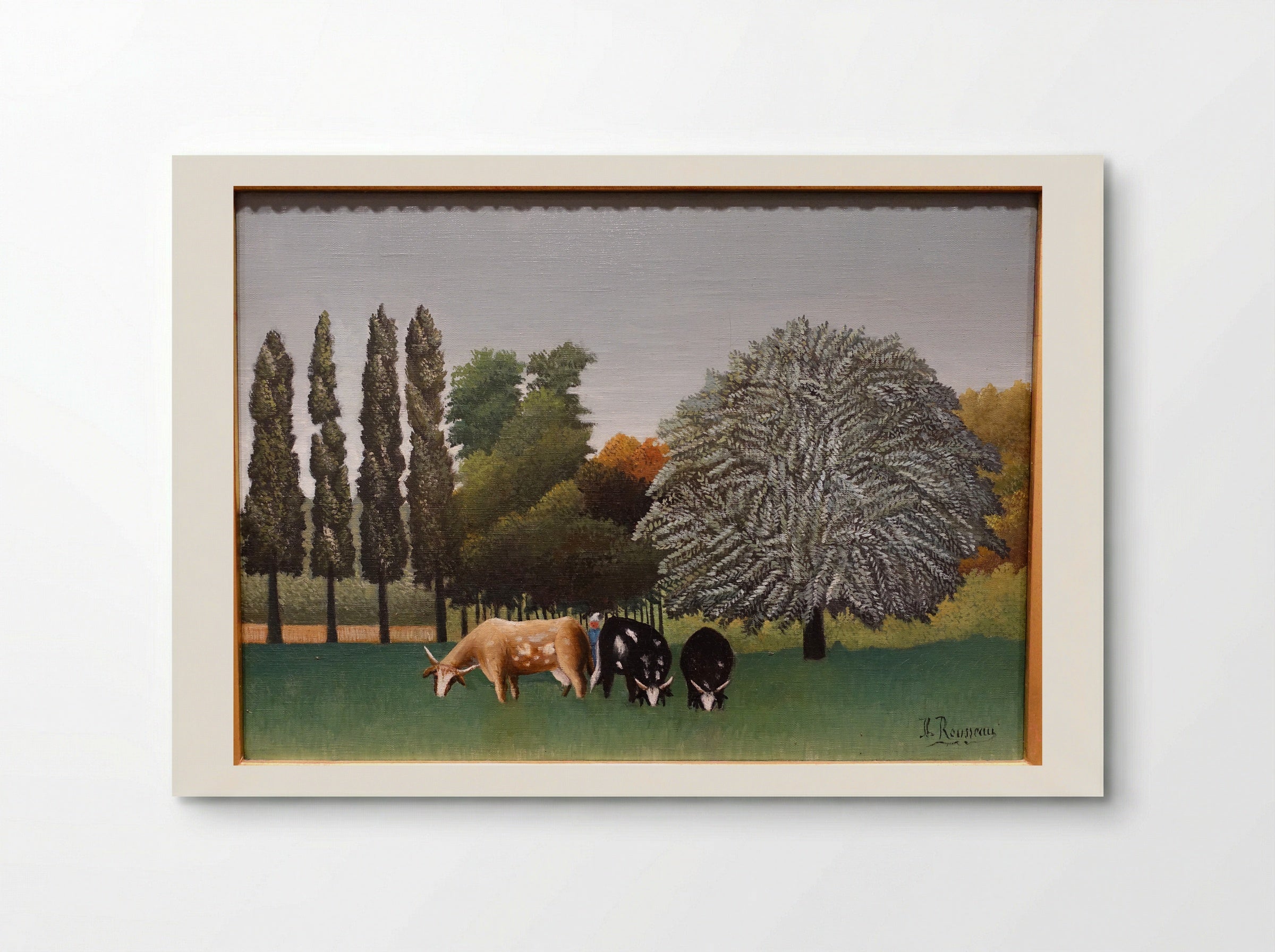
The Banks of the Oise - Henri Rousseau
Archival giclée
Frames arrive ready to hang
Secure checkout
Made to order
Description
A quiet rural scene by Henri Rousseau, featuring cattle grazing beneath trees along the Oise river, rendered in his signature self-taught, precise style.
Henri Rousseau, a self-taught customs officer, produced this work during the later period of his career. The painting depicts a quiet, rural scene along the Oise river, a subject he returned to frequently. Rousseau employs a distinct, non-academic approach to composition, favouring clear outlines and a flattened sense of space over traditional perspective. The three cattle in the foreground are rendered with a simplified, almost sculptural quality, while the trees behind them exhibit his characteristic method of painting foliage leaf by leaf. The colour palette is restrained, dominated by muted greens, earthy browns, and a pale, overcast sky. Rousseau avoids the atmospheric blurring common in the work of his contemporaries, opting instead for a precise, deliberate arrangement of forms. The verticality of the poplars on the left provides a rhythmic contrast to the rounded, voluminous canopy of the large tree on the right. A small, solitary figure is visible between the cattle, a common inclusion in Rousseau's compositions that adds a sense of scale to the quiet environment. This work reflects the artist's unique vision, which operated outside the established art schools of Paris. His focus on clarity and the decorative arrangement of natural elements earned him the admiration of later avant-garde painters who valued his directness. The painting remains a clear example of his ability to transform ordinary French countryside scenes into compositions that possess a dreamlike, static quality. By stripping away the complexities of academic technique, Rousseau creates a scene that feels both immediate and removed from time. The surface texture of the oil paint remains visible, contributing to the tactile quality of the grass and the dense foliage. This print captures the specific tonal balance and the precise, rhythmic structure of the original composition.
Return policy
Because every print is made to order, we don't offer change-of-mind returns, refunds or exchanges. If your order arrives faulty, damaged or incorrect, we'll replace it free of charge — just contact us within 48 hours of delivery. See our refunds page for full details.
Shipping
We ship worldwide, printing at the production hub nearest to your delivery address. Delivery times and costs vary by destination — you'll see the options available to you at checkout.
Manufacturing
Each print is produced to order using 12-colour giclée printing on FSC-certified archival paper. Designed in Britain and printed at your nearest production hub to reduce waste and speed up delivery.
The Banks of the Oise - Henri Rousseau

Artist Biography
Henri Rousseau
Nicknamed Le Douanier (“the Customs Officer”) due to his job on the outskirts of Paris, Rousseau only began painting seriously at age 40 and retired nine years later to pursue art full time. Though he never left France, his exotic landscapes—lush with oversized foliage and wild animals—were inspired by visits to botanical gardens, illustrated books, and stories from soldiers who had served abroad.
Rousseau believed himself to be a great realist, proudly comparing himself to Picasso. He also pioneered the "portrait landscape" genre, blending figures into rich natural backdrops. Once mocked, Rousseau is now celebrated as a visionary outsider whose work continues to inspire, including references in modern pop culture such as the film Madagascar.
Our Features
Designed for Lasting Impact
Specific Features
Every Solis piece is made to order with archival, gallery-quality materials built to last.
- Museum-grade giclée printing for rich, fade-resistant colour
- Archival matte fine-art paper, FSC-certified
- Multiple sizes and framing options available
- Frames in black, natural wood, dark wood or white
- Framed prints arrive ready to hang
Care & Cleaning
To keep your artwork looking its best:
- Dust gently with a soft, dry cloth
- Avoid prolonged direct sunlight
- Never use liquid cleaners on the print or canvas surface
- Keep in a dry, room-temperature space
- Handle prints with clean, dry hands
Materials & Sizing
Museum-grade giclée on FSC-certified archival matte paper, with framed and canvas options.
- Paper sizes: A4, A3, A2, A1, A0 and B2 (50×70 cm)
- Canvas: XS (20×30 cm) to Large (60×90 cm)
- Frames: black, natural wood, dark wood or white
Why Choose Us ?
Damage-free delivery guarantee
Fast Shipping
Museum-Quality Materials
Artist Biography
Henri Rousseau
Nicknamed Le Douanier (“the Customs Officer”) due to his job on the outskirts of Paris, Rousseau only began painting seriously at age 40 and retired nine years later to pursue art full time. Though he never left France, his exotic landscapes—lush with oversized foliage and wild animals—were inspired by visits to botanical gardens, illustrated books, and stories from soldiers who had served abroad.
Rousseau believed himself to be a great realist, proudly comparing himself to Picasso. He also pioneered the "portrait landscape" genre, blending figures into rich natural backdrops. Once mocked, Rousseau is now celebrated as a visionary outsider whose work continues to inspire, including references in modern pop culture such as the film Madagascar.
You May Also Like