

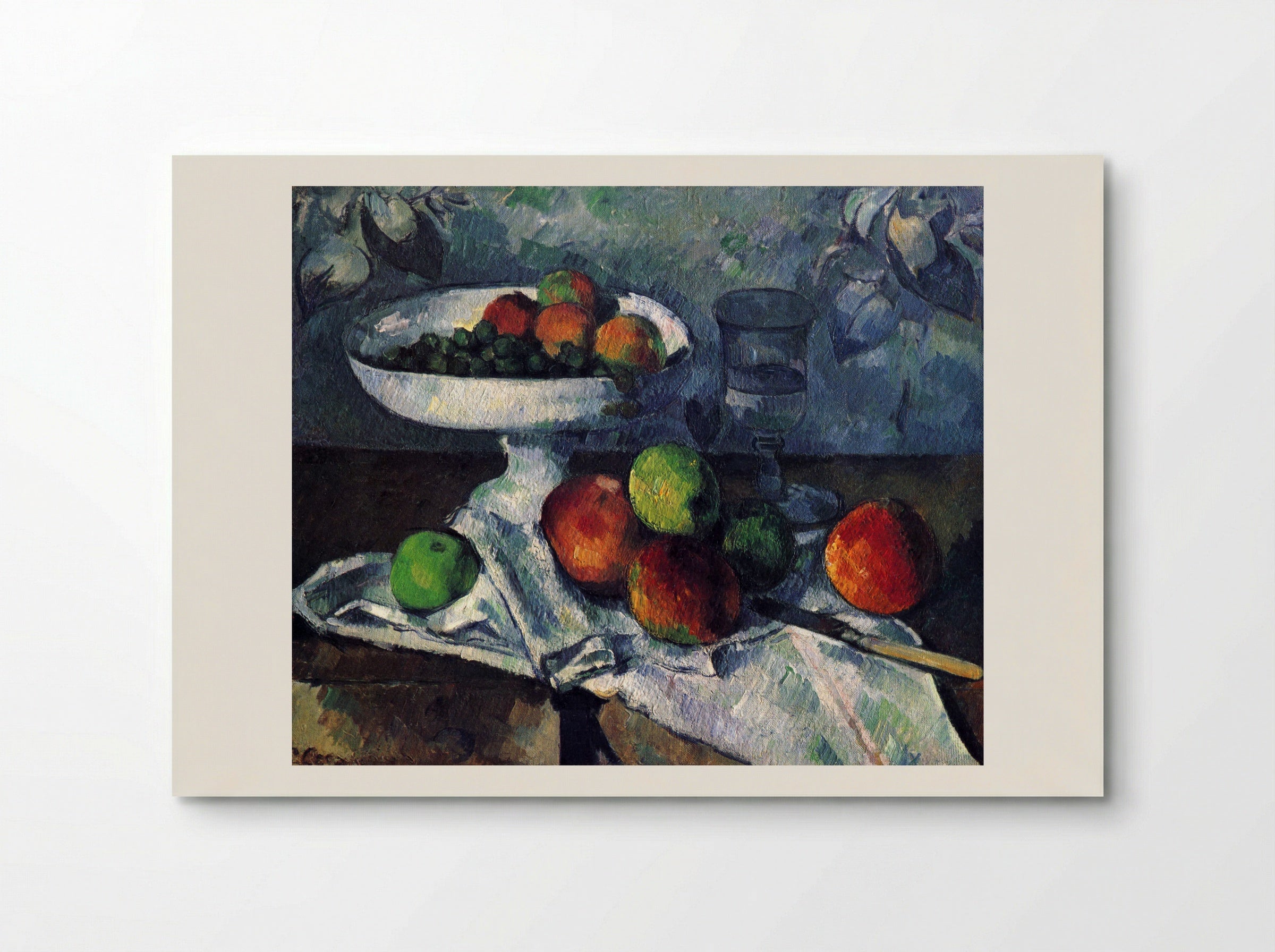
Compotier, Glass and Apples - Paul Cézanne
Archival giclée
Frames arrive ready to hang
Secure checkout
Made to order
Description
A still life by Paul Cézanne, 'Compotier, Glass and Apples' showcases the artist's distinctive approach to form and perspective. The painting features a compotier filled with fruit, a drinking glass, and several apples arranged on a draped table.
Paul Cézanne, a French artist born in 1839, is often considered a bridge between late 19th-century Impressionism and early 20th-century Cubism. His reduction of natural forms to their geometric essentials is evident in his still-life paintings. Cézanne's work can be seen as a rejection of the fleeting optical effects of Impressionism, in favour of a more solid, structured approach to painting. He died in 1906. 'Compotier, Glass and Apples' exemplifies Cézanne's mature style. The composition features a table draped with a white cloth, upon which a compotier (a fruit dish on a footed stand) filled with fruit is placed. A drinking glass and several apples are arranged around the compotier. The painting is characterised by its use of colour to define form and space. Cézanne's brushstrokes are visible, and he employs a limited palette of greens, reds, and blues to create a sense of depth and volume. The perspective is deliberately distorted, with the tabletop tilted upwards to allow the viewer to see all the objects clearly. This flattening of space is a hallmark of Cézanne's style and anticipates the Cubist movement that would follow.
Return policy
Because every print is made to order, we don't offer change-of-mind returns, refunds or exchanges. If your order arrives faulty, damaged or incorrect, we'll replace it free of charge — just contact us within 48 hours of delivery. See our refunds page for full details.
Shipping
We ship worldwide, printing at the production hub nearest to your delivery address. Delivery times and costs vary by destination — you'll see the options available to you at checkout.
Manufacturing
Each print is produced to order using 12-colour giclée printing on FSC-certified archival paper. Designed in Britain and printed at your nearest production hub to reduce waste and speed up delivery.
Care and materials
Specific Features
Every Solis piece is made to order with archival, gallery-quality materials built to last.
- Museum-grade giclée printing for rich, fade-resistant colour
- Archival matte fine-art paper, FSC-certified
- Multiple sizes and framing options available
- Frames in black, natural wood, dark wood or white
- Framed prints arrive ready to hang
Care & Cleaning
To keep your artwork looking its best:
- Dust gently with a soft, dry cloth
- Avoid prolonged direct sunlight
- Never use liquid cleaners on the print or canvas surface
- Keep in a dry, room-temperature space
- Handle prints with clean, dry hands
Materials & Sizing
Museum-grade giclée on FSC-certified archival matte paper, with framed and canvas options.
- Paper sizes: A4, A3, A2, A1, A0 and B2 (50×70 cm)
- Canvas: XS (20×30 cm) to Large (60×90 cm)
- Frames: black, natural wood, dark wood or white
Compotier, Glass and Apples - Paul Cézanne

Artist Biography
Paul Cézanne
While often associated with the Impressionists, Cézanne diverged from their fleeting, optical approach. He sought to capture the underlying structure and solidity of objects, famously stating his desire to "make of Impressionism something solid and durable, like the art in the museums." This pursuit led him to develop his signature style, characterised by fragmented brushstrokes, subtle colour modulations, and a flattening of perspective. His landscapes, still lifes, and portraits, such as "The Basket of Apples" and "Mont Sainte-Victoire," reveal a profound engagement with form and perception.
Though initially met with ridicule and rejection by the Salon, Cézanne's relentless experimentation paved the way for modern art movements like Cubism and Fauvism. Artists like Picasso and Matisse revered him as a forefather, recognising his revolutionary approach to depicting the world. Today, Paul Cézanne's art hangs in the world's finest museums, a testament to his enduring influence and the power of artistic vision.
Why Choose Us ?
Damage-free delivery guarantee
Fast Shipping
Museum-Quality Materials
You May Also Like