

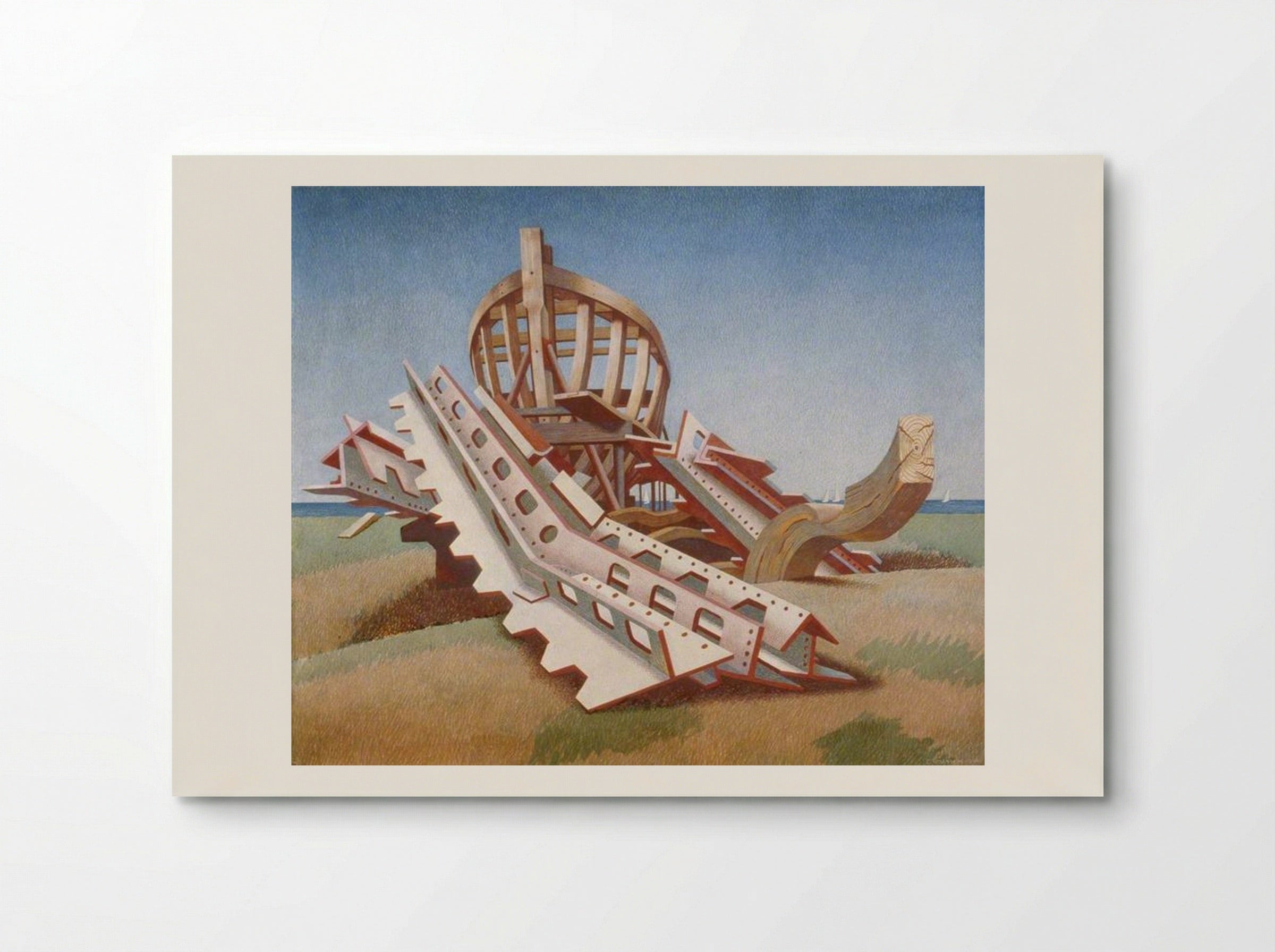
Light Sections - Edward Wadsworth
Archival giclée
Frames arrive ready to hang
Secure checkout
Made to order
Description
Edward Wadsworth's 'Light Sections' presents a geometric composition of ship-like forms, rendered with precision and clarity. The restrained colour palette and interplay of light and shadow create a sense of depth and order.
Edward Wadsworth (1889-1949) was a British artist associated with Vorticism, a short-lived but influential modernist movement. Wadsworth served in the Royal Naval Volunteer Reserve during the First World War, experiences that shaped his later artistic output. His work often explores themes of industry, machinery, and maritime subjects, rendered with a precise, almost clinical aesthetic. He later embraced a form of Surrealism. 'Light Sections' presents a composition of geometric forms and wooden structures set against a pale sky and neutral ground. The arrangement suggests the skeletal remains of a ship under construction or deconstruction. The interplay of light and shadow across the surfaces creates a sense of depth and volume, while the clean lines and sharp angles contribute to the work's overall sense of order. The colour palette is restrained, dominated by whites, creams, and browns, with subtle hints of red and blue. The painting's precision and clarity reflect Wadsworth's interest in the machine age and his engagement with the formal principles of Vorticism.
Return policy
Because every print is made to order, we don't offer change-of-mind returns, refunds or exchanges. If your order arrives faulty, damaged or incorrect, we'll replace it free of charge — just contact us within 48 hours of delivery. See our refunds page for full details.
Shipping
We ship worldwide, printing at the production hub nearest to your delivery address. Delivery times and costs vary by destination — you'll see the options available to you at checkout.
Manufacturing
Each print is produced to order using 12-colour giclée printing on FSC-certified archival paper. Designed in Britain and printed at your nearest production hub to reduce waste and speed up delivery.
Care and materials
Specific Features
Every Solis piece is made to order with archival, gallery-quality materials built to last.
- Museum-grade giclée printing for rich, fade-resistant colour
- Archival matte fine-art paper, FSC-certified
- Multiple sizes and framing options available
- Frames in black, natural wood, dark wood or white
- Framed prints arrive ready to hang
Care & Cleaning
To keep your artwork looking its best:
- Dust gently with a soft, dry cloth
- Avoid prolonged direct sunlight
- Never use liquid cleaners on the print or canvas surface
- Keep in a dry, room-temperature space
- Handle prints with clean, dry hands
Materials & Sizing
Museum-grade giclée on FSC-certified archival matte paper, with framed and canvas options.
- Paper sizes: A4, A3, A2, A1, A0 and B2 (50×70 cm)
- Canvas: XS (20×30 cm) to Large (60×90 cm)
- Frames: black, natural wood, dark wood or white
Light Sections - Edward Wadsworth

Artist Biography
Edward Wadsworth
Born in Cleckheaton, Yorkshire, in 1889, Wadsworth studied engineering before switching to art, spending time in Munich and then winning a scholarship to the Slade School of Fine Art in London. By 1914 he was a signatory of the Vorticist Manifesto and a contributor to BLAST, the movement's combative journal. His pre-war work shared Vorticism's love of hard angles and mechanical force, applied to the industrial landscapes of the Black Country where he grew up.
After the war he moved away from abstraction, adopting tempera as his primary medium and concentrating on coastal still lifes: rope, anchors, shells, and nautical equipment arranged against flat backgrounds or grey sea horizons. The shift aligned him with a broader European return to representational order, and these later compositions earned him election as an Associate of the Royal Academy in 1943. He died in Bayswater in June 1949, having moved through nearly every major mode of British modernism without fully belonging to any of them.
Why Choose Us ?
Damage-free delivery guarantee
Fast Shipping
Museum-Quality Materials
You May Also Like