



Edward Wadsworth
- vorticism
Edward Wadsworth's most consequential act as an artist may have been bureaucratic rather than painterly. In 1917[1], as a lieutenant in the Royal Naval Volunteer Reserve, he oversaw the transfer of dazzle camouflage designs to hundreds of Allied ships, an industrial-scale deployment of abstract pattern intended to confuse submarine commanders about a vessel's speed and heading. The project placed his Vorticist training directly in service of the war effort, and the paintings he made from it, including Dazzle-ships in Drydock at Liverpool (1919), stand among the most striking documents of that strange overlap between modernism and military necessity.
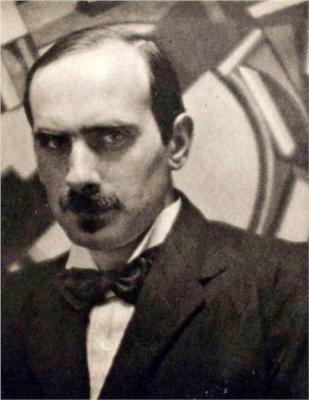
Biography
Born in Cleckheaton, Yorkshire, in 1889[1], Wadsworth studied engineering before switching to art, spending time in Munich and then winning a scholarship to the Slade School of Fine Art in London. By 1914[1] he was a signatory of the Vorticist Manifesto and a contributor to BLAST, the movement's combative journal. His pre-war work shared Vorticism's love of hard angles and mechanical force, applied to the industrial landscapes of the Black Country where he grew up.
After the war he moved away from abstraction, adopting tempera as his primary medium and concentrating on coastal still lifes: rope, anchors, shells, and nautical equipment arranged against flat backgrounds or grey sea horizons. The shift aligned him with a broader European return to representational order, and these later compositions earned him election as an Associate of the Royal Academy in 1943[1]. He died in Bayswater in June 1949[1], having moved through nearly every major mode of British[1] modernism without fully belonging to any of them.
Timeline
- 1889Born in Cleckheaton, Yorkshire.
- 1914Signed the Vorticist Manifesto and contributed to BLAST, the movement's journal; his pre-war work showed Vorticism's interest in hard angles and mechanical force.
- 1917As a lieutenant in the Royal Naval Volunteer Reserve, oversaw the transfer of dazzle camouflage designs to Allied ships.
- 1919Painted "Dazzle-ships in Drydock at Liverpool".
- 1943Elected as an Associate of the Royal Academy.
- 1949Died in Bayswater in June, aged 60.
Notable Works
Tap to view larger.
Next stop
Browse the movements →
Every movement in the collection, from the Renaissance to Pop art.
Edward Wadsworth prints
Hand-finished archival prints from Edward Wadsworth's body of work.


Related Artists


Take Edward Wadsworth home.
See all Edward Wadsworth prints →Frequently Asked Questions
What is Edward Wadsworth known for?
Edward Wadsworth is known for overseeing the transfer of dazzle camouflage designs to Allied ships during the First World War. He is also known for his paintings that came from this project, such as Dazzle-ships in Drydock at Liverpool (1919[1]).What is Edward Wadsworth's most famous work?
Edward Wadsworth is well known for his precise style, his interest in the sea, and his use of tempera. Although he experimented briefly with Post-Impressionism early in his career, he is best known for adopting a style that has been linked to Surrealism. This influence is visible in his dreamlike clarity and unusual arrangements of familiar seaside objects. His painting *The Beached Margin*, completed in 1937[1], is one example of this style. It depicts nautical objects set against a marine backdrop, rendered with careful detail. Wadsworth's technical skill is clear in his handling of egg tempera, a medium he mixed himself. Another example is *Havant port, Marseilles* from 1926. The painting is tempera on plywood with a linen canvas, and gesso ground. The detailed vessels are traversing a perfectly calm sea.What should I know about Edward Wadsworth's prints?
Edward Wadsworth is known for his association with Vorticism, and his prints often reflect this interest in geometric forms and industrial subjects. When considering Wadsworth's prints, remember that the artist usually decides to limit the edition. The number of prints is not limited by the woodblock itself; one block can produce many prints if cared for properly. The artist's decision to limit an edition is a choice, not a necessity. Each print in a limited edition is typically numbered and signed by the artist, usually in pencil, on the bottom margin. This indicates the print's place within the edition (for example, 1/50 means it is the first print of an edition of 50). The title is written in the centre, and the signature on the right. These practices help to authenticate the print and confirm the artist's approval. The edition claim is written as a pair of numbers on the left bottom margin of the print itself.What style or movement did Edward Wadsworth belong to?
Edward Wadsworth was initially associated with Vorticism, a British[1] movement that emerged around 1914[1]. Vorticism combined elements of Cubism and Futurism, but it distinguished itself via its focus on geometric shapes and machine-age aesthetics. Wadsworth contributed woodcuts to the Vorticist journal *Blast*. His work from this period displays a stark, abstract style. After the First World War, Wadsworth moved away from Vorticism. By the 1920s, his style had evolved towards a precise, meticulous realism, often using tempera. Although he retained an interest in geometric forms, his later work incorporated surreal elements and unexpected juxtapositions. Some critics have noted a connection between his work and Surrealism, particularly in his treatment of objects and space. His style is marked by clarity and detailed representation, and often features maritime subjects.What techniques or materials did Edward Wadsworth use?
Edward Wadsworth initially favoured a precise, ordered style, influenced by his engineering background. He briefly explored Post-Impressionism and was associated with Vorticism. Wadsworth is known to have read books about painting technique. He abandoned oil paint in favour of tempera. Tempera involves mixing pigments with a binder, typically egg yolk and water with a little acetic acid. This medium dries rapidly, so colour is built up via thin coats or hatched strokes. For his tempera paintings, Wadsworth often used a plywood panel covered with linen canvas and a thick gesso ground. He would sketch his composition in pencil on the gesso, sometimes scoring lines into the ground to guide his brush. He used subtle colour ranges, often earth tones with accents of viridian and ultramarine. He briefly experimented with Seurat's Pointillist technique, applying colours in dots.What was Edward Wadsworth known for?
Edward Wadsworth (born in Cleckheaton, Yorkshire, in 1889[1]; died in London, 1949[1]) is known for his association with the Vorticist movement and for his later tempera paintings of nautical subjects. Wadsworth studied engineering before attending Bradford School of Art and the Slade School of Fine Art. Around 1913[1], he joined Wyndham Lewis's Vorticist group, and his early work, including woodcuts like *New Delight*, showed the influence of Oriental art. During the First World War, Wadsworth designed camouflage for ships in the Royal Navy; this experience fostered a passion for the sea, which became a recurring theme in his art. After the war, Wadsworth abandoned oil paint in favour of tempera. He developed a precise style, portraying subjects with clear shapes and recognisable functions. His painting *Havant Port, Marseilles* (1926) is an example of his tempera technique, using thin coats of pigment built up gradually. Surrealism also influenced him, leading to dreamlike clarity and unexpected juxtapositions in his work. He also executed mural decorations, including some for the liner Queen Mary.When did Edward Wadsworth live and work?
Edward Wadsworth was born in Cheakheaton, England, in 1889[1]. He is recorded as living and working in England as of 1939[1]. Wadsworth's artistic journey involved several phases. By 1910, he was prepared to understand and appreciate Cubism when it appeared in England. He became involved with the Vorticist movement, led by Wyndham Lewis, which introduced Cubism to England. His artistic career progressed with a solo exhibition at the Leicester Galleries in 1919. He later became a member of "Unit One", a group of eleven English artists. While the passages mention other artists living and working in places such as Paris, Switzerland, and Holland, Wadsworth is recorded as living in England.Where can I see Edward Wadsworth's work?
Edward Wadsworth's artworks can be viewed in several galleries and museums. In London, The Tate holds "The Beached Margin", while the Victoria and Albert Museum also has pieces. Other UK locations include the Brighton Museum & Art Gallery, Manchester Art Gallery, the National Museums of Scotland (Royal Museum) in Edinburgh, and the Towneley Hall Art Gallery in Burnley. Outside the UK, museums with holdings of Wadsworth's work include the Los Angeles County Museum of Art (LACMA), the Metropolitan Museum of Art in New York, the Minneapolis Institute of Arts, the Museum of Modern Art in New York, the Royal Ontario Museum in Toronto, and the Virginia Museum of Fine Arts in Richmond.Where was Edward Wadsworth from?
Edward Wadsworth was born in Cleckheaton, Yorkshire, in 1889[1]. Early in his career, from 1908[1], his style was precise, ordered and mathematical. He had studied engineering before attending Bradford School of Art and the Slade. For a time, he associated with Wyndham Lewis's Vorticism movement. During the First World War, Wadsworth served in the Royal Navy; he designed camouflage for ships. This experience led to a passion for the sea and ships, which became recurrent subjects in his art. In 1921, Wadsworth inherited a fortune after his father's death. Afterward, he spent much of his time in the south of France. Several paintings depict the port of Marseilles. Although he planned a series of paintings of principal British[1] ports, he seems to have abandoned this idea as he became more interested in France. Wadsworth died in London in 1949[1].Who did Edward Wadsworth influence?
Edward Wadsworth's influence is most apparent in the work of artists who engaged with Vorticism and abstraction in Britain. Although Vorticism, the movement he helped found with Wyndham Lewis, was short-lived (lasting roughly from 1914[1] to 1920), it promoted a distinctly modern aesthetic. After the First World War, Wadsworth moved away from complete abstraction. He developed a style incorporating hard-edged realism with surrealist elements. This later work, featuring precisely rendered objects and maritime themes, had an impact on a range of younger artists. For example, his influence can be seen in the paintings of Tristram Hillier, who shared Wadsworth's interest in the precise depiction of objects and the creation of unsettling juxtapositions. Others who explored similar themes in their work include artists associated with the Unit One group, which was founded by Paul Nash in 1933 to promote modernism in British[1] art and architecture. While not a direct stylistic imitation, Wadsworth's example encouraged a generation to explore new possibilities in the representation of the modern world.Who influenced Edward Wadsworth?
Edward Wadsworth's early work shows the influence of various sources, including his engineering studies. He studied engineering at Munich between 1906[1] and 1909; during this period, he encountered German Jugendstil and the work of Swiss artist Ferdinand Hodler. After returning to Britain, Wadsworth became associated with Wyndham Lewis and other members of the Vorticist group. Wadsworth's paintings and woodcuts from this period show the influence of Cubism and Futurism, styles promoted by the group. However, Wadsworth's approach was distinct; he developed a style that combined the machine aesthetic with an interest in surface pattern and texture. Unlike some of his Vorticist colleagues, Wadsworth moved away from pure abstraction after the First World War. His later work incorporated more representational elements, often featuring maritime subjects and classical motifs. These later paintings demonstrate an engagement with Surrealism and a broader interest in European modernism.Who was Edward Wadsworth?
Edward Wadsworth (born in Cleckheaton, Yorkshire, in 1889[1]; died in London, 1949[1]) was a painter and engraver known for his precise style and his use of tempera. Initially trained as an engineer, Wadsworth studied at the Bradford School of Art and the Slade School of Fine Art. Early in his career, he briefly explored Post-Impressionism and associated with Wyndham Lewis's Vorticism. Wadsworth had a passion for the sea and ships, which became recurrent subjects in his art. His first recorded oil painting, from 1908[1], depicted Le Havre. During the First World War, he served in the Royal Navy, designing and painting camouflage for ships. This experience further fuelled his interest in maritime themes. In his artistic practice, Wadsworth abandoned oil paint in favour of tempera. He was deeply interested in painting techniques, and he repeatedly read Cennino Cennini's treatise, *Il Libro dell'Arte*, a technical textbook on tempera methods. Wadsworth's tempera paintings often featured detailed forms in clear light. He also executed mural decorations, including some for the liner Queen Mary. His painting *The Beached Margin* (1937) displays his technical ability with tempera, his meticulous draughtsmanship, and his interest in unexpected juxtapositions.
Sources
Editorial draws on the following primary and tertiary references for Edward Wadsworth.
- [1] wikipedia Wikipedia: Edward Wadsworth Used for: biography, birth dates, death dates, identifiers, movement attribution, nationality.
- [2] book Beard, Lee, 1973- author, Butler, Adam, author; Van Cleave, Claire, author; Fortenberry, Diane, author; Stirling, Susan, author, Beard, Lee, 1973- author, Butler, Adam, author; Van Cleave, Claire, author; Fortenberry, Diane, author; Stirling, Susan, author - The Art Book_ New Edition, Mini Format Used for: biography, stylistic analysis.
- [3] book Post-impressionism : cross-currents in European painting Used for: biography.
- [4] book Post-impressionism : cross-currents in European painting Used for: biography.
- [5] book Anfam, David A;Callen, Anthea. Techniques of the impressionists, Techniques of the great masters of art Used for: biography, stylistic analysis.
- [6] book Qian, Zhaoming, The modernist response to Chinese art : Pound, Moore, Stevens Used for: stylistic analysis.
Editorial overseen by Solis Prints. Sources verified 2026-10-01. Click a source for details, or hover over [N] in the page above to preview.
Editorial standardsMethodologyCorrectionsAI disclosureAbout the editorial team