

About Yoko Ono
Japanese-American · 1933–present
- Fluxus
- Conceptual
- Contemporary
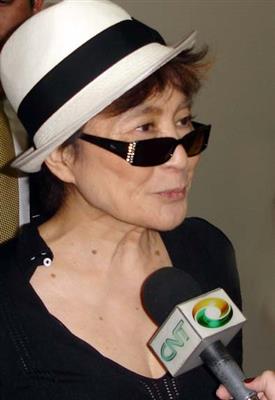
Yoko Ono is an experimental artist whose conceptual works challenge traditional art forms and invite audience participation.
Museums2
Countries1
Largest reported holdingMuseum of Modern Art, New York City · 2 recorded works
Loading map…
Where to see Yoko Ono
Collection holdings are reported here; current display varies. Check with each museum before visiting.
-
2 recorded works
Museum of Modern Art
New York City, United States
-
 1 recorded work
Art Institute of Chicago
Chicago, United States

Frequently Asked Questions
Where can I see Yoko Ono's work?
Yoko Ono's work has been featured in many exhibitions internationally. In 1970, her work appeared in Language IV at the Dwan Gallery in New York; the 3rd Salon International de Galeries Pilotes, Artists and Discoverers of "Our Time" in Lausanne; and New Multiple Art at the Whitechapel Art Gallery, London. The 1980s saw Ono's pieces in Reconstructions: Avant-Garde Art in Japan 1945-1965, which travelled from Oxford to Edinburgh; Marcel Duchamp und die Avantgarde seit 1950 at Museum Ludwig, Cologne; and Japon des Avant-gardes 1910-1970 at the Centre Georges Pompidou, Paris. During the 1990s, Ono's art was included in Japanese Art after 1945: Scream Against the Sky, which travelled from Yokohama to the Guggenheim Museum SoHo, New York, and the San Francisco Museum of Modern Art. More recently, her pieces were shown in Pop Art: U.S./U.K. Connections 1956-1966 at The Menil Collection, Houston, in 2001; and Les Années Pop 1956-1968 at the Centre Georges Pompidou, Paris, also in 2001. The Solomon R. Guggenheim Museum in New York has also held exhibitions featuring Ono's work.What should I know about Yoko Ono's prints?
Yoko Ono's prints, like those of many artists, exist within a complex and sometimes unregulated marketplace. Understanding some basic printmaking conventions can help you make informed choices. Prints are often produced in limited editions, a decision made by the artist, not dictated by the medium. The edition size is declared, and each print is numbered (for example, 12/25 means it is the 12th print of an edition of 25). The print should also be signed, usually in pencil, by the artist. These details are typically found on the bottom margin of the print. The Professional Art Dealers Association of Canada defines an original print as an image conceived as a print and executed solely as a print, usually in a numbered edition, and signed by the artist. Each print is individually inked and pulled; it is a multi-original medium. It is important to distinguish between an original print and a reproduction, which is a copy of a work originally created in another medium. A reproduction does not become an original print simply by being numbered or signed. The intent of the artist is a factor, as is the process used.Why are Yoko Ono's works important today?
Yoko Ono's art remains important because of her early role in performance art and conceptual art. As a Fluxus artist, Ono often used her own body to communicate ideas about control, power, and trust. Her 1964 performance *Cut Piece* is a key work. Ono knelt on the floor and invited audience members to cut away pieces of her clothing. The performance revealed the charged relationship between artist and viewer; looking at art was replaced by actively participating in art. By the end, Ono was left in shredded underwear. The audience became complicit in her nudity. In 1966, Ono installed her *Yes Painting* in London. John Lennon attended the exhibition and climbed a ladder to look through a spyglass at a tiny canvas. All that he saw was the word 'Yes'. Ono's 'instruction paintings' were meant for others to do. She said, 'My paintings are all instruction paintings (and meant for others to do)'. Ono derived this method of painting or conceptual art in Japan toward the end of WWII 'when we had no food to eat, and my brother and I exchanged menus in the air.'What techniques or materials did Yoko Ono use?
Yoko Ono employs a range of techniques and materials in her artistic practice. In the late 1950s, she created forms from wire covered with paper, a method she found cheap and direct. She exploited the wire's natural tendency to bend, painting surfaces by dribbling diluted black casein paint. Gravity directed the paint's flow, creating linear effects that contrasted with the work's organic character. She also incorporated pages from newspapers like the *Post*, favouring them over the *Times* and the *News* for their ink density. The wire structures were shaped in the air, a process she likened to three-dimensional drawing. Ono expresses a preference for materials that seem organic and full of surprises, such as clay and paper. She acknowledges the need to respect the nature of each material, noting that cardboard can be hostile and wood stubborn. She avoids metal and glass, fearing their potential for harm. Ono also used ink, watercolour, and newspaper collage on paper.Who did Yoko Ono influence?
Yoko Ono's work and ideas affected a number of artists working in different modes. Ono's work relates to Fluxus, a movement that often invited audience participation. John Lennon attended a Fluxus exhibition in London in 1966, where he climbed a ladder to view Ono's *Yes Painting*. Lennon was so taken with the work that he began a relationship with Ono. Ono's instruction paintings, as she called them, were meant for others to realise. She has said her interest was mainly in ‘‘painting to construct in your head,’’ ‘a sunset can go on for days,’ and ‘you can eat up all the clouds in the sky.’ Ono participated in the Destruction in Art Symposium in London, 1966, organised by Gustav Metzger. There, she affirmed Dada's pledge, stating, “The only kind of intentional destruction that I’m interested in at this point is a kind of destruction that brings about larger construction.”Who influenced Yoko Ono?
Yoko Ono's work intersects with multiple artistic movements and figures. John Cage (1912-1992), the Los Angeles-born composer, experimented with sound, silence, and nontraditional instruments. Cage's theories on anti-art and absurdism impacted artists in New York. Cage, along with Robert Rauschenberg and Jasper Johns, felt the impact of Marcel Duchamp's ideas. These four were involved in projects and experiments involving sound and sight, often incorporating Merce Cunningham's choreography. Cage's book *Silence* was published in 1961; his best-known piece, *4'33"*, premiered in 1952. Other figures who moved in similar artistic circles included Jasper Johns, who created *Target* (1955). Ono's work shares traits with artists associated with New York Dada. Composers such as Arnold Schoenberg, Edgard Varèse, and Stefan Wolpe also explored similar ideas.What is Yoko Ono's most famous work?
It is difficult to name only one work as Yoko Ono's most famous, as her notability arises from several areas: performance art, music, and activism. Ono gained attention in the 1960s as part of the Fluxus movement, which challenged conventional art boundaries. Her performance work *Cut Piece*, first performed in 1964, is a significant example. In this piece, Ono sat on a stage and invited audience members to cut away pieces of her clothing. The work is often interpreted as a statement on violence, vulnerability, and the role of the audience. Ono's involvement with John Lennon also brought her widespread public attention. Together, they staged happenings and used their platform to promote peace. Their collaborations, such as the *Bed-Ins for Peace* in 1969, became iconic images of the anti-war movement. Ono has produced many artworks, musical recordings, and films since then.What style or movement did Yoko Ono belong to?
Yoko Ono is associated with the Fluxus movement, which often incorporates audience participation. In 1966, Ono installed her *Yes Painting* in London's Indica Gallery. The work featured a ladder and spyglass pointed at a small canvas, which, when viewed, revealed the word 'Yes'. John Lennon attended the exhibition, viewed the canvas, and was reportedly thrilled by the work. Ono stated that her 'instruction paintings' are meant for others to do, to 'construct in your head'. Ono's work, such as her 1964 performance *Cut Piece*, also communicates ideas about control, power, and trust. In this performance, Ono knelt on the floor and invited audience members to cut away pieces of her clothing. This piece explores the relationship between artist and viewer, replacing passive observation with active participation.
Sources
Where to See guide aggregates verified holdings of Yoko Ono's works across the following collections.
- [1] museum Art Institute of Chicago Used for: museum holdings.
- [2] book Charlotte Mullins, A Little History of Art Used for: biography.
- [3] book Jesse Bryant Wilder, MA, MAT, Art History For Dummies Used for: biography, stylistic analysis.
- [4] book Jesse Bryant Wilder, Art History For Dummies Used for: biography, stylistic analysis.
Editorial overseen by Solis Prints. Sources verified 2026-10-14. Click a source for details, or hover over [N] in the page above to preview.
Editorial standardsMethodologyCorrectionsAI disclosureAbout the editorial team