



About Domingos Sequeira
Kingdom of Portugal · 1768–1837
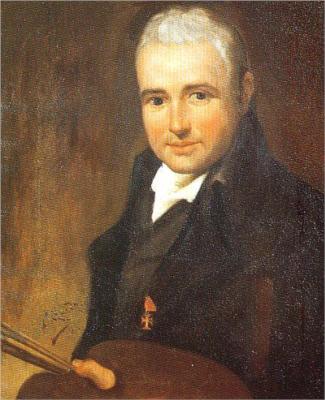
Portuguese Neoclassical court painter whose late work, shaped by Turner and exile, helped inaugurate Portuguese Romanticism.
Museums1
Countries1
Most worksSão Paulo Museum of Art, São Paulo · 2 works
Loading map…
Where to see Domingos Sequeira
Ranked by works you can see in person.
-
2 works
São Paulo Museum of Art
São Paulo, Brazil

Frequently Asked Questions
Where can I see Domingos Sequeira's work?
It is difficult to determine exactly where to view works by Domingos Sequeira, as information about the locations of his paintings is not widely available in the provided references. However, to view paintings by Nicolas Poussin, the following museums have collections: the M. H. de Young Memorial Museum in San Francisco; the Museu de Arte in São Paulo; the John and Mable Ringling Museum of Art in Sarasota, Florida; the Nationalmuseum in Stockholm; the National Trust in Stour Head, Wiltshire; and the Galleria Sabauda in Turin. Other locations include the Graf Harrach’sche Gemäldegalerie and the Kunsthistorisches Museum, both in Vienna; the National Gallery of Art in Washington, D.C.; the Sammlung Oskar Reinhart in Winterthur, Switzerland; and the Art Gallery of Toronto. Additionally, the Duke of Bedford collection at Woburn Abbey in Bedfordshire holds at least one painting. These museums may be a starting point for further research into Sequeira's work.What should I know about Domingos Sequeira's prints?
When considering Domingos Sequeira's prints, bear in mind that the art market uses specific terms to describe prints based on when they were made. A 'vintage print' means one made around the same time as the negative. A 'period print' is one made within roughly ten to fifteen years of the original shooting. Anything made later is generally called an 'old print', as opposed to a 'modern print' created recently from the original negative. An 'original print' is one made by the artist or under their supervision. A 'facsimile' is a print made by rephotographing a print, or using the original negative, with a print base and processing as close as possible to a vintage print. Printmakers often limit the size of an edition. Each print is then marked with the edition number and the print's individual number within that edition, for example, 35/100. The artist usually signs and numbers the prints in pencil. Some artists also create a small number of 'artist's proofs', marked AP.Why are Domingos Sequeira's works important today?
Domingos Sequeira (1768[1]-1837[1]) was a Portuguese painter whose works offer insights into the art and politics of his time. He is regarded for his technical skill, particularly in drawing and composition. Sequeira's artistic career unfolded during a turbulent period in Portuguese history, marked by political upheaval and war. His paintings reflect the changing social and political conditions of the late 18th and early 19th centuries. They provide visual records of significant historical events, such as the Peninsular War, and the transition from monarchy to constitutionalism. His religious paintings and portraits show his ability to capture human emotion and convey spiritual themes. His work contributed to the development of Portuguese art and left a record of a nation undergoing transformation. Sequeira's art allows viewers to examine a specific time in European history through a Portuguese lens.What techniques or materials did Domingos Sequeira use?
Unfortunately, the provided texts do not contain information about Domingos Sequeira's techniques or materials. They discuss the methods of El Greco, Velazquez, and early Italian tempera painting. Without specific information, a general answer is still possible. Artists' choices are not always dictated by their medium. Understanding the processes used is essential to art history. Oil paint was prepared by the artist or their workshop. Pigments were ground, then tempered with linseed oil. The artist would apply a ground layer to prepared canvas, often using a palette knife. The composition was sketched onto the ground, and the artist blocked in areas of light and dark. Soft brushes blended colour; fine brushes added details. Some artists used small clay models to plan compositions.Who did Domingos Sequeira influence?
Domingos Sequeira's influence is most apparent in the work of his direct students and followers in Portugal. He taught at the Aula de Desenho in the late eighteenth century. Later, he instructed at the Palácio da Ajuda. His emphasis on naturalism and historical subject matter affected Portuguese art in the early 1800s. Sequeira's Romantic style can be seen in the work of painters such as Joaquim Pedro de Sousa. Sousa studied with Sequeira and became known for his history paintings. Sequeira's impact extended to his sons. One of them, Augusto Sequeira, also became a painter. Augusto assisted his father and produced portraits and religious works. Though not as famous as his father, Augusto continued in a similar artistic vein. Beyond his immediate circle, Sequeira's impact is more diffuse. His promotion of Romanticism helped shape the broader artistic environment in Portugal. Later generations of Portuguese artists absorbed elements of his style and approach.Who influenced Domingos Sequeira?
It is difficult to summarise the influences on Domingos Sequeira. Henri Matisse influenced a number of artists. Some used his figurative work to move past abstract expressionism. Some, like Patrick Henry Bruce and Arthur Burdett Frost Jr, became his pupils and moved towards abstraction and pure colour. Max Weber discovered Cubism through Matisse's teaching and the study of Cézanne. The silhouetted forms and expressive shapes of Matisse's drawings offered direct inspiration to some artists. Other artists, such as Nathan Oliveira, stood apart from groups and trends. Oliveira felt that art should reaffirm our presence and the depth of our existence. His later paintings were more spiritual, moving away from the isolation of early expressionist painters.What is Domingos Sequeira's most famous work?
It is difficult to name Domingos Sequeira's single most famous work, as his artistic output spanned various subjects and styles. However, he is well regarded for his history paintings and religious scenes. One example is his painting of the Marriage of the Virgin. The subject matter of the Marriage of the Virgin is not described in the Bible. Instead, the scene stems from Jacobus da Voragine’s Gallery. Another of Sequeira's noted paintings is the Marquise de Seignelay as Thetis (1691). This work depicts Catherine-Thérèse de Matignon-Thorigny, marquise de Seignelay, daughter-in-law of Jean-Baptiste Colbert. The painting implies that the marquise, like Thetis, is a good mother who protects her sons. The presence of Cupid has been read as Catherine-Thérèse’s announcement to her peers that she was available for marriage. In fact, her foot rests on a shell, one of the attributes of Venus, the goddess of love.What style or movement did Domingos Sequeira belong to?
Domingos Sequeira's career coincided with the shift from Rococo to Neoclassicism[1] in European art. Rococo, which emerged in the early 18th century, favoured beauty and happiness and was expressed in flowing shapes and light ornamentation. By the 1760s, though, there was a conscious turn toward Neoclassicism, with its use of Greek and Roman elements, and its clean lines. The discovery of the ruins of Pompeii and Herculaneum stimulated a more scientific interest in classical antiquity. Neoclassicism favoured virtue and heroism. Accuracy of representation was favoured over colour. Lisbon became an architectural centre of the Enlightenment in Portugal, replacing the late Baroque style with a more rational formal language. The Teatro de S. Carlos in Lisbon signalled the arrival of Neoclassicism as the legitimate architectural style for buildings representing the interests of the middle classes.
Sources
Where to See guide aggregates verified holdings of Domingos Sequeira's works across the following collections.
- [1] wikipedia Wikipedia: Domingos Sequeira Used for: biography.
- [2] book Elizabeth Gilmore Holt; Project Muse, A Documentary History of Art, Volume 2 _ Michelangelo and the Mannerists, The Baroque and the Eighteenth Century Used for: biography.
- [3] book Elizabeth Gilmore Holt; Project Muse, A Documentary History of Art, Volume 2 _ Michelangelo and the Mannerists, The Baroque and the Eighteenth Century Used for: biography.
- [4] book Allison Lee Palmer, Historical Dictionary of Neoclassical Art and Architecture Used for: biography.
- [5] book Tomlinson, Janis A, Painting in Spain : El Greco to Goya, 1561-1828 Used for: biography.
Editorial overseen by Solis Prints. Sources verified 2026-08-29. Click a source for details, or hover over [N] in the page above to preview.
Editorial standardsMethodologyCorrectionsAI disclosureAbout the editorial team