



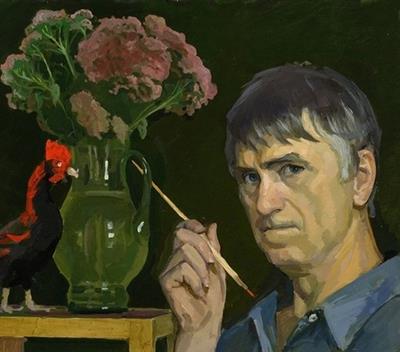
About Dmitri Zhilinsky
Museums3
Countries2
Largest reported holdingTretyakov Gallery, Moscow · 2 recorded works
Loading map…
Where to see Dmitri Zhilinsky
Collection holdings are reported here; current display varies. Check with each museum before visiting.
-
2 recorded works
Tretyakov Gallery
Moscow, Russia
-
2 recorded works
Museum Boijmans Van Beuningen
Rotterdam, Netherlands


-
1 recorded work
Russian Museum
Saint Petersburg, Russia

Frequently Asked Questions
Where can I see Dmitri Zhilinsky's work?
Dmitri Zhilinsky's artworks can be found in numerous public collections. These include the All-Russian[1] Museum of Decorative and Folk Art (Moscow), the Astrakhan Kustodiev Picture Gallery, the Dagestan Museum of the Arts (Makhachkala), and the Irkutsk Regional Art Museum. His work is also held at the Ivanovo State Museum of History and the Revolution, the Kuskovo State Porcelain Museum, the Museum of Art and History (Serpukhov), the Museum of Fine Arts (Ekaterinburg), and the State Art Museum (Omsk). Further examples can be seen at the State Kasteev Kazakhstan Museum of Arts (Alma-Ata), the State Lunacharskii Museum of Fine Arts (Krasnodar), the State Museum of Fine Arts (Nizhnii Tagil), and the State Museum of Russian Art (Kiev). Other locations include the State Radishchev Art Museum (Saratov), the State Russian Museum (St Petersburg), the State Tret'iakov Gallery (Moscow), the Tobol'sk State Historical-Architectural Museum (Tobol'sk), and the Uzbekistan State Museum of Fine Arts (Tashkent).Why are Dmitri Zhilinsky's works important today?
Dmitri Zhilinsky (1927[1]-2015[1]) was a Soviet and Russian[1] artist whose work provides insight into the artistic and ideological crosscurrents of his time. He navigated a path between the strictures of Socialist Realism and the pull of modernism. Zhilinsky's early artistic education was exceptionally fine. Some had begun training before the Revolution, and even as teenagers had become familiar with the best of Western contemporary work, particularly through Sergei Shchukin's collection in Moscow. At the State Free Art Workshops and at Vkhutemas they studied Cezanne with the Jack of Diamonds artists (Il'ia Mashkov, Petr Konchalovskii, Robert Fal'k, Aristarkh Lentulov), as well as colour and design with Stepanova, Popova, Aleksandr Vesnin, and other Inkhuk artists. After 1968[1], the bifurcation between ‘official’ and ‘inofficial’ cultures solidified. Both classical modernism and the local neo-avantgardes were increasingly pushed out of the public sphere into a domestic underground. Zhilinsky's art offers a window into the complexities of Soviet artistic life, where artists had to negotiate official expectations while exploring their own creative vision. His paintings, often figurative, possess a distinctive style that blends elements of realism with a more personal, expressive approach.Who did Dmitri Zhilinsky influence?
Dmitri Zhilinsky's artistic approach, which combined elements of early Renaissance painting with modern sensibilities, had an impact on a subsequent generation of artists. His emphasis on precise drawing, clear composition, and a certain spiritual quality resonated with those seeking an alternative to the dominant styles of Soviet Realism. While it is difficult to pinpoint specific individuals who directly imitated Zhilinsky's style, his work encouraged a move toward greater artistic freedom and individual expression. Artists who explored similar themes of family, history, and spirituality, but with a more personal and less propagandistic approach, can be seen as carrying on some aspects of his project. These artists often worked outside the mainstream art establishment, creating a space for more diverse artistic voices. Zhilinsky's influence is thus more broadly felt in the revitalisation of figurative painting and a renewed interest in the Russian[1] artistic heritage.Who influenced Dmitri Zhilinsky?
Dmitri Zhilinsky (1927[1]-2015[1]) developed a distinctive style that combined modernism with elements of earlier Russian[1] art. He is considered part of the Soviet-era "Severe Style" movement, though his work moved beyond its strictures. Zhilinsky's early influences included the Russian icon tradition. These religious images informed his approach to composition and the use of symbolic details. The art of the Italian Quattrocento, particularly the work of artists like Sandro Botticelli, also played a role in his artistic formation. These painters' emphasis on clarity of line and form resonated with Zhilinsky. Later in his career, Zhilinsky explored more personal and symbolic themes. He incorporated elements of surrealism and fantasy into his paintings. He moved away from the strict realism of Soviet art, developing a more individualistic style. He drew inspiration from his own life, family, and spiritual beliefs. His later works often feature dreamlike imagery and complex allegories.What style or movement did Dmitri Zhilinsky belong to?
It is difficult to place Dmitri Zhilinsky within a single style or movement. However, his work can be considered in relation to the broader context of representing movement in art. The challenge of depicting motion in static forms has long occupied artists. Leonardo da Vinci considered static sculptures "doubly dead" because they lacked implied movement. Art theorists such as Heinrich Wölfflin have analysed how artists use lines and forms to create either stable or dynamic effects. In the early 20th century, the Futurist movement made the representation of speed and dynamism a central aim. Artists like Giacomo Balla used techniques such as stroboscopic effects to convey motion, as seen in his "Dynamism of a Dog on a Leash" (1912). Even abstract art, such as the action paintings of Jackson Pollock, explored implied movement through form and gesture. Considering these approaches to representing movement may provide a useful lens through which to view Zhilinsky's artistic output.What was Dmitri Zhilinsky known for?
Dmitri Zhilinsky (1927[1]-2015[1]) was a Soviet and Russian[1] artist, known for paintings that combined figurative elements with symbolic and allegorical themes. He worked in various media, including mosaics, panel paintings, and drawings. Zhilinsky's style moved away from strict Socialist Realism. He incorporated influences from early Renaissance art, particularly the work of artists such as Botticelli and Piero della Francesca. His compositions often featured flattened perspectives and a clear, linear style. He is well known for his group portraits, which depict artists, musicians, and other cultural figures. These works often explore themes of family, creativity, and the passage of time. One example is "Gymnast of the USSR" (1964[1]-1965[1]), an early work that established his reputation. Later paintings include "Family by the Sea" (1964), now in the collection of the Tretyakov Gallery. Zhilinsky taught at the Surikov Art Institute in Moscow. He received numerous awards and honours during his career, a recognition of his contribution to Soviet and Russian art.What is Dmitri Zhilinsky known for?
Dmitri Zhilinsky is known for his paintings, such as By the Sea. Family and Gymnnasts of the USSR. He is also known for his triptych 1937[1], a direct reckoning with Stalinist terror that was completed in 1987.What was Dmitri Zhilinsky's art style?
Around 1963[1], Dmitri Zhilinsky discovered tempera on gesso, which transformed his technique and pushed him towards Renaissance painters and the icon tradition. His work Gymnnasts of the USSR depicts Soviet champions with the frontal solemnity of a devotional panel.
Sources
Where to See guide aggregates verified holdings of Dmitri Zhilinsky's works across the following collections.
- [1] wikipedia Wikipedia: Dmitri Zhilinsky Used for: biography.
- [2] book guggenheim-guhe00solo Used for: biography.
- [3] book Yevgenia Petrova (editor), Origins of the Russian avant-garde_ celebrating the 300th anniversary of St. Petersburg_ the Walters Art Museum, Baltimore (13 February-25 May 2003), Fine Arts Museums of San Francisco (29 June-21 September 2003) Used for: biography.
- [4] book J. E. Bowlt, Russian Art of the Avant Garde - Theory and Criticism 1902-1934 Used for: biography, stylistic analysis.
- [5] book edited and translated by John E. Bowlt, Russian Art of the Avant-Garde_ Theory and Criticism 1902-1934 (The Documents of 20th-Century Art) (English and Russian Edition) Used for: biography, stylistic analysis.
- [6] book Russian art of the avant-garde : theory and criticism, 1902-1934, with 105 illustrations Used for: biography, stylistic analysis.
- [7] book Peter. Leek, Russian Painting Used for: biography.
Editorial overseen by Solis Prints. Sources verified 2026-10-14. Click a source for details, or hover over [N] in the page above to preview.
Editorial standardsMethodologyCorrectionsAI disclosureAbout the editorial team