



About Currier and Ives
1857–1907
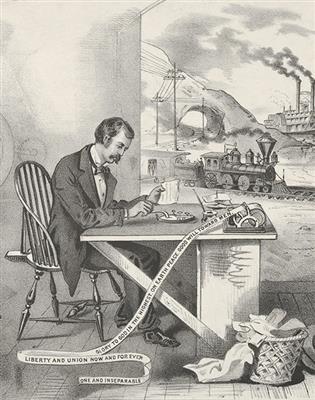
New York printmaking firm that published over 7,500 hand-coloured lithographs documenting American life between 1835 and 1907[1].
Museums5
Countries1
Largest reported holdingVanderbilt Museum of Art, Nashville · 7 recorded works
Loading map…
Where to see Currier and Ives
Collection holdings are reported here; current display varies. Check with each museum before visiting.
-
7 recorded works
Vanderbilt Museum of Art
Nashville, United States
-
2 recorded works
National Gallery of Art
Washington D.C., United States

-
1 recorded work
Amon Carter Museum of American Art
Fort Worth, United States
-
1 recorded work
Metropolitan Museum of Art
New York City, United States
-
1 recorded work
Yale University Art Gallery
New Haven, United States


Frequently Asked Questions
Where can I see Currier and Ives's work?
Currier and Ives's prints can be viewed in several museums. In the United States, these include the Metropolitan Museum of Art (New York), the Los Angeles County Museum of Art (California), the Minneapolis Institute of Arts (Minnesota), the Museum of Modern Art (New York), the National Museum of American Art (Washington, DC), the Virginia Museum of Fine Arts (Richmond), the Wolfsonian at Florida International University (Miami Beach), and the Yale University Art Gallery (New Haven). The Charles Hosmer Morse Museum of American Art (Winter Park, Florida) also holds relevant works. In Canada, the Royal Ontario Museum (Toronto) has examples. In the United Kingdom, see the Brighton Museum & Art Gallery, the Geffrye Museum (London), the Manchester Art Gallery, the National Museums of Scotland (Edinburgh), and the Victoria & Albert Museum (London).What should I know about Currier and Ives's prints?
Currier and Ives were American printmakers Nathaniel Currier (1813-1888[1]) and James Merritt Ives (1824-1895[1]). Based in New York City from 1835 to 1907[1], the firm mass-produced inexpensive lithographs. These prints depicted a wide range of subjects, from historical events to everyday life. Initially, Currier worked alone. He produced prints documenting news events; for example, the fire that destroyed the New York City's Merchant Exchange. Ives joined the company as a bookkeeper in 1852, becoming a partner in 1857[1]. Currier and Ives employed many artists to create original designs. These were then transferred to lithographic stones for printing. The prints were hand-coloured by a team of mostly women workers, which kept production costs low. Due to their affordability, Currier and Ives prints became hugely popular with the American public. They offered a visual record of 19th-century America, reflecting popular tastes and interests. The firm's slogan was "Prints for the People". After Currier and Ives retired, the business was continued by their sons, until the company closed in 1907.Why are Currier and Ives's works important today?
Currier and Ives, a printmaking firm based in New York City, operated from 1835 to 1907[1]. Their prints offer a popular record of 19th-century American life and culture. Nathaniel Currier (1813-1888[1]) began the business, later joined by James Merritt Ives (1824-1895[1]). The firm mass-produced inexpensive lithographs, marketed to a broad audience. These prints covered a wide range of subjects: historical events, portraits, genre scenes, and sporting activities. They documented the rapid changes in American society, including westward expansion, industrialisation, and urbanisation. Many prints depict everyday life, offering glimpses into domestic interiors, leisure activities, and social customs. Currier and Ives employed numerous artists and artisans to create their prints. While not always considered high art, their work had considerable influence on popular taste and visual culture. Their images helped shape national identity and collective memory. Today, these prints are valued as historical documents, offering insights into the social, political, and cultural context of 19th-century America. They provide a visual record of a rapidly changing nation, appealing to collectors, historians, and anyone interested in American history.What techniques or materials did Currier and Ives use?
Currier and Ives were prolific producers of mass-market lithographs in 19th-century America. They employed a division of labour, with multiple artists and artisans involved in the creation of each print. The firm primarily used lithography, a printmaking technique that relies on the chemical repulsion of oil and water. An image is drawn with a greasy crayon or tusche (a greasy ink) onto a prepared limestone or metal plate. The stone is then treated with chemicals that fix the image and make the non-image areas receptive to water. During printing, the stone is dampened with water, which adheres to the blank areas, and then inked with an oil-based ink, which adheres only to the drawn image. Paper is then pressed against the stone to transfer the image. Currier and Ives prints were typically hand-coloured after printing, often by a team of women working in an assembly line. The colours were applied using stencils or brushes, resulting in a characteristic style with flat, bright colours. The firm also employed specialists who added details and shading to enhance the realism of the images.Who did Currier and Ives influence?
Currier and Ives, as a commercial printmaking firm, had a broad, diffuse influence rather than a direct impact on individual artists. Their inexpensive, mass-produced lithographs made art accessible to a wide audience in the United States and beyond. Many artists and illustrators found employment creating images for the firm. These included Frances Flora Bond Palmer, who created some of their most popular works, and George H. Durrie, whose winter scenes became iconic. The firm’s success also inspired other printmakers and publishers to enter the market, increasing the availability of popular imagery. The firm's output shaped popular taste and contributed to a shared visual culture. Their prints depicted a wide range of subjects, from historical events to everyday life, and helped to create a sense of national identity. The firm's distribution network was extensive; this ensured their images reached homes, businesses, and public spaces across the country. The firm's influence can be seen in the subsequent development of American illustration and commercial art.Who influenced Currier and Ives?
Nathaniel Currier and James Merritt Ives oversaw a large printmaking firm; they were businessmen more than artists. They employed many artists and printmakers, so pinpointing direct influences is difficult. However, some context is possible. Currier began his career in the 1820s as an apprentice to William and John Pendleton, who ran a lithography shop in Boston. Lithography itself was a relatively new technology at the time, having been invented in the late 1790s. The firm of Currier & Ives produced images for a mass market; their prints were often based on popular paintings or drawings. They also employed staff artists to create original compositions. The prints covered a wide range of subjects, including historical events, portraits, genre scenes, and sporting events. It is likely that the artists working for Currier and Ives were influenced by the popular art and illustrative styles of their day, including academic painting and popular illustration. The firm's focus on appealing to a broad audience meant that their artistic choices were often guided by commercial considerations.What is Currier and Ives's most famous work?
It is difficult to name a single "most famous" work from the thousands of prints produced by Currier and Ives. The firm operated for over seventy years, creating images that were popular and widely distributed. Their lithographs covered a range of subjects, appealing to a broad audience. Prints depicting American life were common. These included scenes of cities, rural areas, sporting events, and historical moments. "The Life of a Hunter: A Tight Fix" (1861[1]) is one example of their outdoor scenes. Another popular category was depictions of ships, such as "Clipper Ship 'Great Republic'" (1856), which captured the public's fascination with maritime travel. Sentimental domestic scenes were also a staple, often portraying family life or seasonal celebrations. The firm's success lay in its ability to capture the spirit of the times and make art accessible to the masses. Rather than one definitive piece, the collective body of work from Currier and Ives provides a visual record of 19th-century America.What style or movement did Currier and Ives belong to?
Currier and Ives prints are linked to the Regionalism movement, which also includes folk and primitive arts. This movement aimed to produce popular art accessible to everyone, reinforcing democracy. Regionalism embodies a notion of objectivity similar to journalism. Currier and Ives prints, along with cartoons and comic strips, contribute to this tradition. The motivation stems from literary objectivity applied to a genre tradition. During the 1930s, the native element received emphasis from artists such as Thomas Hart Benton, Grant Wood, and John S. Curry. Benton developed a vigorous style, incorporating detail into ordered turbulence. Wood created a simplified style with rural Midwestern motifs, while Curry addressed native material in an illustrative style. Regionalism's advocates extolled popular idioms for their democratic attributes. However, their dialectical purpose celebrated both the heroic and the genre, revealing an inconsistency due to a lack of myth for illustration.
Sources
Where to See guide aggregates verified holdings of Currier and Ives's works across the following collections.
- [1] wikipedia Wikipedia: Currier and Ives Used for: biography.
- [2] book Howard Simon, 500 Years of Illustration Used for: biography.
- [3] book Jesse Bryant Wilder, Art History For Dummies Used for: stylistic analysis.
- [4] book McGraw-Hill, Art In Focus Used for: biography.
- [5] book Susie Hodge, Artists and Their Pets Used for: stylistic analysis.
- [6] book Masterpieces of western art : a history of art in 900 individual studies from the Gothic to the present day Used for: biography.
- [7] book DTPMac17, oi-iv Used for: biography.
- [8] book Mark Rothko;Christopher Rothko;, The Artist's Reality Used for: biography.
Editorial overseen by Solis Prints. Sources verified 2026-09-30. Click a source for details, or hover over [N] in the page above to preview.
Editorial standardsMethodologyCorrectionsAI disclosureAbout the editorial team