



About Charles Laval
Museums4
Countries4
Most worksMusée d'Orsay, Paris · 3 works
Loading map…
Where to see Charles Laval
Ranked by works you can see in person.
-
3 works
Musée d'Orsay
Paris, France
-
2 works
Van Gogh Museum
Amsterdam, Netherlands


-
1 works
Indianapolis Museum of Art
Indianapolis, United States
-
1 works
Kunsthalle Bremen
Bremen, Germany


Frequently Asked Questions
Where can I see Charles Laval's work?
To view works by Charles Laval, consider the Musée d’Orsay in Paris. Other French[2] museums that may hold his paintings include the Musée des Beaux-Arts in Nantes, the Musée des Beaux-Arts in Nancy, and the Musée Toulouse-Lautrec in Albi. The Musée des Arts Décoratifs, also in Paris, could be another option. Elsewhere in Europe, one might try the Musées Royaux des Beaux-Arts de Belgique in Brussels. In the United States, museums such as the Metropolitan Museum of Art in New York, the Los Angeles County Museum of Art (LACMA), and the Minneapolis Institute of Arts are possibilities. Always check museum websites or catalogues in advance, to confirm that works by Laval are on display.What should I know about Charles Laval's prints?
Information about Charles Laval's prints is scarce. However, some general information about fine art prints may be useful. The term "original print" refers to an image conceived as a print, executed solely as a print, and usually part of a numbered, signed edition. Each print in the edition is considered an original, made from a plate, stone, screen, or block created specifically for that purpose. The artist inks and pulls each print individually, making it a "multi-original" medium. Numbering accounts for the prints in the edition; for example, 12/25 indicates the 12th print of an edition of 25. Reproductions, on the other hand, are copies of artworks originally created in another medium, such as painting or watercolour. These are typically produced using photo-mechanical means. Numbering or signing a reproduction does not change its fundamental nature as a copy. The market assigns worth based on the print's context. The subject matter, purpose, and intended audience all influence its creation. The intent behind the print, whether to replicate another image or to be an original work of art, also distinguishes it.Why are Charles Laval's works important today?
Charles Laval was a Post-Impressionist painter who is most remembered for his association with Paul Gauguin and Émile Bernard. His importance lies primarily in his contribution to the development of the Pont-Aven School[2] and the synthetist style. Laval met Gauguin in 1886[2], and the two artists travelled to Panama and Martinique in 1887. This journey exposed Laval to new visual stimuli, which influenced his artistic style. His paintings from this period show a move away from Impressionism towards simpler forms and more expressive colours. Laval's role in the Pont-Aven School is significant. This group of artists, centred in the village of Pont-Aven in Brittany, sought to move beyond Impressionism by emphasising the artist's subjective experience and using simplified forms and bold colours. Laval's work, alongside that of Gauguin and Bernard, helped to define the aesthetic of this movement. Although his career was cut short by his death at the age of 41, Laval's artistic explorations contributed to the shift towards abstraction that characterised much of 20th-century art.What techniques or materials did Charles Laval use?
Charles Laval's artistic practice involved a range of media, including painting and drawing. He is most noted for his paintings. Laval's Brittany period paintings show the influence of Paul Gauguin and Émile Bernard. This is visible in his use of cloisonnism, with its flat planes of colour defined by dark outlines. He also adopted synthetism, favouring simplified forms and symbolic content. Laval's palette choices are notable. He moved away from representational colour, using colour to convey emotion and mood. His application of paint varied. Some works feature smooth, blended surfaces, while others display visible brushstrokes. After his time in Brittany, Laval's style evolved. His later works show an interest in impressionism. These paintings often depict scenes from his travels, with a lighter palette and looser brushwork. Laval also produced drawings in charcoal and chalk. These studies often served as preparatory sketches for his paintings.Who did Charles Laval influence?
While not a major figure, Charles Laval moved within circles of artists who became quite well known. Laval is most often remembered as a friend and colleague of Paul Gauguin and Émile Bernard. He met Gauguin in the autumn of 1886[2], and the two painters became close. Laval is considered part of the Pont-Aven School[2], an art colony associated with Gauguin in Brittany. Laval, along with Gauguin and Bernard, exhibited at the Volpini café in 1889. Laval also briefly shared a studio with Gauguin in Paris, and in 1887, he travelled to Panama and Martinique with Gauguin. Laval's paintings from this period show the influence of Gauguin's style, particularly in their use of colour and simplified forms. He is considered a Post-Impressionist. Laval's career was cut short by his early death at the age of 41, so his body of work is small.What is Charles Laval's most famous work?
It is difficult to identify Charles Laval's single "most famous" work with certainty. Laval was a Post-Impressionist painter associated with the Pont-Aven School[2] in Brittany, and his career was somewhat overshadowed by those of his contemporaries, such as Paul Gauguin. While Laval produced a body of paintings, watercolours, and drawings, no single work has achieved widespread recognition as his definitive masterpiece. His paintings often depict Breton subjects, portraits, and scenes from his travels. Some better-known examples include his self-portrait, and works created during his time in Panama and Brittany. However, these are not generally considered to be extremely famous when compared to works by better-known artists of the period. Due to his close association with Gauguin, Laval's work is often viewed in the context of their artistic exchange and mutual influence. This makes it challenging to isolate one piece that distinctly establishes his individual fame.What style or movement did Charles Laval belong to?
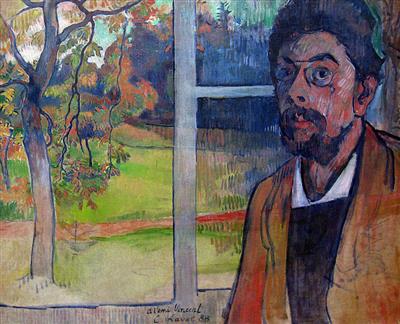
Charles Laval (1862[2]-1894[2]) is associated with Post-Impressionism, particularly through his close association with Paul Gauguin. He trained at Bonnat’s atelier, and in 1886[2], he encountered Gauguin in Pont-Aven; he then became Gauguin's disciple. The two artists travelled to Martinique together in 1887. By June 1888, Laval was back in Pont-Aven, where he joined the circle around Gauguin and Émile Bernard. He exhibited with them at the Cafe Volpini exhibition in 1889. His painting Going to Market, Brittany (1888) dates from the summer after his return from Martinique. In this period, Bernard's new synthetic style influenced both Gauguin and Laval. This influence is seen in the painting's blue outlines, flat colours, lack of perspective, and the decorative head-dresses of the Breton peasants. The stylistic similarities between the three artists were noted by Bernard. Laval's friendship with Gauguin also brought him into contact with Vincent van Gogh. Laval painted Self-Portrait in a , to His Friend Vincent (1888), sending it to Arles after Gauguin's arrival there in October 1888. The painting formed a companion piece to the self-portraits of Gauguin and Bernard dedicated to Van Gogh.What was Charles Laval known for?
Charles Laval (1862[2]-1894[2]) trained at Bonnat’s atelier. He is known for his association with Paul Gauguin; the two artists met in Pont-Aven in 1886[2]. Laval became Gauguin’s disciple and travelled with him to Martinique in 1887. By June 1888, Laval had rejoined Gauguin, this time in Pont-Aven, and became part of the circle around Gauguin and Émile Bernard. In 1889, he exhibited with them at the Cafe Volpini exhibition. Laval’s style was similar to that of Gauguin, and some of his paintings have been misattributed. The impact of Bernard’s style can be seen in Laval's 1888 painting, *Going to Market, Brittany*, in its use of blue outlines, flat colours, lack of perspective, and the head-dresses of the Breton peasants. This proximity in style caused adverse criticism at the Cafe Volpini exhibition. Despite the effect Gauguin had on Laval’s artistic development, their friendship resulted in Gauguin’s *Still-Life with Profile of Laval* (1886). It also brought Laval into contact with Vincent Van Gogh, for whom he painted *Self-Portrait in a with to His Friend Vincent* (1888). Laval was engaged to Madeleine Bernard around 1890. He suffered from tuberculosis, and was forced to leave France for Egypt. He was later joined there by Madeleine Bernard, and they possibly married in the year of his death.
Sources
Where to See guide aggregates verified holdings of Charles Laval's works across the following collections.
- [1] museum Kunsthalle Bremen Used for: museum holdings.
- [2] wikipedia Wikipedia: Charles Laval Used for: biography.
- [3] book Arts and Crafts in Middle Ages. A Description of Mediaeval Workmanship in Several of the Departments of Applied Art, …— Boston, 1914 Used for: biography.
- [4] book Lilian H. Zirpolo, Historical Dictionary of Baroque Art and Architecture Used for: biography, stylistic analysis.
- [5] book Milam, Jennifer Dawn, Historical Dictionary of Rococo Art Used for: biography, stylistic analysis.
- [6] book Post-impressionism : cross-currents in European painting Used for: biography.
- [7] book Post-impressionism : cross-currents in European painting Used for: biography.
- [8] book Steven Naifeh, Van Gogh Used for: biography.
Editorial overseen by Solis Prints. Sources verified 2026-08-29. Click a source for details, or hover over [N] in the page above to preview.
Editorial standardsMethodologyCorrectionsAI disclosureAbout the editorial team