

About Bertalan Por
Hungarian · 1880–1964
- portrait
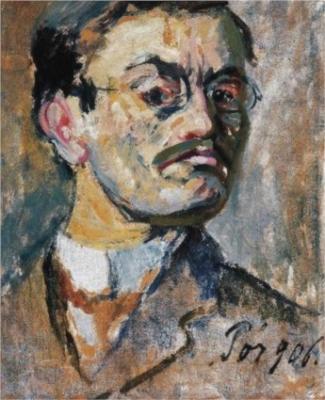
Hungarian[1] modernist painter and member of The Eight (Nyolcak), whose Fauvist-inflected work combined avant-garde aesthetics with openly political sympathies.
Museums1
Countries1
Most worksHungarian National Gallery, Budapest · 3 works
Loading map…
Where to see Bertalan Por
Ranked by works you can see in person.
-
3 works
Hungarian National Gallery
Budapest, Hungary
Also here (6)
Bertalan SzekelyVilmos Aba-NovakEndre BalintAladar Korosfoi-KrieschEgry JózsefAugust von Pettenkofen

Frequently Asked Questions
Where can I see Bertalan Por's work?
Bertalan Por's works can be found in a number of public collections. These include the Museum of Fine Art in Budapest, the Musée d'Art et d'Histoire in Geneva, the Kunstmuseum in Lucerne, and the Kunstmuseum in Winterthur. His work is also held in New York at the Brooklyn Museum, the Museum of Modern Art, and the Solomon R. Guggenheim Museum. In Switzerland, his pieces are at the Aargauer Kunsthaus in Aarau, the Graphische Sammlung of the ETH in Zurich, and the Kunstmuseum in Zurich. Additional locations include the Museo de Arte Moderno in Barcelona, the Staatliche Museen SPK, Kupferstichkabinett in Berlin, the Moderne Galerie, Josef-Albers-Museum in Bottrop, Germany, and the Herbert F. Johnson Museum of Art in Ithaca, New York. Finally, the Kunstmuseum St. Gallen also holds some of his pieces.What should I know about Bertalan Por's prints?
Bertalan Por (1880[1]-1964[1]) was a Hungarian[1] painter and graphic artist. He is best known for his socially conscious art, often depicting scenes of rural life and the working class. Por studied at the Hungarian Academy of Fine Arts and later in Paris. His early work showed the influence of French Post-Impressionism. After the First World War, his style shifted towards a more realistic and socially engaged approach. He became associated with the group of Hungarian artists known as the "Activist" movement. These artists used their work to address social and political issues. Prints by Por often feature strong, graphic lines and a limited colour palette. They reflect his interest in social justice and his sympathy for the struggles of ordinary people. Common subjects include agricultural workers, industrial labourers, and scenes of poverty. His prints were intended to be accessible to a wide audience, promoting awareness of social problems. Por’s work can be found in major Hungarian collections, as well as international museums.Why are Bertalan Por's works important today?
Bertalan Por's art is important because it prompts ongoing discussion in aesthetics and art theory. His work fits into a tradition of artists who explore the links between European and Asian artistic culture. Por's art can be viewed through the lens of the 'morphological model', a theory of art forms that considers the relationship between artistic cultures. This model looks at the transformation of images and ideas across different cultures and time periods. It examines how legends and myths become subjects of artistic and scientific speculation. Por's art, like other art, can be seen as a search for formulas that evoke specific responses in viewers. This approach suggests that art operates through a 'Trigger Theory', which explores human and animal responses to particular visual configurations. This theory acknowledges the subjective element in how people respond to art.What techniques or materials did Bertalan Por use?
Bertalan Por's artistic practice is informed by his early training as a dental technician, where he worked with materials such as metal, wax, plaster, and porcelain. His travels to locations such as Cuba, Mongolia, and Indonesia also influenced his artistic approach. Technique, in art, involves both manual and mechanical operations that act upon raw material. The artist’s choice of material is conditioned by the effect they intend to achieve. Por mixes standard artist's oil colour with a medium of wax and turpentine. He keeps this medium warm on a hot plate, mixing it with paint by brush just before applying colour to the canvas. The mixture is applied to the canvas with a brush and worked over so the medium and paint are thoroughly mixed and evenly cover the shape. The paint is then worked with a large painting spatula and a small painting knife until it reaches a satisfactory state.Who did Bertalan Por influence?
It is difficult to say exactly who Bertalan Por influenced. One source mentions that Klee's drawings, with their definite origin in an object, event, or idea, influenced American artists such as Baziotes and Gottlieb. Klee's drawings often contained figurative representation, letters, numbers, arrows, and symbols. Klee's use of different codes within one work led him to invent forms of reciprocal ornament between different levels of signification. This play of conventions opened up drawing and painting to include signs and symbols not previously available. Klee made drawing a medium for serious expression and defended the scale of drawing, multiple encoding, and personal projection in art. Another artist, Cy Twombly, has influenced many painters, from Brice Marden to Terry Winters and Ross Bleckner.What is Bertalan Por's most famous work?
It is difficult to name Bertalan Por's single most famous work. His output included tempera and acrylic pieces, often referred to as 'Studies' or 'Opus'. These titles were sometimes followed by a number. Examples of his work include Study 353 B (1930[1]), ME43B (1932), Study 102 (1932), ME 23 (1935), ME 351 (1936), ME 429 (1938), Study 388 (1938), Opus 36 (1942), Opus 6 (1942-52), Opus 18A (1943), Study 154 (1949), Study 225 A (1949), Opus 96 (1957), Study 274 (1957), Opus 91 (1958), Study 348 (1958), Opus 70 (1959), and SW 58 (1959-78). Many of Por's works are held in collections in Zurich and New York. For example, ME 429 (1938), Opus 36 (1942), Opus 91 (1958), and Opus 70 (1959) are held by the Solomon R. Guggenheim Museum in New York.What style or movement did Bertalan Por belong to?
Unfortunately, the provided passages do not mention Bertalan Por, nor do they offer details about artistic movements beyond Futurism. Therefore, I cannot place Por within a specific movement based on this information. The texts focus on the work of Anton Giulio Bragaglia and his "photodynamism", a technique involving blurred-motion photography to capture the sensation of movement. Bragaglia's approach aimed to convey the energy and rhythm of action, prioritising the dynamic effect of an image over representational accuracy. His work resonated with Futurist ideals, particularly the desire to free artistic creations from strict reproduction. The Futurist leader Marinetti supported Bragaglia's research, which led to "photodynamic" portraits of Futurist members. Without additional information, it is impossible to connect Por to Futurism or any other movement with certainty.What was Bertalan Por known for?
Without more context, it is difficult to specify what Bertalan Por was known for. The available text mentions portraits by Georg Baselitz, portraits and still lifes by Balthasar Klossowski de Rola (Balthus), portraits and ceilings by Giovanni Battista Gaulli (Baciccio), portraits by Hans Baldung (called Grien), and Giacomo Balla's work as an illustrator, caricaturist, and portraitist. Another passage discusses Gerhard Richter's "48 Portraits", a series of painted portraits of composers, essayists, poets, philosophers, and scientists, based on encyclopedia photographs. Richter created this work for the Venice Biennale in 1972, aiming to explore the structure of knowledge and the nature of portraiture itself. He excluded artists from the series to avoid interpretations of influence. The work questions the tradition of portraiture and the role of encyclopedias in determining significance.
Sources
Where to See guide aggregates verified holdings of Bertalan Por's works across the following collections.
- [1] wikipedia Wikipedia: Bertalan Por Used for: biography.
- [2] book By Jeffrey Taylor, In Search of the Budapest Secession: The Artist Proletariat and the Modernism’s rise in the Hungarian Art Market, 1800-1914 Used for: biography.
- [3] book Katalin Cseh-Varga;, The Hungarian Avant-Garde and Socialism Used for: biography.
- [4] book Katalin Cseh-Varga, The Hungarian Avant-Garde and Socialism Used for: biography.
- [5] book Katalin Cseh-Varga, Used for: biography.
Editorial overseen by Solis Prints. Sources verified 2026-08-29. Click a source for details, or hover over [N] in the page above to preview.
Editorial standardsMethodologyCorrectionsAI disclosureAbout the editorial team