



About Adriana Varejão
Brazilian · 1964–present
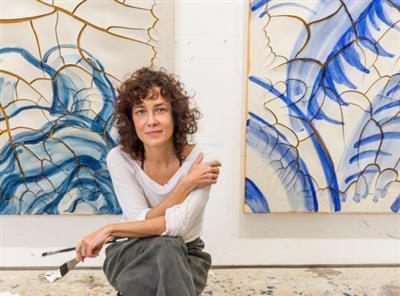
Brazilian[1] painter whose visceral tile-based canvases examine colonialism, identity, and the violence buried inside decorative surfaces.
Museums5
Countries4
Largest reported holdingStedelijk Museum Amsterdam, Amsterdam · 2 recorded works
Loading map…
Where to see Adriana Varejão
Collection holdings are reported here; current display varies. Check with each museum before visiting.
-
2 recorded works
Stedelijk Museum Amsterdam
Amsterdam, Netherlands
-
1 recorded work
Museo Nacional Centro de Arte Reina Sofía
Madrid, Spain


-
1 recorded work
Solomon R. Guggenheim Museum
New York City, United States
-
1 recorded work
Metropolitan Museum of Art
New York City, United States
-
1 recorded work
Stedelijk Museum voor Actuele Kunst
Ghent, Belgium


Frequently Asked Questions
Where can I see Adriana Varejão's work?
Adriana Varejão's pieces are held in several prominent collections. These include museums in North and South America, as well as Europe. In Brazil, her work can be viewed at the Museu de Arte Moderna in São Paulo and the Instituto Inhotim in Brumadinho. In North America, collections include the Museum of Modern Art and the Solomon R. Guggenheim Museum in New York; the San Diego Museum of Art; and the Museum of Fine Arts in Boston. European museums holding her work include the Tate Modern in London and the Moderna Museet in Stockholm. These institutions offer opportunities to view Varejão's diverse output, which includes painting, sculpture, and installation. Her art often explores themes of cultural identity, colonialism, and the body through the use of varied materials and techniques.What should I know about Adriana Varejão's prints?
When considering Adriana Varejão's prints, bear in mind a few aspects of fine-art printmaking. The artist will often decide to limit the edition, marking each print with a fraction, such as 35/100, to indicate its place in the sequence. The lower number is the print's individual number; the higher is the total edition size. Some artists also create artist's proofs, marked "AP", which are outside the numbered edition. It is standard practice for the artist to sign and number their prints in pencil, usually along the bottom margin. The edition claim appears on the left, the title in the centre, and the signature on the right. Printmaking is unregulated, but commercial sales are subject to the Trade Descriptions Act of 1968, requiring truthful descriptions. Claims of edition size add value, so buyers expect accuracy. Photographic prints, like other print media, are vulnerable to factors such as foxing, creasing, and UV degradation. These factors should be considered when collecting.Why are Adriana Varejão's works important today?
Adriana Varejão's work is significant because it challenges conventional understandings of history, identity, and artistic expression. Her art critically assesses cultural, historical, and social symbols, offering new iconographies that question traditional and nationalistic views. Varejão's approach involves incorporating the past into the present, disrupting continuity and prompting a re-evaluation of established norms. This method isn't about revivalism; instead, it explores systems that remain effective across time. She appropriates dynamic instruments from the past, such as the iconography of religious authority or the sarcasm of Goya, to engage with contemporary issues. Her art also addresses the complexities of Portuguese identity and history, particularly in relation to European cultural and political dynamics. By engaging with historical narratives and cultural traditions, Varejão provides alternative visions that deconstruct propagandistic imagery and challenge established perspectives. This encourages viewers to question moulded perspectives and resist imposed order.Who did Adriana Varejão influence?
It is difficult to assess definitively who Adriana Varejão has influenced. However, we can analyse artists who demonstrably influenced her. Varejão's work shows an engagement with artistic traditions and innovations of the past. For example, El Greco considered himself a student of Titian. He was an advocate of the Venetian style. Similarly, Velázquez's early works looked to Caravaggio. After spending time with the royal collections of Madrid, and in Venice, he became intent on creating an updated version of Titian’s painterly naturalism. Rembrandt's thick deposits of textured paint may seem unrelated to the lively surfaces of Titian’s late paintings, but in some instances the connection is close. Titian's legacy, both in terms of his actual works, and in terms of how Vasari wrote about them, is a constant backdrop. These artists, like Varejão, built upon the achievements of their predecessors.Who influenced Adriana Varejão?
It is difficult to summarise influences on an artist's practice. As Henri Matisse said, the best explanation of a painter's style is found in the paintings themselves. However, some artists and movements that have been identified as important to Varejão's artistic development include: Cubism: Varejão was impressed by Cubist still lifes, particularly those of Braque. She studied Cubism and the work of Picasso, exploring the reasons behind her interest in this style. Cézanne and van Gogh: Through her study of Braque and Picasso, Varejão discovered the works of Cézanne and van Gogh. New York School artists: By 1950-51, Pollock, de Kooning, and Rothko, as well as the entire New York School, had become Varejão's mentors. She saw Gorky's exhibition at the Whitney in 1951, which made a big impression on her. She also saw many of Pollock's paintings from the 1940s. Other artists: Varejão was also moved and intrigued by Louis's Veils and Unfurleds and Noland's targets and chevrons in the later 1950s and early 1960s.What style or movement did Adriana Varejão belong to?
It is difficult to assign Adriana Varejão to a single style or movement. However, some art historians link aspects of her work to the baroque. The baroque, which gained prominence in the early 17th century, moved away from the static qualities of Renaissance art. Artists like Rubens employed a dynamic spiral line in their compositions. This technique created a sense of movement, with forms blending into one another. Baroque paintings often feature figures that surge and twist, with draperies that flow, creating a sense of vitality. Rubens's influence extended to other baroque artists, such as Bernini, whose sculptures also embodied this principle of movement. Although French artists initially showed restraint, they later embraced the baroque style, particularly after rediscovering Rubens at the end of the 17th century. While Varejão's art is contemporary, some scholars suggest her work shares an emphasis on flowing movement, a key characteristic of the baroque.What was Adriana Varejão known for?
Adriana Varejão is a Brazilian[1] artist known for her large-scale paintings and installations. She was born in Rio de Janeiro in 1964[1]. Varejão's work frequently incorporates ceramic tiles. These tiles allude to Brazil's colonial past, particularly the influence of Portuguese and Asian aesthetics. She often fractures and reassembles these tiles. This creates a sense of disruption and reveals hidden layers beneath the surface. Her art explores themes of cultural hybridity, colonisation, and the body. Varejão examines how different cultures intersect and influence one another, often with a focus on the complex history of Brazil. Her paintings often feature depictions of wounds, flesh, and anatomical imagery. These elements can be interpreted as metaphors for the violence and trauma associated with colonisation and cultural exchange. Varejão has exhibited extensively internationally. Her work is included in major public collections, such as the Tate Modern in London and the Museum of Modern Art in New York.What is Adriana Varejão known for?
Adriana Varejão is known for her painted azulejo, the blue-and-white ceramic tile synonymous with Portuguese colonial architecture. She uses this medium to create trompe l'oeil tile surfaces, which she then ruptures to reveal anatomical flesh, gore, or layered history.
Sources
Where to See guide aggregates verified holdings of Adriana Varejão's works across the following collections.
- [1] wikipedia Wikipedia: Adriana Varejão Used for: biography.
- [2] book Leonor de Oliveira;, Portuguese Artists in London Used for: biography.
- [3] book Pollock, Griselda (editor);Sauron, Victoria Turvey (editor), The Sacred and the Feminine_ Imagination and Sexual Difference (New Encounters_ Arts, Cultures, Concepts) Used for: biography.
- [4] book Pollock, Griselda (editor);Sauron, Victoria Turvey (editor), The Sacred and the Feminine_ Imagination and Sexual Difference (New Encounters_ Arts, Cultures, Concepts) Used for: biography.
Editorial overseen by Solis Prints. Sources verified 2026-10-14. Click a source for details, or hover over [N] in the page above to preview.
Editorial standardsMethodologyCorrectionsAI disclosureAbout the editorial team