



About Adolphe Piot
French · 1831–1910
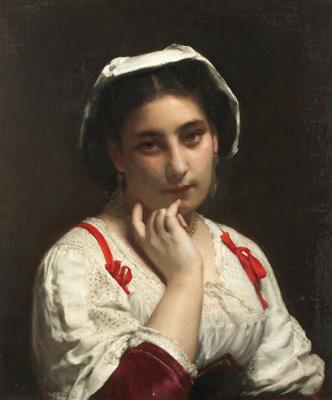
French[2] academic painter who spent nearly sixty years showing intimate portraits of young women and children at the Paris Salon.
Museums3
Countries2
Largest reported holdingSt. Johnsbury Athenaeum, St. Johnsbury · 1 recorded work
Loading map…
Where to see Adolphe Piot
Collection holdings are reported here; current display varies. Check with each museum before visiting.
-
1 recorded work
St. Johnsbury Athenaeum
St. Johnsbury, United States
Also here (1)
-
 1 recorded work
Museum of Fine Arts of Reims
Reims, France

-
1 recorded work
The Huntington Library, Art Museum, and Botanical Gardens
San Marino, United States

Frequently Asked Questions
Where can I see Adolphe Piot's work?
Adolphe Piot's paintings appear in collections throughout France. Examples of his work are held by museums in Picardy, his home region, and in other locations. The Musée de Picardie in Amiens holds Piot's 1878[2] painting, *Le petit marchand de violettes*. This oil-on-canvas work depicts a young flower seller. Another Piot painting, *Portrait de jeune femme*, is in the collection of the Musée Antoine Lécuyer in Saint-Quentin, also in Picardy. This museum's collection focuses on Maurice Quentin de la Tour (1704-1788[2]) and 18th-century art, but it also includes 19th-century works such as Piot's portrait. Further afield, the Musée Baron Martin in Gray, Haute-Saône, possesses Piot's *Portrait de Madame Rigault*. The museum is located in the Château de Gray, a historic building that adds to the experience of viewing the collection.What should I know about Adolphe Piot's prints?
When considering prints by Adolphe Piot, bear in mind some basic terminology. A 'vintage print' means the photograph was printed around the time the negative was taken. A 'period print' means it was made within roughly 10 to 15 years of the shot. Anything printed later is termed an 'old print', while a 'modern print' is one recently made using the original negative. An 'original print' is one made by the artist or under their direct supervision. A 'facsimile' is a print made by re-photographing a print, or using the original negative, with the same base and processing as the reference print. Within the print market, there are two sectors; the old print market and the contemporary print market. The old print market combines several effects of rarity; original rarity, residual rarity, rarity or uniqueness of the represented subject, and rarity of the artistic excellence.Why are Adolphe Piot's works important today?
Adolphe Piot was a French[2] academic painter, mostly of genre scenes and portraits. He was active in the late 19th and early 20th centuries. While Piot may not be as widely recognised as some of his contemporaries, his works offer insights into the artistic tastes and social customs of his time. Genre paintings, in particular, provide a window into everyday life, depicting scenes of domesticity, leisure, and social interaction. Piot's portraits, often of society figures, offer a glimpse into the world of the French upper classes during the Belle Époque. The importance of studying artists like Piot lies in gaining a more complete understanding of art history. By examining the works of artists who were popular in their day, but who may have been overlooked in favour of more radical or innovative figures, we can develop a more nuanced appreciation of the artistic landscape of the period. These artists contributed to the broader artistic trends and movements of their time.What techniques or materials did Adolphe Piot use?
Information regarding Adolphe Piot's specific techniques or materials is scarce. However, we can discuss some painting methods used by his contemporaries in France during the 18th and 19th centuries. Some artists favoured painting on glass, applying details first. This removed the need for draughtsmanship skills; the artist could then add colour with oil varnish or watercolours. Another method, eludoric painting, involved applying a thin film of water to a fine cloth primed with poppy oil, then painting in oil under the water. Excess oil floated off, and the artist could rework the painting as needed. Painters also experimented with different oil recipes to make colours dry faster. This involved mixing the oil with lead and exposing it to the sun. Some artists looked to revive older methods, such as encaustic painting, tempera, or the early oil techniques used by Jan van Eyck.What style or movement did Adolphe Piot belong to?
Adolphe Piot (1831[2]-1910[2]) was a French[2] academic artist. He is best known for portrait and genre painting. His style is associated with academicism; this was a dominant approach in European art during the 19th century. Academic art valued tradition, skill, and adherence to established rules taught in academies, such as the French Académie des Beaux-Arts. Academic painters often chose historical, mythological, or allegorical subjects. Piot, however, focused on contemporary portraiture and scenes of everyday life. Even so, his technique shows academic training in its emphasis on careful drawing, realistic detail, and polished surfaces. Piot's paintings often feature women in domestic settings or engaged in leisure activities. These works reflect the tastes of the middle-class art market of his time. While not formally part of the realist movement, Piot shared its interest in depicting contemporary subjects. His approach combined elements of realism with the refinement and idealisation typical of academic painting.What is Adolphe Piot known for?
Adolphe Piot is known for his portraits of young women, children, and figures set against dark backgrounds. His paintings, such as "Printemps" and "Young Girl with a Basket of Flowers", appealed to the French[2] middle-class market for intimate figure painting.What was Adolphe Piot's art style?
Adolphe Piot's art style involved gentle light falling on a single subject, with everything else subordinated to shadow. His portraits carried a composed simplicity that appealed to the French[2] middle-class market for intimate figure painting.
Sources
Where to See guide aggregates verified holdings of Adolphe Piot's works across the following collections.
- [1] museum Museum of Fine Arts of Reims Used for: museum holdings.
- [2] wikipedia Wikipedia: Adolphe Piot Used for: biography.
- [3] book Brodskaya Nathalia, Brodskaya Nathalia - Symbolism Used for: biography.
- [4] book Masterpieces of western art : a history of art in 900 individual studies from the Gothic to the present day Used for: biography.
- [5] book Post-impressionism : cross-currents in European painting Used for: biography.
Editorial overseen by Solis Prints. Sources verified 2026-10-14. Click a source for details, or hover over [N] in the page above to preview.
Editorial standardsMethodologyCorrectionsAI disclosureAbout the editorial team