

![The Archer [L'Arciere] by Adolfo de Carolis](https://cdn.shopify.com/s/files/1/0833/9292/1935/files/artwork-adolfo-de-carolis-the-archer-l-arciere_a61093c0-7a2d-4673-b165-be5ea9a90f1a.jpg?width=480)


About Adolfo de Carolis
Italian · 1874–1928
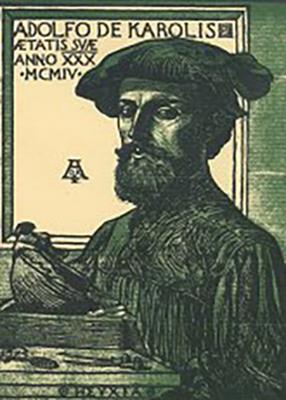
Italian[2] Art Nouveau illustrator who collaborated with D'Annunzio and Eleanora Duse, blending Symbolist painting with woodcut and monumental fresco.
Museums3
Countries3
Largest reported holdingNational Gallery of Art, Washington D.C. · 3 recorded works
Loading map…
Where to see Adolfo de Carolis
Collection holdings are reported here; current display varies. Check with each museum before visiting.
-
 3 recorded works
National Gallery of Art
Washington D.C., United States
-
1 recorded work
Galleria Nazionale d'Arte Moderna e Contemporanea di Roma
Rome, Italy

-
1 recorded work
National Library of Wales
Aberystwyth, United Kingdom
Also here (4)

Frequently Asked Questions
Where can I see Adolfo de Carolis's work?
Works by Adolfo de Carolis can be viewed in several museums internationally. In Spain, one can visit the Museo Art Nouveau y Art Deco (Salamanca) and the Museu d’Art Modern (Barcelona). The Museu Calouste Gulbenkian is located in Lisbon, Portugal. In France, museums include the Musée d’Art et d’Industrie (Roubaix), the Musée de l’Ecole de Nancy, the Musée des Arts Décoratifs (Paris), and the Musée des Beaux-Arts (Nancy). In Belgium, visit the Brangwyn Museum (Brugge) and the Clockarium Museum (Brussels). In the United Kingdom, museums holding relevant works are the Bakelite Museum (Williton), the Brighton Museum & Art Gallery, the Geffrye Museum (London), the Manchester Art Gallery, the National Museums of Scotland (Edinburgh), and the Victoria & Albert Museum (London). In the United States, see the Charles Hosmer Morse Museum of American Art (Winter Park, Florida), the Los Angeles County Museum of Art, the Metropolitan Museum of Art (New York), the Minneapolis Institute of Arts, the Museum of Modern Art (New York), the Royal Ontario Museum (Toronto), the Virginia Museum of Fine Arts (Richmond), and the Wolfsonian at Florida International University (Miami Beach).Why are Adolfo de Carolis's works important today?
Adolfo de Carolis (1874[2]-1928[2]) was an Italian[2] artist with a diverse output. He is known for painting, woodcuts, illustration, and decorative schemes. His importance lies in his contribution to the revival of woodcut techniques in Italy at the start of the 20th century. De Carolis's style combined elements of Art Nouveau with classical and Renaissance influences. He moved away from purely commercial uses of printing. Instead, he created woodcuts as artworks in their own right. His illustrations for classical texts, such as Virgil's "Aeneid", show his interest in history and mythology. These illustrations helped to popularise classical literature among a wider audience. His decorative work, including murals and architectural details, can still be seen in several public buildings in Italy. These include the Palazzo del Governo in Ancona. De Carolis taught at the Academy of Fine Arts in Florence. He passed on his skills and artistic vision to a new generation of artists. His influence can be seen in the work of his students and in the continued interest in woodcut as a fine art medium.Who was Adolfo de Carolis?
Adolfo de Carolis was an Italian[2] artist who worked in decorative painting and monumental decoration. He is known for his scholarly craftsmanship, and he restored the Borgia Apartments of the Apostolic Palace in Rome early in his career. He co-founded In Arte Libertas with Nino Costa, and he collaborated with Gabriele D'Annunzio.What techniques or materials did Adolfo de Carolis use?
Adolfo de Carolis was an Italian[2] artist known for his diverse artistic output. He worked across several media, including painting, drawing, woodcut and illustration. De Carolis's early training was at the Academy of Fine Arts in Bologna. There, he studied painting, but he later developed a strong interest in printmaking, especially woodcut. This medium became a significant part of his artistic production. He frequently employed woodcut to create illustrations for books and magazines. His paintings often display a careful attention to detail and a strong sense of design. De Carolis also designed decorative schemes for public buildings. These projects allowed him to integrate his artistic skills into architectural settings. He combined different materials and techniques to achieve a unified aesthetic effect. His work can be seen as part of the broader revival of interest in decorative arts that occurred in Italy during the early 20th century. He was versatile in his approach to art making.Who did Adolfo de Carolis influence?
Adolfo de Carolis's sphere of influence is difficult to assess. He is not mentioned in standard surveys of Futurism, Metaphysical painting, or the School of Paris. However, some scholars note cross-influences among Italian[2] artists of the early 20th century. For example, Modigliani's nudes influenced Felice Casorati, who was drawn to their chromatic qualities and sense of volume. Modigliani's integration of archaic styles also impacted Arturo Martini, who used it as a corrective to the monumental aspirations of the Novecento movement. De Chirico's Metaphysical art, with its exploration of memory and the non-logical, also contributed to the artistic landscape of the time. These examples show a complex web of artistic relationships in Italy during this period; however, none of the passages mention direct influences of or on de Carolis.Who influenced Adolfo de Carolis?
Adolfo de Carolis was active in a period of artistic change and innovation; accordingly, he was exposed to a variety of influences. De Carolis, along with other artists, was aware of the work of painters such as Paul Cézanne, Edgar Degas, Édouard Manet, Claude Monet, Auguste Renoir, and Henri de Toulouse-Lautrec. He would also have known the work of earlier masters, including Giotto, Sandro Botticelli, Leonardo da Vinci, Raphael, Michelangelo, Titian, Tintoretto, and Caravaggio. De Carolis's career also overlapped with the rise of Futurism. Umberto Boccioni, Carlo Carrà, Giacomo Balla, and Luigi Russolo were all associated with this movement. So too were figures such as F. T. Marinetti, Ardengo Soffici, and Luciano Folgore. The Futurist aesthetic, with its interest in modernity and technology, was in the air.What is Adolfo de Carolis's most famous work?
Adolfo de Carolis (1874[2]-1928[2]) was an Italian[2] artist known for his work in various media, including painting, woodcut, and illustration. He is associated with the Art Nouveau and Symbolist movements. It is difficult to identify a single, universally recognised "most famous work" by de Carolis. His career encompassed a wide range of projects, and his notability varies depending on the specific area of interest. De Carolis produced illustrations for books such as "L'Aiglon" by Edmond Rostand and "La Nave" by Gabriele D'Annunzio. These illustrations helped to popularise his style and reach a broad audience. His series of woodcuts for Giovanni Pascoli's poem "Italy" also gained recognition. He also completed several large-scale decorative projects, including frescoes and murals for public buildings. These works, while significant, are less easily accessible than his prints and illustrations. Therefore, while de Carolis does not have one single defining piece, his illustrations for "La Nave" and his woodcut series "Italy" are among his best-known creations.What style or movement did Adolfo de Carolis belong to?
Adolfo de Carolis's work is best associated with Art Deco, although his career spanned periods with differing stylistic trends. Art Deco, which gained momentum between the two World Wars, is characterised by a blend of traditional and modern elements. It combines functional and decorative aspects, familiar motifs with exotic influences, and integrates both fine and applied arts. Art Deco fashion, a component of the wider movement, often featured simple, straight lines, stylised natural motifs, Cubistic patterns, and streamlined forms. The style favoured lightweight fabrics, vivid colours, and geometric designs. While Art Deco shares some similarities with Art Nouveau, it distinguishes itself through its hybridity, broader adoption, and a lack of a unifying definition. It is a style about stylisation, representation, lifestyle, and cultural imagination within multiple modernities.
Sources
Where to See guide aggregates verified holdings of Adolfo de Carolis's works across the following collections.
- [1] museum National Gallery of Art Used for: museum holdings.
- [2] wikipedia Wikipedia: Adolfo de Carolis Used for: biography.
- [3] book Artmarketissue66january2022 Used for: biography.
- [4] book Braun, Emily, 1957-; Asor Rosa, Alberto; Royal Academy of Arts (Great Britain), Italian art in the 20th century : painting and sculpture, 1900-1988 Used for: biography.
- [5] book Post-impressionism : cross-currents in European painting Used for: biography.
Editorial overseen by Solis Prints. Sources verified 2026-09-30. Click a source for details, or hover over [N] in the page above to preview.
Editorial standardsMethodologyCorrectionsAI disclosureAbout the editorial team