

Timeline
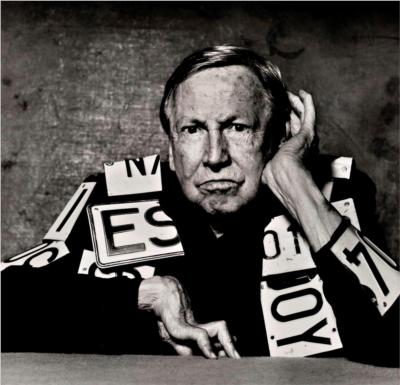
- 1937Born in Stuttgart, Germany. He grew up during the Second World War, witnessing the burning of books, an experience that would profoundly shape his art.
- 1957Studied at the Akademie der Bildenden Kunste in Stuttgart in his early twenties, training as a visual artist before turning to graphic design and illustration.
- 1961Emigrated to the United States at age 24, working as an art director in New York City where he received awards from the New York Art Directors Club and the Society of Illustrators.
- 1969Appointed Professor of Art at Pratt Institute in New York at age 32, and became director of the Pratt Adlib Press. Began concentrating exclusively on his own work as sculptor, printmaker and painter.
- 1980By age 43, had exhibited in over 75 solo shows worldwide from his base in New York. His work, steeped in Surrealism and Dadaism, centred on machinery and machine-like constructions.
- 2000Continued working from Red Hook in the mid-Hudson region of New York State, with pieces held by the Guggenheim, MoMA, the Met, the Library of Congress and the 9/11 Memorial Museum.
Notable Works
Tap to view larger.
Next stop
Pop Art →
Explore the artists and ideas of Pop Art.
Related Artists
_%E2%80%93_LOC.jpg)



Frequently Asked Questions
What is Werner Pfeiffer known for?
Werner Pfeiffer is known for his art, which centres on book objects, collage, and printmaking. His archive is held at Vassar College.What is Werner Pfeiffer's most famous work?
It is difficult to name one single work as Werner Pfeiffer's most famous. He is best known for his work with paper, especially his artist's books and altered books. His early career involved training as a typesetter, and he later studied graphic design. Pfeiffer’s artistic practice often incorporates found printed matter, which he reworks through collage, assemblage, and other techniques. The altered books transform existing volumes into sculptural objects, while his artist's books frequently explore themes of language, communication, and the environment. While Pfeiffer has produced a substantial body of work, including prints, drawings, and installations, his innovative approach to book art has gained him particular recognition. He treats books as both a medium and a subject, deconstructing and reconstructing them to create new meanings and forms. These works often invite viewers to reconsider the physical and conceptual nature of the book.What should I know about Werner Pfeiffer's prints?
Werner Pfeiffer (born 1937) is a German-American artist known for his book art, collage, and prints. He studied at the Werkkunstschule in Darmstadt, Germany, before moving to the United States in 1960. Pfeiffer's prints often incorporate collage elements and explore themes related to language, communication, and social commentary. His work frequently combines text and image, reflecting an interest in the interplay between visual and verbal forms of expression. Pfeiffer's background in graphic design is evident in his careful attention to typography and layout. His prints range from abstract compositions to more representational imagery. Many incorporate found materials, such as newspaper clippings or fragments of text. Pfeiffer has created prints using various techniques, including woodcut, etching, and screen printing. These methods allow him to achieve a range of textures and effects. His work can be found in the collections of the Museum of Modern Art, the Brooklyn Museum, and the Victoria and Albert Museum[1].What style or movement did Werner Pfeiffer belong to?
Werner Pfeiffer's work has connections to Pop Art, an art movement that emerged in both Britain and the United States in the 1950s and 1960s. Pop Art took inspiration and motifs from mass consumer society, industrial production, advertising, and the media. The movement explored themes such as sensationalism, star cults, and the glorification of the banal. English Pop Art employed collage and other methods to integrate everyday objects, while American Pop Art often adopted imagery from magazine cut-outs, film stills, and advertisements. Artists like Andy Warhol and Roy Lichtenstein are central figures in the American phase of Pop Art. The Guggenheim Museum curator Lawrence Alloway coined the term 'Pop Art' in 1956.What techniques or materials did Werner Pfeiffer use?
Werner Pfeiffer's glass pictures use opaque glass, rather than the transparent glass common in window pictures. He used only one pane for each picture, which allowed the work to be hung on a wall, or mounted into a wall (indoors or outdoors). The technique he used was sandblasting. The material was flashed glass, which often consisted of a milk glass body covered with a thin coating of another colour (usually black or red). To sandblast, the glass was covered with stencil paper or rubber. The design was cut out, and sand was blown with pressure to grind a relief into the glass wherever it was uncovered. A short sandblasting could also dull the glossy surface, creating a frosted effect. Pfeiffer used this method to produce a dull dark grey on a shiny deep black, requiring a second stencil cut and sandblasting. He also applied glass painters' colours, which became permanent after being burned in a kiln.What was Werner Pfeiffer known for?
Werner Pfeiffer is known for his contributions to Pop art, a movement that gained traction in both America and Europe during the 1950s and 1960s. Pop art draws inspiration from mass consumer society, mass production, advertising, and the media. Pfeiffer's work, like that of other Pop artists, incorporates imagery and techniques from popular culture. The goal was to make art more accessible. Artists like Andy Warhol and Roy Lichtenstein adopted themes from politics, gossip, magazine cut-outs, and film stills. They employed printing techniques to transfer images, often simplifying colours and enlarging formats. Lichtenstein, for example, reproduced comic-strip images on a large scale, complete with Benday dots. These artists aimed to comment on how mass media portrays subjects, rather than merely imitating them. The movement also included artists such as Jim Dine, Claes Oldenburg, and James Rosenquist.When did Werner Pfeiffer live and work?
Werner Pfeiffer was born in Stuttgart, Germany, in 1937. He emigrated to the United States in 1954. Pfeiffer studied at the Pratt Institute in New York, receiving a Bachelor of Fine Arts degree in 1960. He then pursued graduate studies at Columbia University, earning a Master of Fine Arts degree in 1962. Pfeiffer's artistic practice has been centred in the United States since the mid-1950s. He has worked as a graphic designer, printmaker, and book artist. His work often incorporates elements of collage, typography, and found materials. Pfeiffer taught at Pratt Institute for many years. He has exhibited his work widely in the United States and internationally. Pfeiffer continues to live and work in the United States.Where can I see Werner Pfeiffer's work?
Werner Pfeiffer's work can be viewed in several museums and collections internationally. In Germany, significant holdings are at the Bauhaus-Archiv, Museum für Gestaltung in Berlin; the Stiftung Bauhaus Dessau; the Stiftung Meisterhäuser Dessau; and the Bauhaus-Museum Weimar. Other German museums with collections of related material include the Briicke Museum and Nationalgalerie in Berlin; the Kunsthalle in Bremen; the Ludwig Museum and Wallraf-Richartz Museum in Cologne; the Folkwang Museum in Essen; the Kunsthalle in Hamburg; the Niedersachsisches Landesmuseum in Hanover; the Stadtische Kunsthalle in Mannheim; and the Von der Heydt Museum in Wuppertal. Outside of Germany, the Zentrum Paul Klee in Bern, Switzerland, and the Misawa Bauhaus Collection in Tokio, Japan, also hold relevant works. In the United States, collections can be found at the Busch-Reisinger Museum in Cambridge, Massachusetts; and at the Josef and Anni Albers Foundation in Bethany, Connecticut.Where was Werner Pfeiffer from?
Werner Pfeiffer was born in Stuttgart, Germany, in 1937. He received his diploma in graphic design from the Basel School of Design in Switzerland in 1963. Pfeiffer then moved to the United States in 1964, where he began his career as a designer and artist. He became known for his experimental book designs, prints, and collages. Pfeiffer's work often incorporated elements of language, typography, and visual poetry. He explored themes of communication, perception, and the relationship between text and image. He taught at various institutions, including Pratt Institute and the Rhode Island School of Design. Pfeiffer's work has been exhibited internationally and is included in the collections of major museums.Who did Werner Pfeiffer influence?
Werner Pfeiffer's work occurred in the context of a post-World War II reassessment of German art. A younger generation of German painters challenged the derivative abstraction prevalent in central Europe at the time. Pfeiffer and his peers worked against the conceptual abstraction and gestural style based on Art Informel. They pursued a sensuous, emotional, representational style of painting. These artists met with disapproval for over a decade. They remained true to their credo, especially in Berlin and the Rhineland, which were bastions of non-representational art. The point of departure for artists who rejected academically teachable spontaneity lay mostly in their personal backgrounds. Those from the East were more strongly influenced by memories and experiences associated with Caspar David Friedrich and Ernst Ludwig Kirchner.Who influenced Werner Pfeiffer?
The provided texts contain lists of names associated with the Bauhaus movement (1919-1933). These lists include artists, designers, and instructors connected to the Bauhaus, such as Gyula Pap, Richard Paulick, Max Peiffer Watenphul, Walter Peterhans, Josef Pohl, Hans Przyrembel, Konrad Püschel, Margaretha Reichardt, Rainer Maria Rilke, Otto Rittweger, Karl Peter Röhl, Agnes Roghé, Hajo Rose, Reinhold Rossig, Xanti Schawinsky, Hinnerk Scheper, Oskar Schlemmer, Joost Schmidt, Kurt Schmidt, Eberhard Schrammen, Lothar Schreyer, Herbert Schürmann, Kurt Schwertfeger, Werner Siedhoff, Alma Siedhoff-Buscher, Franz Singer, Franz Skala, Naum Slutzky, Irmgard Sörensen, Paula Stockmar, Gunta Stölzl, Wolfgang Tümpel, Otto Umbehr, Henry van de Velde, Reingard Voigt, Lis Volger, Wilhelm Wagenfeld, Nikolai Wassiljew, Vincent Weber, Margaret Willers, Hans Wittwer, Anni Wottiz, Iwao Yamawaki, and Michiko Yamawaki. However, these passages do not directly address who influenced Werner Pfeiffer. The lists may suggest potential artistic influences or contemporaries within the Bauhaus circle; further research would be needed to confirm specific connections or influences.Who was Werner Pfeiffer?
There is no information about an artist named Werner Pfeiffer in the provided passages. However, the texts do contain biographical information on several other German artists. Werner Biittner was born in Jena (German Democratic Republic) in 1954, emigrating to West Germany at age six. In 1976, Biittner founded the League for Struggle against Contradictory Conduct with Albert Oehlen, and in 1977, they began publishing the journal of the Dum-Dum league. By 1981, Biittner co-founded the Church of Indifference with Albert and Markus Oehlen. He participated in joint projects and exhibitions with Albert Oehlen and Kippenberger from 1982 onward. Biittner also wrote Schrecken der Demokratie (Horrors of Democracy) in 1983 and Wahrheit ist Arbeit (Truth is Work) with Kippenberger and Albert Oehlen in 1984. As of the late 1980s, Biittner lived and worked in Hamburg.
Sources
Editorial draws on the following primary and tertiary references for Werner Pfeiffer.
- [1] museum Victoria and Albert Museum Used for: museum holdings.
- [2] book Michael Siebenbrodt, Bauhaus Used for: biography, stylistic analysis.
- [3] book Michael Siebenbrodt, Bauhaus (1919-1933) Used for: biography, stylistic analysis.
- [4] book Husslein-Arco, Agnes, editor; Koja, Stephan, editor; Law, Rebecca (Translator), translator; McInnes, Robert (Translator), translator; Somers, Nick, translator; Monet, Claude, 1840-1926. Paintings. Selections; Österreichische Galerie Belvedere, h Used for: stylistic analysis.
Editorial overseen by Solis Prints. Sources verified 2026-09-04. Click a source for details, or hover over [N] in the page above to preview.
Editorial standardsMethodologyCorrectionsAI disclosureAbout the editorial team