



Shirin Neshat
- Contemporary
- Photography
- Video
Shirin Neshat spent 12 years in the United States before returning to her home country of Iran in 1990. This visit, after the Islamic Revolution, dramatically altered her artistic path. She found a society transformed, especially for women, a change she began to explore through her photography and video work.
Biography
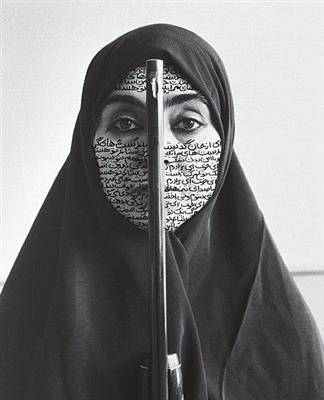
Her series, 'Women of Allah' (1993-1997), emerged from this experience. Neshat photographed women, often herself, clad in chadors, their faces and hands inscribed with Persian calligraphy. These texts were verses of contemporary Iranian poetry by women, exploring themes of martyrdom, faith, and identity.
Neshat's work often examines the complexities of identity, gender, and political structures within Islamic societies. She later expanded her practice into video installations, creating immersive experiences that further explored these dichotomies. Films like 'Turbulent' (1998) and 'Rapture' (1999) used dual screens to present contrasting narratives, often between male and female perspectives, or between tradition and modernity.
Born in Qazvin, Iran, in 1957, Neshat moved to the United States for her education in the mid-1970s. Her art continues to question preconceived notions and encourages viewers to consider multiple viewpoints. She maintains a studio in New York, where she produces work that engages with global issues, particularly those affecting the Middle East.
Timeline
- 1957Born in Qazvin, Iran
- 1975Moved to the United States for education
- 1990Returned to Iran after 12 years in the United States
- 1993Began 'Women of Allah' series
- 1997Finished 'Women of Allah' series
- 1998Created 'Turbulent'
- 1999Created 'Rapture'
- 2000Maintains a studio in New York
Notable Works
Tap to view larger.
Next stop
Contemporary →
Explore the artists and ideas of Contemporary.
Related Artists


_%E2%80%93_LOC.jpg)

Frequently Asked Questions
What is Shirin Neshat known for?
Shirin Neshat is known for her photographic series, 'Women of Allah' (1993-1997), and video installations like 'Turbulent' (1998) and 'Rapture' (1999). Her art examines the complexities of identity, gender, and political structures within Islamic societies.What is Shirin Neshat's most famous work?
Shirin Neshat is an Iranian-born artist known for video installations and photography exploring the complexities of identity, particularly concerning women in Islamic societies. Her most recognised work is likely the video installation *Turbulent*, created in 1998. It gained international attention when it was shown at the Venice Biennale in 1999, where Neshat won the Golden Lion award. *Turbulent* is a two-channel video installation intended to be projected on facing walls. It presents a male singer performing for an audience of men, singing a traditional song of divine love. On the opposite screen, a woman stands in an empty space. After the man's performance, she begins to sing using wordless vocalisation. The piece explores themes of gender, cultural oppositions, and the constraints placed on women's expression in certain Islamic contexts. Neshat has described her goal as addressing the desire for freedom from social, cultural, and political conditioning.What should I know about Shirin Neshat's prints?
Shirin Neshat is known for film and video works, some of which are sold as installations in limited editions. Many of her photographs have links to these films. Through 2009, all of Neshat's works sold at auction were photographs. These photographs are often sold in editions, sometimes alongside the film or video from which they originate. Edition sizes and numbering can vary widely, so it is important to understand editioning when collecting photographs. The Professional Art Dealers Association of Canada defines an original print as an image conceived and executed solely as a print, usually in a numbered edition and signed by the artist. Each print in the edition is an original, printed individually from a matrix created for that purpose. Terms to know include "vintage print" (a photograph printed around the time that the negative was taken), "period print" (made within 10 to 15 years of shooting), and "modern print" (recently printed from the original negative).What style or movement did Shirin Neshat belong to?
Shirin Neshat is recognised as a leading figure in video art. Her work is informed by feminist and postcolonial theory. These theories critique patriarchy and imperialism. Neshat's art explores the construction of identity, particularly for women in Islamic society. Born in Qazvin, Iran, in 1957, Neshat left Iran at seventeen. The 1979 Iranian Revolution, which transformed Iran into a fundamentalist Islamic society, stranded her in the United States. A visit in 1990 shocked her, inspiring her to resume her artistic practice, which she had abandoned around 1983. Neshat's photographs and video installations often deal with themes of cultural displacement, gender, and the complexities of contemporary Islam. Her early photographs, such as *Rebellious Silence* (1994), presented veiled, gun-toting women. These works explored the connections between violence, politics, religion, and the status of women in extremist Islamic practice. Neshat's first video piece, *Anchorage* (1996), showed the artist performing actions associated with Middle Eastern culture. Her video trilogy, *Turbulent* (1998), *Rapture* (1999), and *Fervor* (2000), examines gender and culture.What techniques or materials did Shirin Neshat use?
Shirin Neshat is known for her work in photography and video. Her early photographs, such as "Rebellious Silence" (1994), often depicted veiled Middle Eastern women, sometimes with guns. These black-and-white images frequently included inscriptions of Persian poetry on the subjects' bodies. Neshat expanded her practice to include time-based video installations. "Anchorage" (1996) was a four-minute single projection. "The Shadow under the Web" (1997) involved simultaneous projections of four videos. "Turbulent" (1998), "Rapture" (1999), and "Fervor" (2000) are a trilogy of two-screen video installations that explore gender and culture. These videos are often black and white and incorporate musical soundtracks. Neshat's video installations are projected directly onto walls, encouraging viewers to move around the space. Her film "Women Without Men" won the Silver Lion award for best director at the Venice Film Festival in 2009.What was Shirin Neshat known for?
Shirin Neshat is an Iranian visual artist best known for work in photography, video, and film. Her art explores themes of gender, identity, and politics, often focusing on the experiences of women in Islamic societies. Born in Qazvin, Iran, in 1957, Neshat moved to the United States to study art. She gained recognition in the 1990s with photographic series such as "Women of Allah" (1993-97). This collection featured portraits of women inscribed with Persian calligraphy, which addressed complex issues of femininity and power within the context of the Iranian Revolution. Neshat's video installations, for example "Rapture" (1999), have also received acclaim. These immersive works often employ dual-screen projections to create visual dialogues between opposing perspectives. Her first feature-length film, "Women Without Men" (2009), won the Silver Lion at the Venice Film Festival. This film explores the lives of four Iranian women during the 1953 Iranian coup d'état. Through her art, Neshat offers a nuanced examination of Iranian culture and the complexities of living between Eastern and Western worlds. Her work has been exhibited in museums and galleries worldwide.Where can I see Shirin Neshat's work?
Shirin Neshat's artwork has been featured in many exhibitions around the world. Her work was included in the 46th Venice Biennale, in Venice, in 1995. It was also part of the exhibition "Passages de l'image" at the Musée National d'Art Moderne, Centre Georges Pompidou, Paris (1990-1991), which then travelled to Barcelona and Columbus, Ohio. Later, it was displayed at the San Francisco Museum of Modern Art in 1992. Neshat's art has appeared in group exhibitions such as the 9th Biennale of Sydney (1992-1993) and Documenta 8 in Kassel, Germany (1987). Her pieces have also been part of shows at the Whitney Museum of American Art in New York. To see Neshat's work, it is best to check the websites of major museums and galleries for upcoming exhibitions. These include institutions such as the Museum of Modern Art in New York, the Los Angeles County Museum of Art, and the Tate Gallery in London.Where was Shirin Neshat from?
Shirin Neshat was born in Qazvin, Iran, in 1957. At the age of seventeen, like many children from educated Iranian families, she was sent abroad to study. Neshat attended the University of California at Berkeley, where she obtained both undergraduate and graduate degrees in art. The Iranian Revolution in 1979, which transformed Iran from a secular society into an Islamic society, stranded her in the United States. Neshat did not return to Iran until 1990, a year after Ayatollah Khomeini’s death. She found the transformation of her homeland shocking. As she has said, "Before I left they were Iranian-Persians, and now they were strict Muslims. Visually, everything was black and white, and women had to be in dark clothes." This visit inspired her to begin making art again, something she had abandoned when she moved to New York in 1983. Neshat's photographs became a means for her, having lived half her life outside Iran, to understand her homeland's transformation, the changed role of women, and her own position in relation to the culture she had lost.Who did Shirin Neshat influence?
Shirin Neshat's work gained international attention in the late 1990s, especially after she won the International Award at the 1999 Venice Biennale for her video installation, Turbulent (1998). Her art often explores the complexities of cultural identity, particularly as it relates to women in Islamic societies. Neshat herself acknowledges the writings of feminist scholar Fatima Mernissi as an influence. Her video work also has precedents in the work of video artists from the 1970s and early 1980s, such as Juan Downey, Mona Hatoum, and Edin Velez; these artists also explored cultural displacement and the insider/outsider perspective. Neshat's films and videos share thematic and stylistic links with works by Marina Abramovic, Ulay, Vito Acconci, Joan Jonas, and Bill Viola. Neshat's short films, such as Rapture (1999) and Fervor (2000), are wordless, lyrical narratives that focus on women. The videos and their musical soundtracks attracted acclaim. Critic G. Roger Denson of The Huffington Post named her "Artist of the Decade" in 2010.Who influenced Shirin Neshat?
Shirin Neshat acknowledges the writings of feminist scholar Fatima Mernissi as an influence. Her work also takes inspiration from the contemporary Iranian writer Moniru Ravanipur's 1989 novel *Ahl-i-gharq* (*Brave Enough to Drown*). Neshat's interest in the relationship between space and ideology developed, in part, from her involvement with the Storefront for Art and Architecture in Lower Manhattan, where she was co-director from around 1986 to 1996. Neshat's videos share similarities with video art from the 1970s and early 1980s, such as Juan Downey, Mona Hatoum, and Edin Velez. These artists also examined cultures from which they had been displaced. They raised questions about how one can form a perspective as both an insider and an outsider. Other video artists whose work explores gender dynamics, such as Acconci, Benglis, Wilke, Abramovic, Ulay, and Klaus vom Bruch, also relate to Neshat's practice. Neshat has stated that she believes "beauty is a fundamental way of getting closer to the Divine," a concept derived from spiritual Islam. Some early works feature lines of poetry by female Persian poets Forough Farrokhzad and Tahereh Saffarzadeh.Who was Shirin Neshat?
Shirin Neshat, born in Qazvin, Iran, in 1957, is an artist known for her photography and video installations. At the age of seventeen, she moved abroad for her education, eventually earning degrees in art from the University of California at Berkeley. The Iranian Revolution in 1979 prevented her return, transforming her homeland into a fundamentalist Islamic society. Neshat's visit in 1990, after Ayatollah Khomeini’s death, profoundly affected her. She observed a country that was ideologically based, where women were compelled to wear dark clothing. This inspired her to resume artmaking, which she had stopped around 1983 when she moved to New York. Neshat's photographs, often featuring veiled, gun-toting Middle Eastern women (frequently the artist herself), explore complex themes of gender, identity, and cultural displacement. Her early photographs, such as Rebellious Silence, explored Western views of the Middle East, and the contradictory status of women in revolution and war. She later extended her practice to video, with works like Anchorage (1996). Her video installation Turbulent (1998) gained her recognition as a leading video artist. This work is the first in a trilogy that includes Rapture (1999) and Fervor (2000), each exploring social segregation in fundamentalist Islam.Why are Shirin Neshat's works important today?
Shirin Neshat's art explores cultural identity, particularly the position of women in relation to Islamic culture. Born in Iran in 1957, she relocated to the United States as a teenager. The 1979 Iranian Revolution, which transformed Iran into an Islamic society, profoundly affected her. Neshat's photographs and video installations reflect on this transformation, and on her own sense of cultural displacement. Her early photographs, such as *Rebellious Silence* (1994), presented veiled, gun-toting women. These works challenged Western stereotypes of the Middle East, exploring the connections between violence, religion, and politics. Neshat's video installations, including *Turbulent* (1998), *Rapture* (1999) and *Fervor* (2000), examine gender and cultural dynamics. These short, black-and-white videos consider the social segregation of men and women in fundamentalist Islam. Neshat sees her art as a discourse on feminism and contemporary Islam, testing myths and realities. She prefers to raise questions rather than offer answers, creating works that resist simple political statements.
Sources
Editorial draws on the following primary and tertiary references for Shirin Neshat.
- [1] book Unknown, Reclaiming female agency : feminist art history after postmodernism Used for: biography, stylistic analysis.
- [2] book Norma Broude; Mary D. Garrard; Alison Arieff; Janis Bergman-Carton (editors), Reclaiming female agency _ feminist art history after postmodernism Used for: biography, stylistic analysis.
- [3] book Charlene Spretnak (auth.), The Spiritual Dynamic in Modern Art _ Art History Reconsidered, 1800 to the Present Used for: biography, stylistic analysis.
Editorial overseen by Solis Prints. Sources verified 2026-10-14. Click a source for details, or hover over [N] in the page above to preview.
Editorial standardsMethodologyCorrectionsAI disclosureAbout the editorial team