

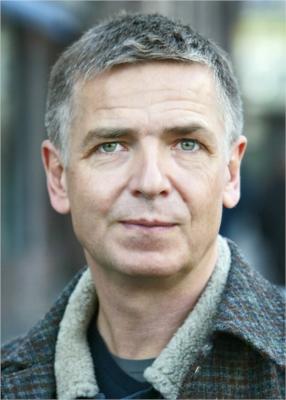
Andreas Gursky
- Contemporary
- Photography
Andreas Gursky is recognised for his large-scale photographs, which often present expansive views of globalised spaces. He captures scenes from high vantage points, creating compositions that flatten perspective and offer an almost overwhelming amount of detail. His work frequently depicts environments like stock exchanges, factories, or vast public gatherings, transforming everyday scenes into something monumental and contemplative.
Biography
Born in Leipzig, East Germany, in 1955, Gursky moved to West Germany with his family in 1957. His father was a commercial photographer, providing an early introduction to the craft. Gursky studied photography at the Folkwang University of the Arts in Essen from 1978 to 1981. He then moved to the Kunstakademie Düsseldorf, where he studied under Bernd and Hilla Becher from 1981 to 1987. The Bechers' systematic approach to industrial architecture deeply influenced his structured compositions, though Gursky applied their rigorous methodology to contemporary subjects.
From the late 1980s, Gursky began employing digital manipulation, a practice that became central to his artistic method. He uses this technique not to create fiction, but to enhance reality, constructing images that are often composites of multiple shots. This allows him to achieve a uniform focus across vast scenes and to remove distracting elements, resulting in photographs of immense clarity and precision. His work questions the nature of photographic truth in an increasingly mediated world.
Gursky's photographs often explore themes of consumerism, global capitalism, and the human impact on the modern environment. His subjects range from Amazon warehouses to the Rhine river, each depicted with a detached, almost scientific objectivity. These works invite viewers to consider the scale and complexity of contemporary life, presenting familiar scenes in an unfamiliar, often awe-inspiring way. His large prints command attention, drawing the viewer into their detailed worlds.
Timeline
- 1955Born in Leipzig, East Germany
- 1957Moved to West Germany with family
- 1978Studied at Folkwang University of the Arts in Essen
- 1980Began employing digital manipulation in his work
- 1981Studied at Kunstakademie Düsseldorf under Bernd and Hilla Becher
- 1987Finished studies at Kunstakademie Düsseldorf
Notable Works
Tap to view larger.
Next stop
Contemporary →
Explore the artists and ideas of Contemporary.
Related Artists



_%E2%80%93_LOC.jpg)

Frequently Asked Questions
What is Andreas Gursky known for?
Andreas Gursky is known for his large-scale photographs that present expansive views of globalised spaces. He captures scenes from high vantage points, creating compositions that flatten perspective and offer an overwhelming amount of detail. His work frequently depicts environments like stock exchanges and factories.Who was Andreas Gursky?
Andreas Gursky is recognised for his large-scale photographs, which often present expansive views of globalised spaces. Born in Leipzig, East Germany, in 1955, he moved to West Germany with his family in 1957. His father was a commercial photographer, providing an early introduction to the craft.What was Andreas Gursky's art style?
From the late 1980s, Gursky began employing digital manipulation, a practice that became central to his artistic method. He uses this technique not to create fiction, but to enhance reality, constructing images that are often composites of multiple shots. This allows him to achieve a uniform focus across vast scenes and to remove distracting elements.When was Andreas Gursky born?
Andreas Gursky was born in 1955 in German.
Sources
Editorial draws on the following primary and tertiary references for Andreas Gursky.
- [1] book Beard, Lee, 1973- author, Butler, Adam, author; Van Cleave, Claire, author; Fortenberry, Diane, author; Stirling, Susan, author, Beard, Lee, 1973- author, Butler, Adam, author; Van Cleave, Claire, author; Fortenberry, Diane, author; Stirling, Susan, author - The Art Book_ New Edition, Mini Format Used for: biography.
- [2] book Fred S. Kleiner, Helen Gardner, Gardner’s Art Through the Ages_ A Concise Global History, Loose-leaf Version Used for: biography.
- [3] book Penelope J.E. Davies, Walter B. Denny, Frima Fox Hofrichter, Joseph Jacobs, Ann S. Roberts, David L. Simon, Janson's History of Art_ The Western Tradition (8th Edition) Used for: biography.
Editorial overseen by Solis Prints. Sources verified 2026-10-14. Click a source for details, or hover over [N] in the page above to preview.
Editorial standardsMethodologyCorrectionsAI disclosureAbout the editorial team