

Marie-Denise Villers
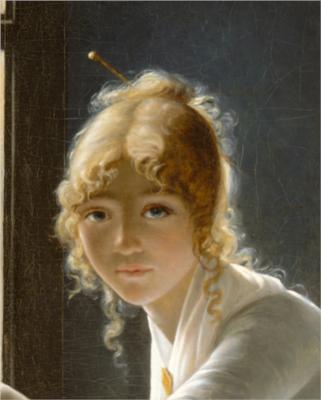
For decades, the Metropolitan Museum displayed Villers's most famous painting as a Jacques-Louis David. They had bought Portrait of Charlotte du Val d'Ognes in 1917, calling it "the New York David". In 1951, curator Charles Stirling suggested it was actually by "a little known woman". The painting lost its title and artist attribution. It took until 1995 for Margaret Oppenheimer to argue successfully that Villers was the painter.
Biography
She was born Marie-Denise Lemoine in Paris in 1774. Two of her three sisters and a cousin were also trained portraitists; painting was a family trade. She studied under Francois Gerard and Jacques-Louis David himself, and took lessons from Anne-Louis Girodet-Trioson, whom she met at the Salon of 1799. In 1794 she married the architecture student Michel-Jean-Maximilien Villers, who supported her career at a time when marriage typically ended a woman's professional art practice.
The Charlotte du Val d'Ognes portrait (1801) is now widely considered a self-portrait: a young woman drawing by a broken window, backlit, with a crack in the glass that art historians have read as a statement about the barriers facing women artists. David himself commented on how realistic Villers's portraits were. Her last known work is a portrait of the Duchess of Angouleme, exhibited in 1814. Her life between 1814 and her death in 1821 is unknown.
Timeline
- 1774Born Marie-Denise Lemoine in Paris, one of four sisters. At least three of her sisters were also trained as portrait painters.
- 1794At 20, married the architecture student Michel-Jean-Maximilien Villers in Paris.
- 1799At 25, exhibited for the first time at the Paris Salon and began taking lessons with Francois Gerard and Jacques-Louis David.
- 1801At 27, exhibited her portrait of Charlotte du Val d'Ognes at the Salon, a painting later misattributed to Jacques-Louis David for nearly two centuries.
- 1814At 40, exhibited her last known work, a portrait of the Duchess of Angouleme, at the Salon in Paris.
- 1821Died on 19 August aged 47 in Paris. In 1995, scholar Margaret Oppenheimer definitively attributed her portrait of Charlotte du Val d'Ognes, ending its long misidentification as a David.
Notable Works
Tap to view larger.
Next stop
Neoclassicism →
Explore the artists and ideas of Neoclassicism.
Related Artists


Frequently Asked Questions
What is Marie-Denise Villers known for?
Marie-Denise Villers is known for her portraits, particularly Portrait of Charlotte du Val d'Ognes (1801), which is now widely considered a self-portrait. Jacques-Louis David commented on how realistic her portraits were. Her last known work is a portrait of the Duchess of Angouleme, exhibited in 1814.What should I know about Marie-Denise Villers's prints?
Marie-Denise Villers (1774-1821) was a French portrait painter. Although not much is known about her life, she exhibited at the Paris Salons in the late 1790s and early 1800s. Villers studied with Anne-Louis Girodet, a student of Jacques-Louis David. She also studied with François Gérard. Villers’s early work shows the influence of Davidian Neoclassicism. However, she moved away from this style later in her career. Prints of Villers's paintings are not common, but some exist. "Young Woman Drawing" (1801) is her best-known painting; it exists in several print versions. The painting is a portrait of a woman, possibly the artist herself, sitting in front of a window, drawing. It is in the collection of the Metropolitan Museum of Art in New York. For many years, it was attributed to Jacques-Louis David. Other paintings by Villers include portraits of Madame Soustras and Madame de Senonnes. These paintings are also available as prints, though they are rarer than prints of "Young Woman Drawing". Her work offers a glimpse into the world of female artists in late 18th- and early 19th-century France.What style or movement did Marie-Denise Villers belong to?
Marie-Denise Villers was active during the late eighteenth and early nineteenth centuries, a period when Neoclassicism was the predominant artistic style. This movement emerged around 1750; critics called for a return to classical forms in response to the decorative qualities of Rococo art. Recent excavations at Herculaneum and Pompeii, which began in 1738, increased attention to ancient art. Antiquarian scholars took a more rigorous approach to documenting the past. Prints recorded the archaeological findings at excavation sites in Italy and beyond. Increased exposure to ancient art, through collecting practices and grand tours, awakened interest in the artistic principles of ancient cultures. Figures such as Johann Joachim Winckelmann argued that the art of the ancients should be studied to grasp its core aesthetic features. French artists studying at the Académie de France were urged to study antique works. Jacques-Louis David, a leading figure, exhibited works in the 1780s that were enthusiastically received. Neoclassicism became part of a reformist agenda aimed at re-establishing royal authority in matters of taste. David’s studio became the primary training ground for young French artists well into the 19th century.What techniques or materials did Marie-Denise Villers use?
Marie-Denise Villers was a French painter working in an era when artists were fascinated by technique. Publications on painting materials and methods grew in number. These included books of secrets, artists' treatises, learned journals, and encyclopaedias. Traditional painting methods included tempera, fresco, miniature, oil painting, enamel work, and painting on porcelain. Some more unusual techniques were encaustic, eludoric, and glass painting. Experimentation with encaustic or coloured wax was of particular interest at the time. The method required a hot plate to fuse the final composition. Some approaches involved infusing a gouache painting with wax, while others used coloured waxes directly. Eludoric painting was invented in 1775 as a permanent form of painting.What was Marie-Denise Villers known for?
Marie-Denise Villers (born Marie-Denise Lemoine, 1774-1821) was a French portrait artist. Female artists such as Marie-Louise-Élisabeth Vigée-Lebrun gained prominence in the 18th century as portraitists. Vigée-Lebrun, born in Paris, was sent to a convent school at the age of six. Her father's death when she was twelve led her mother to remarry a wealthy jeweller, and they relocated to a fashionable area of Paris. Although the extent of her artistic training from her father is uncertain, he instilled in her a passion for art. In 1776, she married the art dealer Jean-Baptiste Pierre Lebrun. That year, she created a self-portrait, now held at the Kimbell Museum of Art in Fort Worth, Texas. She became a member of the French Academy and a favoured artist of Queen Marie Antoinette.Where can I see Marie-Denise Villers's work?
Marie-Denise Villers's paintings are held in a number of public collections. These include the Musée du Louvre, in Paris; and the Metropolitan Museum of Art, in New York. Other museums that hold works of art are the Staatliche Museen zu Berlin, Gemaldegalerie; Staatliche Museen zu Berlin, Kupferstichkabinett; Herzog Anton Ulrich-Museum, Kunstmuseum des Landes Niedersachsen in Braunschweig; Gemaldegalerie Alte Meister, Staatliche Kunstsammlungen Dresden; National Gallery of Scotland in Edinburgh; Galleria degli Uffizi in Florence; Stadel Museum, Stadelsches Kunstinstitut und Stadtische Galerie in Frankfurt am Main; Niedersachsisches Landesmuseum in Hanover; National Museums Liverpool, Walker Art Gallery; The British Library in London; The British Museum in London; The National Gallery in London; National Portrait Gallery in London; Tate in London; UCL Art Collections, University College in London; Victoria and Albert Museum in London; The J. Paul Getty Museum in Los Angeles; Museo Thyssen-Bornemisza in Madrid; Staatliche Graphische Sammlung in Munich; Ashmolean Museum in Oxford; Bodleian Library, University of Oxford; Musée du Louvre, Département des Arts Graphiques in Paris; Musée du Louvre, Département des Peintures in Paris; Royal Cabinet of Paintings, Mauritshuis in The Hague; Kunsthistorisches Museum, Gemaldegalerie in Vienna; and National Gallery of Art in Washington.Who did Marie-Denise Villers influence?
Marie-Denise Villers, active as a painter in Paris around 1800, is now better known than she was during her lifetime. This is partly due to the mistaken identification of her work. For many years, her *Young Woman Drawing* (1801) was attributed to Jacques-Louis David. It is difficult to assess Villers's influence on other artists directly, due to gaps in the historical record. However, we can consider her position within the artistic milieu of her time. Villers studied with Anne-Louis Girodet, a student of David, and exhibited at the Salons. These connections suggest she was part of a network of artists who shared ideas and techniques. More research is needed to fully understand the extent of Villers's impact on subsequent generations. The reassessment of her oeuvre may lead to further discoveries about her role in the artistic developments of the late 18th and early 19th centuries.Who influenced Marie-Denise Villers?
Marie-Denise Villers (1774-1821) was a French portrait painter. She studied with Anne-Louis Girodet, who was himself a pupil of Jacques-Louis David. Villers also received instruction from François Gérard. Gérard was another artist in David's circle; therefore, Villers was trained in the Neoclassical style. Some scholars suggest that Villers's work shows the influence of Élisabeth Vigée Le Brun. Le Brun was known for her portraits, particularly of Marie Antoinette. It is possible Villers saw Le Brun's paintings in exhibitions or private collections. However, any influence was likely indirect. Villers's style is more closely aligned with Neoclassicism than Le Brun's Rococo-influenced work. Villers's early death means she did not have a long career. Her known body of work is small. As such, tracing specific influences is difficult. Her artistic education and the prevailing styles of the time offer the best insight into her influences.Who was Marie-Denise Villers?
Marie-Denise Villers (1774-1821) was a French portrait painter. She was born Marie-Denise Lemoine. Villers studied with Anne-Louis Girodet, François Gérard, and possibly Jacques-Louis David. She exhibited at the Paris Salon, first in 1799, and continued to do so until 1817. Her exhibited works included portraits and genre scenes. One of her best-known paintings is *Young Woman Drawing*, which she exhibited at the 1801 Salon. For many years, this work was attributed to Jacques-Louis David. Some scholars have also suggested authorship by Constance Charpentier. The painting is now accepted as Villers's work. It is in the collection of the Metropolitan Museum of Art, New York. Villers came from a family of artists. Her sisters, Marie-Victoire Lemoine and Marie-Élisabeth Gabiou, were also painters. Marie-Victoire Lemoine, the eldest sister, trained her younger sisters. Marie-Denise Villers died in Paris in 1821.Why are Marie-Denise Villers's works important today?
Marie-Denise Villers's works are significant as examples of female artistic success in a male-dominated field. In France, the Académie Royale de Peinture et de Sculpture was essential for artists seeking official careers; however, it limited female membership to only four at any one time. Despite such obstacles, Villers, along with artists such as Adélaïde Labille-Guiard and Élisabeth Vigée Le Brun, achieved recognition. The late 18th century saw an increase in women artists, yet societal norms posed a challenge. Success depended on public acclaim, but virtuous women were expected to prioritise modesty. Villers's career offers insight into how female artists navigated these constraints. Later scholarship has examined the careers of 18th-century women artists, analysing their self-presentation and professional networks. These studies reveal the possibilities and prohibitions that shaped their experiences. By studying Villers's paintings, we gain a better understanding of the struggles and triumphs of women artists during this period.When was Marie-Denise Villers born?
Marie-Denise Villers was born in 1774 in France. Marie-Denise Villers died in 1821, aged 47.How did Marie-Denise Villers die?
Marie-Denise Villers died in 1821 at the age of 47.
Sources
Editorial draws on the following primary and tertiary references for Marie-Denise Villers.
- [1] book Allison Lee Palmer, Historical Dictionary of Neoclassical Art and Architecture Used for: biography.
- [2] book Palmer, Allison Lee, Historical Dictionary of Neoclassical Art and Architecture Used for: biography.
- [3] book Masterpieces of western art : a history of art in 900 individual studies from the Gothic to the present day Used for: biography.
Editorial overseen by Solis Prints. Sources verified 2026-09-30. Click a source for details, or hover over [N] in the page above to preview.
Editorial standardsMethodologyCorrectionsAI disclosureAbout the editorial team