



Filippino Lippi
When Filippino Lippi completed the Brancacci Chapel frescoes in 1483, he was finishing work begun by Masaccio over fifty years earlier — a commission that required painting alongside a ghost. He was twenty-six, illegitimate, and carrying a famous surname. That he succeeded so seamlessly that scholars still argue about the join is perhaps the defining fact of his career.
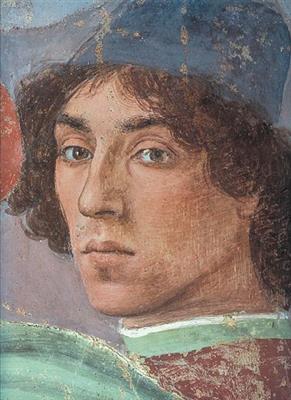
Biography
Born in Prato in 1457[1], the son of Fra Filippo Lippi and a nun he had famously seduced, Filippino was orphaned at twelve when his father died in Spoleto. He made his way to Florence and into the workshop of Sandro Botticelli, himself a former pupil of Fra Filippo's, where he lived in his master's house and absorbed the linearity and grace that would mark his early work. By his late twenties he had attracted independent commissions, including the Sala degli Otto di Pratica in the Palazzo Vecchio, completed on 20 February 1486.
In 1488, at thirty-one, he left Florence for Rome to decorate the Carafa Chapel in Santa Maria sopra Minerva for Cardinal Oliviero Carafa. The five years he spent there changed everything. Roman antiquities, grotesque ornament, sarcophagi and triumphal arches worked their way so deeply into his imagination that they began appearing in his paintings regardless of subject matter — a tendency his contemporaries noticed and that art historians have been annotating ever since.
Back in Florence, he spent the better part of the 1490s and early 1500s on the Strozzi Chapel in Santa Maria Novella, a commission that ran from 1487 to 1503[1]. His later work grew increasingly fantastical and unsettled, the figures elongated, the compositions edgy with classical debris and grim-faced executioners. He died on 18 April 1504[1], aged forty-seven. According to Vasari, every workshop in Florence closed that day in his honour.
Timeline
- 1457Born in Prato, the son of Fra Filippo Lippi and a nun.
- 1469Orphaned at 12 after his father died in Spoleto.
- 1469Moved to Florence and entered the workshop of Sandro Botticelli.
- 1483Completed the Brancacci Chapel frescoes, work begun by Masaccio.
- 1486Completed the Sala degli Otto di Pratica in the Palazzo Vecchio on 20 February.
- 1488Left Florence for Rome, at 31, to decorate the Carafa Chapel in Santa Maria sopra Minerva.
- 1493Returned to Florence after five years in Rome.
- 1493Began work on the Strozzi Chapel in Santa Maria Novella, a commission that lasted until 1503.
- 1504Died on 18 April, aged 47. Every workshop in Florence closed that day in his honour.
Notable Works
Tap to view larger.
Next stop
Browse the movements →
Every movement in the collection, from the Renaissance to Pop art.
Related Artists


Frequently Asked Questions
What is Filippino Lippi's most famous work?
Filippino Lippi is well regarded for his frescoes in the Strozzi Chapel of Santa Maria Novella, Florence. However, no single work is universally considered his "most famous". Lippi received his earliest training from his father, Fra Filippo Lippi. Later, he was a student of Botticelli, whose influence is apparent in his early works. He completed Masaccio's frescoes in the Brancacci Chapel, a project left unfinished when Masaccio died in 1428. Lippi finished the commission some sixty years later, between 1481 and 1485. His other major commissions include work in the church of Santa Maria sopra Minerva in Rome (1488-93) and the Strozzi Chapel in Santa Maria Novella (1487-1502[1]). The Strozzi Chapel frescoes depict scenes from the lives of St John the Evangelist and St Philip. These frescoes are admired for their narrative complexity and use of colour. Lippi's late style moved away from the grace of his earlier paintings, toward a more dramatic and expressive mode. He died in Florence in 1504[1].What should I know about Filippino Lippi's prints?
Filippino Lippi (born in Prato, 1457[1]; died in Florence, 1504[1]) was the son of Fra Filippo Lippi. Orphaned at the age of ten, Filippino was brought up by Sandro Botticelli, who had been a pupil of Lippi senior. His paintings display his father's inclination towards happiness, yet they are tempered by Botticelli's awareness of human fragility. A 'quivering gentleness' marks his work. His first major commission involved completing a Florentine fresco, which had been left unfinished by Masaccio. It was his frescos that established his reputation. After spending years in Rome studying Roman remains, they became a recurring feature in his paintings, regardless of their suitability to the subject matter. One example is his *Portrait of an Old Man* (circa 1485). The plain backdrop brings attention to the man's gentle eyes. The man's personality shines through this portrait, which is painted in the graceful style that characterised Filippino’s work.What style or movement did Filippino Lippi belong to?
Filippino Lippi (circa 1457[1]-1504[1]) is usually categorised as a painter of the Early Renaissance in Florence. His style is complex, since he was influenced by his father, Fra Filippo Lippi, as well as other Florentine masters. Early influences included Sandro Botticelli, under whom he apprenticed. Some scholars see echoes of Andrea del Verrocchio and Leonardo da Vinci in Lippi's work as well. These artists helped to shape his early style. Later in his career, after a period in Rome, Lippi's work moved toward Mannerism. This is evident in the heightened emotion, dynamic compositions, and elongated figures seen in paintings such as the Strozzi Chapel frescoes in Santa Maria Novella, Florence. These late works show a departure from the more restrained style of the Early Renaissance. He blended elements of the earlier Renaissance with newer trends. This makes him a transitional figure.What techniques or materials did Filippino Lippi use?
Filippino Lippi (c. 1457[1]-1504[1]) adopted painting techniques common in Florence during the late fifteenth century. He was the son of Fra Filippo Lippi, who trained him in painting and drawing. Lippi's paintings are mostly tempera on wood panel and fresco. He also produced drawings in pen, ink, and metalpoint. His early paintings, such as the *Adoration of the Magi* (c. 1475-80, National Gallery, London), show the influence of his father and of Sandro Botticelli, with whom he trained. These paintings feature delicate lines, bright colours, and elegant figures. After a period in Rome during the 1480s, Lippi's style changed. His later works, such as the frescoes in the Strozzi Chapel in Santa Maria Novella, Florence (c. 1487-1502[1]), show a greater interest in classical antiquity and dramatic narrative. These frescoes are characterised by their complex compositions, realistic figures, and use of perspective. Lippi also experimented with new techniques, such as oil painting, in his later works. This allowed him to achieve a greater range of colours and textures.What was Filippino Lippi known for?
Filippino Lippi (born in Prato in 1457[1], died in Florence in 1504[1]) was an Italian painter of the early Renaissance. The son of Fra Filippo Lippi, he was orphaned at a young age. He then became a student of Sandro Botticelli, who had been a pupil of his father. His first major commission was to complete a Florentine fresco, which had been left unfinished by Masaccio. It was his frescos that made his name. After spending years in Rome studying Roman remains, they became an important feature in his paintings, whether appropriate to the subject or not. His painting style is graceful and simple. One example is his Portrait of an Old Man (circa 1485). The plain blue background, pale tunic, and hat draw attention to the wrinkled face of the sitter. His work displays a quivering gentleness. Tobias and the Angel (circa 1480) floats ethereally.When did Filippino Lippi live and work?
Filippino Lippi was born in Prato in 1457[1] and died in Florence in 1504[1]. His father, Fra Filippo Lippi, died when Filippino was only twelve. A year later, he was working with Sandro Botticelli, who had been a pupil of his father. His first major commission was to complete a Florentine fresco left unfinished by Masaccio. He spent years in Rome studying Roman remains. These Roman elements would appear repeatedly in his paintings, whether appropriate to the subject or not. Lippi's artistic activity occurred primarily in Florence and Rome. He secured his first major commission in Florence, completing Masaccio's unfinished fresco. Later, his time in Rome allowed him to study and incorporate Roman antiquity into his works. Although his career was centred in these two cities, his influence extended through the Italian Renaissance.Where can I see Filippino Lippi's work?
Filippino Lippi's paintings are held in collections around the world. In Florence, his *Madonna and Child* and *Portrait of an Old Man* (c. 1485) can be seen in the Uffizi Gallery. Other paintings in Europe include *Adoration in the Wood* at the Staatliche Museen in Berlin-Dahlem; *Madonna and Child with two Angels* at the Musée des Beaux-Arts in Strasbourg; *Venus* at the Galleria Sabauda, Turin; and *Madonna and Child with two Angels* at the Akademie der bildenden Künste in Vienna. In the United States, you can find Lippi's *Virgin and Child* at the Walker Art Gallery in Baltimore; *Holy Family* at the North Carolina Museum of Art in Raleigh; and *Adoration of the Magi*, *Madonna Adoring Christ*, *Madonna and Child*, *Madonna and Child with two Angels*, *Mystic Crucifixion*, and portraits at the National Gallery of Art in Washington, D.C.Where was Filippino Lippi from?
Filippino Lippi was born in Prato, Tuscany, in about 1457[1]. His father was the painter Fra Filippo Lippi, and his mother was Lucrezia Buti. Lippi's early artistic training came from his father. After his father's death in 1469, he may have trained with Sandro Botticelli. Giorgio Vasari, in his *Lives of the Artists*, mentions Lippi's dedication to Botticelli's style. He states that Lippi so closely imitated Botticelli that his paintings could easily be mistaken for those of Botticelli. Lippi received important commissions throughout Florence and beyond. These included work in the Palazzo Vecchio, the church of Santa Maria Novella, and the Strozzi Chapel. He died in Florence in 1504[1], while working on a painting for the Annunziata. According to Vasari, his death was mourned by the entire city.Who did Filippino Lippi influence?
Filippino Lippi (born circa 1457[1], died 1504[1]) was the son of Fra Filippo Lippi; Filippino was orphaned at the age of ten. Botticelli, who had been a student of Lippi senior, raised the younger Lippi. Filippino's early paintings were similar in style to Botticelli's. Some of these early works have been misattributed. Later, Filippino moved away from his teacher's style, developing a more exaggerated linear style. Filippino's work displays a gentleness, combined with Botticelli's sense of human frailty. His father, Filippo Lippi, was influenced by Donatello and Ghiberti, as well as by Flemish masters. Filippo played a significant part in determining the direction of Florentine painting during the second half of the 15th century.Who influenced Filippino Lippi?
Filippino Lippi's artistic development was shaped by several influences. As the son of Fra Filippo Lippi, from whom Botticelli also learned painting, Filippino had an early connection to the Florentine art scene. After his father's death, Filippino entered Botticelli's workshop. Initially, his style closely mirrored that of his teacher, leading to some early works being mistaken for Botticelli's. However, Filippino later distinguished himself through a certain emphasis of linear elements. His work also shows the impact of Masaccio, from whom his father learned monumentality of form. While in Rome, Filippino studied Roman remains, which became a recurring element in his paintings, whether or not they suited the subject matter. Donatello's influence can be seen in Filippino's use of truncated donor figures, suggesting a scene excerpted from a larger whole. These various influences contributed to Filippino Lippi's graceful, simple style.Who was Filippino Lippi?
Filippino Lippi (1457[1]-1504[1]) was a painter born in Prato. His father was Fra Filippo Lippi, also a painter. Orphaned at the age of ten, Filippino was a student of Sandro Botticelli, who had been a pupil of Lippi's father. His initial major commission involved completing a Florentine fresco, which had been left unfinished by Masaccio. He spent years in Rome studying Roman remains; these Roman elements recurred in his paintings, regardless of the subject's appropriateness. Filippino's artistic style displays a quivering gentleness. His painting, *Tobias and the Angel*, possesses a delicacy that allows it to float ethereally. A portrait, *Portrait of an Old Man*, is in the Uffizi Gallery, Florence.Why are Filippino Lippi's works important today?
Filippino Lippi (1457[1]-1504[1]) was the son of Fra Filippo Lippi; Botticelli taught him after the elder Lippi's death. Filippino's early paintings so closely resembled Botticelli's that people mistook them. Later, Lippi developed his own style, marked by a certain exasperation of linearism. His importance lies in his frescoes and his graceful, straightforward portraiture. One example is his c.1485 *Portrait of an Old Man*, now in the Uffizi Gallery, Florence. The painting is striking because it is so direct. Although the sitter's identity is unknown, much of his personality shines through. After spending years in Rome, Lippi began incorporating Roman remains into his paintings, whether or not they suited the subject. In 1504[1], he was named to the committee assembled to decide where to place Michelangelo's *David* statue. He suggested the cathedral steps, but others overruled him. By this time, the emerging talents of Michelangelo and Raphael had eclipsed Lippi.
Sources
Editorial draws on the following primary and tertiary references for Filippino Lippi.
- [1] wikipedia Wikipedia: Filippino Lippi Used for: biography, birth dates, death dates, identifiers, movement attribution, nationality.
- [2] book Beard, Lee, 1973- author, Butler, Adam, author; Van Cleave, Claire, author; Fortenberry, Diane, author; Stirling, Susan, author, Beard, Lee, 1973- author, Butler, Adam, author; Van Cleave, Claire, author; Fortenberry, Diane, author; Stirling, Susan, author - The Art Book_ New Edition, Mini Format Used for: biography.
- [3] book Beckett, Wendy, The story of painting Used for: biography.
Editorial overseen by Solis Prints. Sources verified 2026-09-22. Click a source for details, or hover over [N] in the page above to preview.
Editorial standardsMethodologyCorrectionsAI disclosureAbout the editorial team