



Everett Shinn
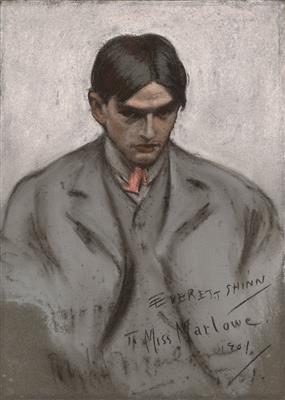
Born on 6 November 1876[1] in Woodstown, New Jersey, Everett Shinn came to painting sideways, through the newspaper trade. At seventeen he was a staff artist for the Philadelphia Press, sketching street scenes on deadline: a training that gave him a reportorial eye and a hand fast enough to catch movement before it disappeared. From Philadelphia he drifted into the orbit of Robert Henri's circle, alongside John Sloan, William Glackens, and George Luks, and by the turn of the century these men were arguing for an art that looked at city life without flinching.
Biography
Shinn was the group's odd man out in more than one sense. John Sloan reportedly called him an accidental member of The Eight, and Shinn eventually became an outspoken opponent of the modernist direction his colleagues quietly endorsed. He did not participate in the 1913[1] Armory Show. What he cared about was performance: the theatre, the music hall, the trapeze. Paintings such as The London Hippodrome (1902) and The Orchestra Pit: Old Proctor's Fifth Avenue Theater (1906) catch the nervous electricity of entertainments shot through with footlights and sawdust, close enough to the action to feel the heat.
He was also the only Ashcan painter who worked seriously in pastels, a medium that suited his instinct for speed and atmosphere over finish. Theatrical commissions consumed considerable energy: he designed murals for David Belasco's theatre (opened 1907[1], recently restored) and decorated the apartments of the playwright Clyde Fitch. Art historian Sam Hunter called him the dandy of the realists, a label that captures something real about the gap between his subjects (workers, acrobats, chorus girls) and his own inclination towards glamour.
He exhibited in the landmark Macbeth Galleries show with The Eight in 1908[1], but his reputation peaked early. Financial reverses during the Depression left him in straitened circumstances, and he died in New York on 1 May 1953[1].
Timeline
- 1876Born in Woodstown, New Jersey, on 6 November.
- 1893At 17, became a staff artist for the Philadelphia Press, sketching street scenes.
- 1900Associated with Robert Henri's circle in Philadelphia, alongside John Sloan, William Glackens, and George Luks.
- 1902Painted "The London Hippodrome".
- 1906Painted "The Orchestra Pit: Old Proctor's Fifth Avenue Theater".
- 1907Designed murals for David Belasco's theatre.
- 1908Exhibited with The Eight at the Macbeth Galleries.
- 1913Did not participate in the Armory Show.
- 1953Died in New York on 1 May.
Notable Works
Tap to view larger.
Next stop
Browse the movements →
Every movement in the collection, from the Renaissance to Pop art.
Related Artists



Frequently Asked Questions
What is Everett Shinn's most famous work?
It is difficult to name one single "most famous" work by Everett Shinn, as his notability rests on several aspects of his career. He is well regarded as a member of the Ashcan School, also known as The Eight, a group of painters who sought to portray everyday life in New York City. Shinn's paintings often depicted scenes of urban life, including theatre performances and city streets. Shinn was also a successful illustrator, working for various magazines and newspapers. His illustrations captured the energy and dynamism of urban life, further cementing his reputation as a chronicler of early 20th-century America. Additionally, Shinn was involved in theatre design, creating sets and costumes for various productions. This theatrical background influenced his painting style, which often incorporated dramatic lighting and staging techniques. Therefore, while there is no single artwork that overshadows all others, Shinn's collective output as a painter, illustrator, and theatre designer has secured his place in American art history.What should I know about Everett Shinn's prints?
Everett Shinn's prints, like those of many artists, exist in a market with specific characteristics. Original prints are produced in limited editions, influencing their value. The number of prints in an edition is restricted due to the manual creation of plates, which have a limited lifespan. Publishers may further limit editions, increasing their desirability among collectors. Some editions are capped at 250 to 500 prints. The pricing of prints depends on several factors: the quantity available, the artist's reputation, the image's popularity, and the quality of materials used. When acquiring a print, it is useful to understand standard practices for signing and numbering editions. In a limited edition, each print is numbered (e.g., 35/100), indicating its position in the total run. Artists sometimes reserve a percentage as artist's proofs, marked with 'AP' after the number. Prints are often signed and numbered in pencil. The art market includes both fine art presses and more commercial entities. Researching the market helps determine where an artist's work fits. Visiting galleries and print shops can provide insight into pricing and quality.What style or movement did Everett Shinn belong to?
Everett Shinn is associated with the Ashcan School, a Realist artistic movement in the United States during the late 19th and early 20th centuries. The Ashcan School artists aimed to depict scenes of everyday life, particularly in New York City's poorer neighbourhoods. Shinn, along with artists like John Sloan and George Bellows, sought to portray the energy of urban life. Their work often featured working-class people, cityscapes, and scenes of leisure and entertainment. Shinn's paintings and illustrations captured the spirit of early 20th-century America, showing both its gritty realities and its moments of joy. Shinn's 1911[1] murals in the Trenton City Hall, New Jersey, depict workers at the Roebling Steel Mills and the Mattock Kilns. These murals, like other Ashcan works, aimed to bridge the gap between art and life by representing the experiences of ordinary people.What techniques or materials did Everett Shinn use?
Oil paint was a common medium. Artists often adjusted the paint's consistency using thinners, such as turpentine or mineral spirits; mediums altered the paint's chemical composition by adding oils or varnishes. A typical medium could be created by mixing linseed oil, damar varnish, and turpentine or mineral spirits. For painting surfaces, artists might use Fredrix Red Label medium-textured canvas. Another option was hardboard panels, prepared with two coats of acrylic gesso. Canvas-textured paper pads offered an inexpensive alternative for experiments. Sketching equipment included a sketch pad and drawing materials, such as a 4B drawing pencil. A palette cup could clip onto the edge of the palette, allowing easy access to thinners. When using acrylics, thinning with water could weaken the polymer film that acted as a binder. Gloss medium could be used as a thinning agent to create a transparent acrylic glaze that retained its strength. Krylon Kamar Varnish could be applied as a non-yellowing finish coat.What was Everett Shinn known for?
Everett Shinn (1876[1]-1953[1]) was an American realist painter, part of the Ashcan School artistic movement. These artists aimed to portray modern urban life, moving away from traditional genteel subjects. Shinn's work often depicted scenes of New York City, including theatre interiors and city streets. He had an interest in the theatre; he not only painted theatre scenes, but also designed sets and wrote plays. In 1911[1], Shinn created murals for the Commission Chambers at Trenton City Hall, in New Jersey. These murals showed workers at the Roebling Steel Mills and the Mattock Kilns. Like other Ashcan artists, Shinn aimed to capture the spirit of American life and bridge the gap between art and the everyday experience. His work, along with that of other members of the Ashcan School, presented subjects of the modern world.When did Everett Shinn live and work?
Everett Shinn was an American realist painter, born in Woodstown, New Jersey, on 6 November 1876[1]. He passed away in New York City on 1 January 1953[1]. Shinn is mainly known for his Ashcan School paintings, which often depicted urban life in New York. However, he also produced work in other locations. He studied at the Pennsylvania Academy of the Fine Arts, before embarking on a career as a newspaper illustrator. This work brought him to New York City in 1897[1], where he began to focus on painting and other fine-art media. His subject matter included theatre scenes, cityscapes, and depictions of social gatherings. Shinn was associated with a group of artists known as the Eight, who sought to challenge the conservative art establishment in the early 20th century. He exhibited with them at the Macbeth Galleries in 1908. He continued to paint and exhibit his work until his death in 1953.Where can I see Everett Shinn's work?
Everett Shinn's paintings, pastels, and drawings are held in numerous public collections in the United States. The Metropolitan Museum of Art in New York City holds paintings such as *Theatre Scene* (1906[1]) and pastels such as *Revue* (1908), as well as drawings. The Museum of Modern Art, also in New York, has Shinn's painting *The White Ballet* (1904). The Brooklyn Museum holds his painting *Outdoor Restaurant* (1909). Further afield, the Art Institute of Chicago possesses Shinn's pastel *Hippodrome, Winter After Noon* (1908). The Phillips Collection in Washington, D.C., includes the painting *A French Music Hall* (1906). The Currier Museum of Art in New Hampshire has Shinn's *The Dancer* (1907). The Detroit Institute of Arts holds *Matinee, Princess Theatre* (1917). These are just a few examples; a survey of museum catalogues will reveal many more works by Shinn available for public viewing.Where was Everett Shinn from?
Everett Shinn was born in Woodstown, New Jersey, on 6 November 1876[1]. His parents, Isaiah Conklin Shinn and Josephine Shinn (née Crosscup), were Quaker farmers. Shinn received his early education at the Woodstown Friends School. At age 17, he moved to Philadelphia and became a staff artist for the *Philadelphia Press*. While working as a newspaper illustrator, he attended evening classes at the Pennsylvania Academy of the Fine Arts. There, from 1893[1] to 1897, he studied with Thomas Anshutz, a former student of Thomas Eakins. In 1897, Shinn relocated to New York City. He initially worked as an illustrator for *Harper's Weekly* and later for *The World*. His early artistic style was influenced by French Impressionism, and he was known for his depictions of urban life, particularly theatre scenes and cityscapes. Shinn was associated with the Ashcan School, a group of realist artists who focused on everyday life in New York.Who did Everett Shinn influence?
Everett Shinn was part of the Ashcan School, also known as The Eight. The group included Robert Henri, John Sloan, Arthur B. Davies, Ernest Lawson, William Glackens, Maurice Prendergast, and George Luks. Henri, who was older, acted as a mentor. Shinn and the others rejected the genteel tradition in American art. They chose to paint modern urban life, often featuring the poor. Later in life, Shinn moved away from the gritty realism of his early work. He became interested in theatre design and historical subjects. He moved to a more decorative style. It is difficult to trace any direct influence from Shinn onto later artists, although the Ashcan School as a whole helped change the direction of American art.Who influenced Everett Shinn?
Everett Shinn studied at the New York School of Art, where he was taught by Robert Henri. Henri encouraged his students to study past artists, particularly Manet, Hals, Rembrandt, Goya, Degas, and Daumier. He also encouraged them to read and attend the theatre. Henri's students discussed writers such as Eugene Sue, Verlaine, and Baudelaire. Henri's teaching methods were earnest and impassioned, and he gave his students a philosophy. He believed he was creating a class of men who would have a good strong conscience and the courage to live up to it. Shinn was also influenced by other members of Henri's class, which included Gifford Beal, George Bellows, and Edward Hopper.Who was Everett Shinn?
Everett Shinn (born in Boston, Massachusetts, in 1876[1]; died in Los Angeles in 1954) was an American artist. He moved to Minneapolis with his family at a young age. Shinn took night-school art classes while working as an illustrator for the Minneapolis Times. Later, he enrolled at the Art Students League, New York, and the School of the Museum of Fine Arts, Boston. In 1905[1], Shinn earned a scholarship to study in Europe. By 1911, he painted murals of workers at the Roebling Steel Mills and the Mattock Kilns in New Jersey. He taught at the Groton School, Boston, in 1912. In 1914, he co-founded the School for Illustration and Painting in Los Angeles. Shinn also taught at the University of Southern California, Los Angeles, and the Otis Art Institute, Los Angeles. He is known for his portraits, figure studies, and still lifes.Why are Everett Shinn's works important today?
Everett Shinn is known for his association with the Ashcan School; this group aimed to portray daily life in New York, especially that of the working class. Shinn's works offer a window into early twentieth-century urban existence. His paintings and pastels often depicted scenes of theatre, cityscapes, and social gatherings. Shinn captured the energy of a rapidly changing society, marking a break from traditional academic art. An example of his work is the murals in the Commission Chambers at Trenton City Hall, New Jersey. These murals show workers at the Roebling Steel Mills and the Mattock Kilns. Like other Ashcan artists such as John Sloan, Shinn aimed to bridge the gap between art and life. He presented popular culture as a liberating form of mass communication. The 1913[1] Armory Show clarified the difference between old and new artistic styles. The Ashcan school conveyed modern subjects, but the style was pre-modern.
Sources
Editorial draws on the following primary and tertiary references for Everett Shinn.
- [1] wikipedia Wikipedia: Everett Shinn Used for: biography, birth dates, death dates, identifiers, movement attribution, nationality.
- [2] book Doss, Erika, 1956-, Benton, Pollock, and the politics of modernism : from regionalism to abstract expressionism Used for: biography.
- [3] book Hopper, Edward, 1882-1967, Edward Hopper : the art and the artist Used for: biography.
- [4] book Landauer, Susan, The not-so-still life : a century of California painting and sculpture Used for: biography.
Editorial overseen by Solis Prints. Sources verified 2026-08-29. Click a source for details, or hover over [N] in the page above to preview.
Editorial standardsMethodologyCorrectionsAI disclosureAbout the editorial team