

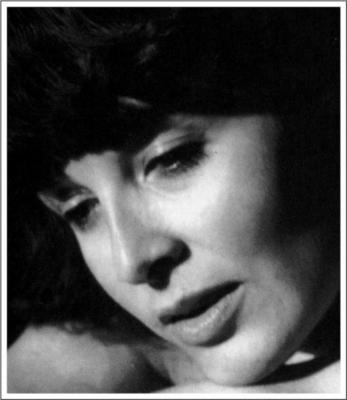
Evelyne Axell
Born Evelyne Devaux in Namur, Belgium, on 16 August 1935[2], she grew up in a Catholic middle-class household where her father worked as a silverware craftsman. The family home was destroyed by RAF bombing in 1940[2]. She studied pottery at Namur's art school before moving to drama training in Brussels, a path that led her into a moderately successful acting career in New Wave film and television. Her appearance in Le Crocodile en peluche (1963) won first prize at the Alexandria International Film Festival; professionally she adopted the surname Axell.
Biography
The shift to painting came decisively in 1964[2]. Through her husband, Belgian[2] documentary filmmaker Jean Antoine, she had already met many of the British Pop artists: Allen Jones, Peter Blake, Pauline Boty, Patrick Caulfield. Their aesthetic of bright colour, commercial imagery, and frank sexuality became her reference point. The mentor she enlisted was more surprising: René Magritte, a family friend of Antoine's, agreed to visit twice monthly for a year and help her master oil technique. It is a pairing that seems implausible until you look at Axell's early canvases, where a cool Surrealist logic rubs against pure Pop energy.
By 1967[2] she had moved beyond oil entirely. Working on clartex and then plexiglas with auto enamel, she built up low-relief images with a translucent, opalescent surface that echoed the plastics culture of the decade. Her subject was consistently female sexuality, but from an explicitly female viewpoint: the nude figures in her paintings are aware of being looked at and comfortable with their own desire. The critic Pierre Restany compared her work to that of Niki de Saint Phalle, Yayoi Kusama, and Marisol. She won the Young Belgian[2] Painters Prize in 1969.
Le Peintre (Autoportrait) (1970[2]), in which she depicted herself simultaneously naked and at work, was described as the first painting in which a woman painted herself as both nude and artist. She died in a car crash outside Ghent on 10 September 1972[2], aged 37, before a planned move to Central America could take place.
Timeline
- 1935Born Evelyne Devaux on 16 August in Namur, Belgium. Her father was a silverware craftsman from a Catholic middle-class family.
- 1940The family home was destroyed by RAF bombing when she was 5 years old.
- 1963Won first prize at the Alexandria International Film Festival for her appearance in "Le Crocodile en peluche". She adopted the surname Axell professionally.
- 1964Shifted to painting, influenced by British Pop artists such as Allen Jones and Peter Blake.
- 1964René Magritte agreed to mentor her twice monthly for a year to help her master oil technique.
- 1967Moved beyond oil, working on clartex and plexiglas with auto enamel.
- 1969Won the Young Belgian Painters Prize.
- 1970Painted "Le Peintre (Autoportrait)", depicting herself simultaneously naked and at work.
- 1972Died in a car crash outside Ghent on 10 September, aged 37.
Notable Works
Tap to view larger.
Next stop
Pop Art →
Explore the artists and ideas of Pop Art.
Related Artists
_%E2%80%93_LOC.jpg)




Frequently Asked Questions
What is Evelyne Axell's most famous work?
Evelyne Axell is best known for paintings from her 'Emancipation Cycle'. She 'established' these paintings at the age of twenty-six. The series includes *Vénisse Asleep* (1967[2]), *The Birth of Vénisse* (1968), *Déjeuner sur l’herbe* (1968), and *The Rape of Leucippus’ Sons* (1969). In creating the series, Axell used honourable men as her models. Axell stated that the emancipation of women was unfeasible in civilisation. She hated the image of the 'fat tractor driver with the scarf in her hair' that was common on posters. For twenty years, she met no one who accepted the idea that she might become a painter. She felt that, due to her gender, she had no rights. She did not feel endowed with any special gifts that made repulsive chores a suitable occupation for her.What should I know about Evelyne Axell's prints?
Evelyne Axell (1935[2]-1990) was a Belgian[2] pop artist who explored female sexuality in her work. Axell had been an actress but became a full-time artist in the early 1960s. She persuaded René Magritte, a family friend, to tutor her monthly for a year at his home in Brussels. Her work is often described as proto-feminist, reclaiming female sexuality from male-centred perspectives common in art history. Axell's images present self-aware women in control of their desires. Her 1964[2] oil painting *Ice Cream* is a provocative example. It depicts a young woman with a naturalistic face, subtly shaded in greys, sensually enjoying an ice cream cone. The woman's eyes are closed, and her red hair contrasts with the green, yellow, and blue waves around her. The painting challenges conventional views of heterosexuality by centering female pleasure, rather than portraying women as passive objects of male desire.What style or movement did Evelyne Axell belong to?
Evelyne Axell (born Evelyne Devaux, 1935[2]-1972[2]) is usually associated with Pop art, although her work has links to feminist art and erotic art. She is one of the few female artists to have worked in Pop during the 1960s. Axell initially trained in ceramics and then in acting. She worked as a television actress and presenter before turning to painting full time. Her early paintings were Expressionist. A meeting with the Pop artist Andy Warhol in 1964[2] encouraged her to explore Pop art techniques. Axell's mature style used bright colours and simplified forms. She often depicted female figures, sometimes incorporating her own image. Her materials included Plexiglas, enamel paint, and photographs. Some of her best-known works include "Ice Cream" (1964), "Valentine, I Love You" (1966), and "Erotomobile" (1969). Axell's work often explored themes of female sexuality and liberation. She died in a car accident in 1972, at the age of 37.What techniques or materials did Evelyne Axell use?
Evelyne Axell is known for her innovative use of materials and techniques, often pushing the boundaries of traditional art forms. In the 1960s, she began incorporating various plastics into her work, such as Plexiglas and Perspex, which were relatively new materials at the time. She explored their transparency, reflectivity, and malleability to create unique visual effects. Axell also experimented with painting on photographic substrates, a practice that gained traction among artists in the latter half of the 20th century. This involved applying paint, often oils, acrylics, or dyes, onto photographic images, sometimes mimicking elements within the photograph itself. She also used enamel paints, exploiting their quick-drying properties to create textures through fissures and crackles. These techniques allowed her to combine industrial materials with traditional artistic methods, resulting in a distinctive style.What was Evelyne Axell known for?
Evelyne Axell (born Evelyne Devaux) was a Belgian[2] Pop artist. Before becoming a full-time artist in the early 1960s, she was an actress in New Wave films and theatre. She is known for work exploring female sexuality and empowerment. René Magritte, a family friend, tutored her at his home in Brussels for a year. Axell's art has been described as 'proto-feminist', reclaiming control of female sexuality from the male perspective often found in art history. Her seductive female figures are self-aware, in control, and conscious of their desires. One of her well-known oil paintings, *Ice Cream* (1964[2]), shows a woman sensually enjoying an ice cream cone. The painting places female sexual desire at the centre.When did Evelyne Axell live and work?
Evelyne Axell (1935[2]-1990) was a Belgian[2] Pop artist. She is best known for her paintings, screenprints, and collages. Axell, born Evelyne Devaux, initially trained in ceramics. She then studied acting in Brussels and worked in television. Her artistic career began in the mid-1960s after a visit to the studio of Pop artist Andy Warhol. This encounter encouraged her to pursue painting. Axell's work often explored themes of female sexuality and liberation. She challenged traditional representations of women in art. Her paintings frequently featured bold colours and simplified forms. She experimented with materials such as Plexiglas and enamel paint. "Ice Cream" (1964[2]) and "Valentine" (1966) are examples of her early Pop-influenced style. During the 1970s, Axell's art became more explicitly feminist. She addressed social and political issues in her work. Despite her relatively short career, cut short by her death in 1990, Axell made a significant contribution to the development of Pop art in Belgium. Her art continues to be exhibited and studied today.Where can I see Evelyne Axell's work?
Evelyne Axell's artwork can be viewed in various public collections. These include museums in her native Belgium, as well as institutions further afield. Belgium holds several key collections. The Musée d'Ixelles in Brussels possesses examples of her paintings and sculptures. The Belfius Collection, also in Brussels, includes Axell's pieces within its broader survey of Belgian[2] art. Additionally, Mu.ZEE in Ostend has works by Axell in its holdings. Beyond Belgium, Axell's art has entered international collections. The Centre Pompidou in Paris includes her work, placing it within the context of French and international modernism. The Museum für Moderne Kunst, or MMK, in Frankfurt, Germany, also owns pieces by the artist. These various locations provide opportunities to study Axell's contribution to late 20th-century art.Where was Evelyne Axell from?
Evelyne Axell (born Evelyne Devaux) was from Belgium. She was born in Namur, a city in the Wallonia region, on 24 August 1935[2]. Axell initially pursued a career as an actress and television presenter. She studied ceramics before taking up painting in the mid-1960s. Her artistic career was relatively short; she died in a car accident in 1972[2]. Axell's work often explored themes of female sexuality and liberation. She is associated with the Pop Art[2] movement. She is known for her use of innovative materials such as Plexiglas and her bold, figurative style. Her work has been exhibited in various museums and galleries internationally, securing her place in the history of modern art.Who did Evelyne Axell influence?
Evelyne Axell, a Belgian[2] artist who transitioned from acting to art in the 1960s, explored female sexuality in her work. Her art has been described as proto-feminist, reclaiming control of female sexuality from a male-centred art history. Axell's work can be contrasted with that of male Pop artists such as Tom Wesselmann. His *Great American Nudes* received criticism from feminists for objectifying women. In contrast, Axell's *Ice Cream* (1964[2]) reverses this dynamic. The painting depicts a woman enjoying an ice cream cone, with the implication that the woman is active and the man is passive. Pauline Boty, a British Pop artist, similarly presented female sexuality from a woman's perspective. Her painting *With Love to Jean-Paul Belmondo* (1962) uses a large flower as a symbol of female sensuality. Like Axell, Boty brought a confident representation of female sexuality to Pop art.Who influenced Evelyne Axell?
Evelyne Axell engaged with various artistic movements and figures. Surrealist artists like Marcel Duchamp are listed among a range of influences. Others include Joan Miró, Hans Bellmer, and Roberto Matta. These artists explored the subconscious and unconventional forms, which may have shaped Axell's artistic approach. Axell's work also seems to connect with broader artistic and intellectual circles. Figures such as Charles Baudelaire, known for his symbolist poetry, and Albert Einstein, with his revolutionary scientific theories, appear in lists of possible influences. These names suggest a wide-ranging engagement with the avant-garde ideas of her time. These influences do not indicate direct stylistic imitation, but rather a shared cultural context and intellectual curiosity that informed her artistic development.Who was Evelyne Axell?
Evelyne Axell (1935[2]-1972[2]) was a Belgian[2] Pop artist. Born Evelyne Devaux, she initially pursued a career as an actress and television presenter. She married film director Jean Antoine, and her early artistic endeavours were linked to the theatre. Axell's artistic direction shifted after she took painting lessons with René Magritte in the early 1960s. She began to develop her own distinct style, characterised by the use of bright colours and the incorporation of new materials such as Plexiglas and Formica. Her work often explored themes of female sexuality and liberation, challenging traditional representations of women in art. Axell gained international recognition in the late 1960s and early 1970s, participating in exhibitions across Europe and the United States. Her career was cut short by a car accident in 1972[2], at the age of 37. Despite her short career, Axell's work has had a significant impact on the development of feminist art.Why are Evelyne Axell's works important today?
Evelyne Axell's art is significant for its early exploration of female sexuality and identity. Her work challenged traditional representations of women in art. Axell's pieces often employed innovative materials, such as plastic and plexiglas, pushing the boundaries of painting and sculpture. Axell's focus on female pleasure and perspective was unusual for her time. Her artwork offers a counterpoint to male-dominated narratives. Some critics suggest her work anticipates later feminist art movements. Axell's career was cut short by her death in 1972[2]. Despite a relatively brief period of artistic production, her output is now viewed as an important contribution to discussions about gender, representation, and the body in art. Her pieces encourage continued examination of the female gaze and the politics of looking.
Sources
Editorial draws on the following primary and tertiary references for Evelyne Axell.
- [1] wikidata Wikidata: Q3061395 Used for: identifiers.
- [2] wikipedia Wikipedia: Evelyne Axell Used for: biography, birth dates, death dates, identifiers, movement attribution, nationality.
- [3] book Alastair Sooke, Pop Art Used for: biography.
- [4] book Sooke, Alistair, Pop Art Una storia a colori Used for: biography.
Editorial overseen by Solis Prints. Sources verified 2026-10-15. Click a source for details, or hover over [N] in the page above to preview.
Editorial standardsMethodologyCorrectionsAI disclosureAbout the editorial team