



Enrique Silvestre
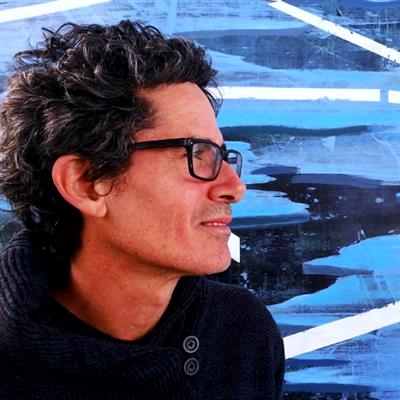
Born in Havana on 4 April 1966[3], Luis Enrique Silvestre Guerra trained at the Escuela Nacional de Bellas Artes San Alejandro before going on to study design at the Instituto Superior de Diseño in the Cuban capital. That rigorous formation shaped an artist with one foot in fine art and the other in graphic communication.
Biography
For eight years from 1987[3], Silvestre worked as a graphic designer and illustrator at Revista Bohemia, Cuba's long-running illustrated weekly. The magazine's visual language, steeped in commentary and Cuban idiosyncrasy, left a permanent mark on his sensibility. In 1999 he left the island and settled in São Paulo, Brazil, where he has since maintained his studio.
His paintings draw on memory: the colours, absurdities, and everyday texture of the Cuba he grew up in. Working across Naif, Pop Art, and Abstract Expressionist registers, he layers that autobiographical material with a lightness that keeps the work from nostalgia. Exhibitions at the Museu Nacional de Belas Artes in Rio de Janeiro, the Cuenca Biennial in Ecuador, Berini Gallery in Barcelona, and the Latin American Art Pavilion at Red Dot Fair in Miami have introduced his work to audiences across three continents.
Timeline
- 1966Born in Havana, Cuba on 4 April.
- 1987Began working as a graphic designer and illustrator at Revista Bohemia in Cuba.
- 1995Left Revista Bohemia after eight years of work.
- 1999Left Cuba and settled in São Paulo, Brazil, where he established his studio.
- 2000Exhibited at the Museu Nacional de Belas Artes in Rio de Janeiro.
- 2000Exhibited at the Cuenca Biennial in Ecuador.
- 2000Exhibited at Berini Gallery in Barcelona.
- 2000Exhibited at the Latin American Art Pavilion at Red Dot Fair in Miami.
Notable Works
Tap to view larger.
Next stop
Browse the movements →
Every movement in the collection, from the Renaissance to Pop art.
Related Artists



Frequently Asked Questions
What is Enrique Silvestre known for?
Enrique Silvestre is known for paintings that draw on his memories of growing up in Cuba. He settled in São Paulo, Brazil, in 1999[3] and has exhibited his work across three continents.What should I know about Enrique Silvestre's prints?
Enrique Silvestre is a contemporary Spanish[3] artist known for his printmaking. He was born in Valencia, where he continues to live and work. Silvestre's prints often feature bold, graphic shapes and a restricted colour palette. His compositions explore the interplay between positive and negative space, creating a sense of depth and movement. Silvestre frequently uses serigraphy (also known as silkscreen printing), a process that allows for precise registration of colours and sharp, clean lines. This technique suits his interest in geometric abstraction and minimalist aesthetics. His work often incorporates elements of collage, combining hand-drawn elements with photographic imagery. Silvestre's prints are characterised by a sense of controlled chaos, balancing careful planning with spontaneity. He has exhibited his prints in Spain and internationally, and his work is held in both public and private collections. Collectors are often drawn to his prints for their striking visual impact and their exploration of contemporary design principles.What style or movement did Enrique Silvestre belong to?
It is difficult to assign Enrique Silvestre to one specific movement. Styles and movements are retrospective labels, and artists' practices can change over time. Some passages discuss the importance of movement, gesture, and form, particularly serpentine lines, in creating beauty and grace. These concepts are linked to the analysis of beauty through action, and the idea that graceful movements can be acquired through practice. Other passages discuss the interplay between clothing and the body, where clothing is seen as an extension of the body's sensuality and form. This involves a stripping down of conventional styles to reveal the body's natural language and magnetism. The use of transparency and incorporeal materials allows the body to re-emerge, while colours are used to create a sense of vagueness and transition.What techniques or materials did Enrique Silvestre use?
Enrique Silvestre's artistic practice centres on construction, using objects and spaces to create environments, architectures, and sculptures. Clay plays a significant part in his work, connecting to the cultural and industrial origins of civilisation. Clay, sourced from riverbeds, combines earth and water, requiring air and fire for manipulation. Silvestre considers clay physical and metaphysical, allowing the human mind to fashion it into abstract schemas or concrete forms. Silvestre’s ceramic pieces relate to painting and architecture. His themes, such as architectures, monuments, and mesas, are conceived pictorially within a set frame. His materials, including sand, plaster, clay, and stoneware, correspond to themes of building or depiction of the world. Silvestre's vision combines diverse time frames, cultural codes, and visual vocabularies, creating unsettling effects. His work synthesises nature and culture, matter and mind, physics and metaphysics.What was Enrique Silvestre known for?
Enrique Silvestre was a painter of religious subjects, active in Seville during the Spanish[3] Counter-Reformation. His style has been described as tenebrist, similar to that of Herrera the Elder. This involved simple figures, sober colours, and thick paint application to convey solemnity. Settling in Seville around 1629, Silvestre became a leading artist in the area. He produced many altarpieces and fresco cycles for monasteries. Examples of his work include "The Death of St Bonaventura" (1629), "St Hugo of Grenoble in the Carthusian Refectory" (circa 1633), and "St Margaret" (circa 1630-1635[3]). He also painted devotional still lifes, such as "Still Life with Lemons, Oranges and Rose" (1633). In 1634, Silvestre was appointed "pintor del rey" (painter to the king). Later, he supplemented his income as an art dealer. By 1658, he had moved to Madrid and entered the Santiago Order. His work shows influences from various artists, including Caravaggio, Velazquez, El Greco, and Dürer.When did Enrique Silvestre live and work?
Enrique Silvestre was born in Valencia, Spain, in 1968[3]. He is a contemporary painter and printmaker, working primarily in abstract styles. Silvestre studied Fine Arts at the San Carlos School of Fine Arts, part of the Polytechnic University of Valencia. He completed his studies in 1992. During his time there, he was influenced by the Spanish[3] Informalism movement, a post-war style of abstraction. After graduating, Silvestre began exhibiting his work in galleries and art fairs across Spain. He gained recognition for his distinctive approach to abstraction, often incorporating elements of collage and mixed media. His prints frequently use bold colours and geometric shapes. Silvestre continues to live and work in Valencia. He is active in the Spanish art scene, participating in solo and group exhibitions. His work can be found in both public and private collections.Where can I see Enrique Silvestre's work?
You can view Art Deco works, possibly including pieces by Enrique Silvestre, in several museums internationally. In the United States, these include the Charles Hosmer Morse Museum of American Art (Winter Park, Florida), the Los Angeles County Museum of Art (Los Angeles), the Metropolitan Museum of Art (New York), the Minneapolis Institute of Arts (Minneapolis), the Museum of Modern Art (New York), the Virginia Museum of Fine Arts (Richmond), and the Wolfsonian at Florida International University (Miami Beach). In Canada, the Royal Ontario Museum (Toronto) holds relevant works. In the United Kingdom, visit the Bakelite Museum (Williton), the Brighton Museum & Art Gallery (Brighton), the Geffrye Museum (London), the Manchester Art Gallery (Manchester), the National Museums of Scotland, Royal Museum (Edinburgh), and the Victoria & Albert Museum (London). Other European museums with Art Deco holdings are the Museo Art Nouveau y Art Deco (Salamanca, Spain), the Museu Calouste Gulbenkian (Lisbon, Portugal), the Museu d’Art Modern (Barcelona, Spain), the Brangwyn Museum (Brugge, Belgium), the Clockarium Museum (Brussels, Belgium), the Musée d’Art et d’Industrie (Roubaix, France), the Musée de l’École de Nancy (Nancy, France), the Musée des Arts Décoratifs (Paris, France), and the Musée des Beaux-Arts (Nancy, France).Where was Enrique Silvestre from?
Enrique Silvestre settled in Seville in 1629, becoming a leading artist there. He produced many altarpieces and decorated a number of monasteries with extensive fresco cycles. In 1634, he was appointed “pintor del rey” (painter to the king). By 1658, he had moved to Madrid, where he entered the Santiago Order. His artistic style shows the influence of Caravaggio, Velazquez, El Greco, Cotán, Dürer, Raphael and Titian. His work included many pictures of saints at prayer and devotional still lifes. His tenebrist style, reminiscent of Herrera the Elder, used massively simple figures and objects, clear, sober colours and deep solemnity of feeling expressed in thickly applied paint. This approach made him an ideal painter of the austere religion of Spain. However, his fortunes declined with the rise of Murillo, and he was compelled to supplement his income by working as an art dealer.Who did Enrique Silvestre influence?
Enrique Silvestre's influence is most visible in the work of his students and collaborators. Though not a household name, Silvestre was a respected teacher. He encouraged a generation of artists to explore abstraction and experiment with new media. Silvestre's emphasis on geometric forms and bold colour palettes appears in the work of several Argentine artists who studied with him in the 1960s and 1970s. These include painters such as Roberto Aizenberg, who adopted Silvestre's interest in surrealism, and sculptors such as Alicia Penalba, who shared his preference for organic shapes. His studio became a hub for artistic exchange, attracting both established and emerging talents. Silvestre's impact extends beyond direct pupils to the broader art community in Buenos Aires. He helped to create an environment where innovation and experimentation were valued. This made a significant contribution to the development of abstract art in Argentina during the latter half of the 20th century.Who influenced Enrique Silvestre?
Enrique Silvestre's artistic development occurred in distinct phases, each marked by different influences. Initially, he absorbed the prevailing academic traditions of his training. This early period emphasised technical skill and historical subjects. Later, Silvestre encountered the work of Joaquín Sorolla. Sorolla's impressionistic approach, with its emphasis on light and colour, had a marked impact. Silvestre adopted a lighter palette and looser brushwork, moving away from the stricter academic style of his early training. Another important influence was Anders Zorn. Zorn's ability to capture fleeting moments and his virtuoso handling of paint inspired Silvestre to further develop his own technique. Silvestre's engagement with these artists helped him to forge a personal style that blended academic training with impressionistic and realist elements. The result was a body of work characterised by its technical skill and sensitivity to light and atmosphere.Why are Enrique Silvestre's works important today?
Enrique Silvestre's work is important because it engages with contemporary issues of Puerto Rican identity and cultural heritage. His art reflects a broader movement of reclaiming and reinterpreting Taíno symbols, particularly in the context of tourism and political expression. Taíno-themed crafts became popular in the 1990s, coinciding with increased cruise ship tourism and protests against the US Navy's presence on Vieques Island. These crafts, often featuring petroglyph designs, were sold as souvenirs and used to express Puerto Rican identity. Banners combining Taíno symbols and national flags appeared at artisan fairs, articulating a sense of shared heritage among politically diverse groups. Silvestre's art contributes to this ongoing dialogue about Puerto Rican identity, drawing on pre-colonial iconography to express cultural pride and resilience. By incorporating these symbols into his work, he participates in a larger effort to connect with the island's indigenous roots, a theme explored by artists and cultural figures.What was Enrique Silvestre's art style?
Enrique Silvestre's art style incorporates Naif, Pop Art, and Abstract Expressionist elements. He layers autobiographical material into his work.
Sources
Editorial draws on the following primary and tertiary references for Enrique Silvestre.
- [1] museum Harvard Art Museums Used for: museum holdings.
- [2] museum Art Institute of Chicago Used for: museum holdings.
- [3] wikipedia Wikipedia: Enrique Silvestre Used for: biography, birth dates, death dates, identifiers, movement attribution, nationality.
- [4] book Dorling Kindersley, Artists: Inspiring Stories of the World's Most Creative Minds Used for: biography.
- [5] book guggenheim-twopri00weis Used for: biography, stylistic analysis.
- [6] book Palmer, Allison Lee, Historical Dictionary of Neoclassical Art and Architecture Used for: biography.
- [7] book Masterpieces of western art : a history of art in 900 individual studies from the Gothic to the present day Used for: biography.
Editorial overseen by Solis Prints. Sources verified 2026-10-16. Click a source for details, or hover over [N] in the page above to preview.
Editorial standardsMethodologyCorrectionsAI disclosureAbout the editorial team