

Biography
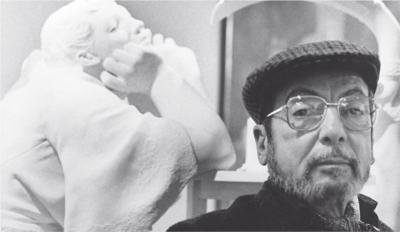
He studied at the Art Students League in New York in the early 1940s and later trained in etching and fresco in Italy, but his most formative education was the city he came from. His canvases return repeatedly to Afro-Colombian[1] and Amerindian figures placed within compressed, theatrical spaces alongside symbolic objects: masks, caged birds, eggs, fruit. The mood is observational but never documentary, the colour warm and declarative.
By the 1950s Grau had won the Salón de Artistas Colombianos (1957[1]) and was exhibiting internationally, including at the Guggenheim International Exhibition in New York in 1958. He was grouped, then and since, with Fernando Botero and Alejandro Obregón as the triumvirate that defined Colombian[1] art in the 20th century, though his approach was quieter than either: less distorted than Botero, less gestural than Obregón.
In his final years Grau donated around 1,300 works to Cartagena, providing the foundation for a Museum of Modern Art in the city that had shaped him. He died in Bogotá in April 2004[1].
Timeline
- 1920Born in Panama City. He grew up in Cartagena, Colombia.
- 1940Studied at the Art Students League in New York in the early 1940s.
- 1957Won the Salón de Artistas Colombianos.
- 1958Exhibited at the Guggenheim International Exhibition in New York.
- 2004Died in Bogotá in April, at 84.
Next stop
Browse the movements →
Every movement in the collection, from the Renaissance to Pop art.
Related Artists


Frequently Asked Questions
What is Enrique Grau known for?
Enrique Grau is known for his paintings that repeatedly return to Afro-Colombian[1] and Amerindian figures. These figures are placed within theatrical spaces alongside symbolic objects such as masks, caged birds, eggs, and fruit.What should I know about Enrique Grau's prints?
Enrique Grau created prints in collaboration with workshops in the United States and Europe. These included Universal Limited Art Editions, Graphicstudio/University of South Florida, Gemini GEL, and Tyler Graphics Ltd. Each workshop had its own character and specialities. Gemini GEL, for example, was known for its embrace of technology, use of new materials, and creation of series of works. Tyler Graphics developed handmade paper, something that Rosenquist used in the 1990s. Printmaking has a long history; early examples include impressions made from seals or stamps in ancient Egypt and China. As paper became available in Europe at the end of the fourteenth century, printmaking began to flourish. Woodcuts were used for book illustration, religious icons, and playing cards. By the late nineteenth century, prints came to be viewed as a major artistic medium, and artists began to sign their prints, distinguishing them from commercial reproductions. Prints allowed artists to reach a wider audience, as they could be produced in greater quantities and at a lower cost than other art forms.What style or movement did Enrique Grau belong to?
It is difficult to assign Enrique Grau to one specific movement. His work contains elements of several styles, and he moved between them, rather than adhering to a single school. Some scholars place Grau within a Neo-Baroque context. This is related to the Baroque style, which originated in the late Renaissance. Baroque art moved away from the classical traits of the late Renaissance, while retaining some formal ideals of Mannerism. Another way to consider Grau's art is through the lens of Art Informel. This movement, which translates from French as 'without form', emerged in the 1950s. Artists working in this style sought a new visual language, abandoning recognisable forms and inventing shapes through improvisation. Art Informel is a broad label, encompassing both figurative and non-figurative painters, and its influence extended across Europe.When did Enrique Grau live and work?
Enrique Grau was born in Panama in 1920[1]. He spent much of his life in Colombia, where he is considered one of the most important artists of the 20th century. Grau studied art at the Art Students League of New York in the 1940s. He then travelled in Europe, studying the Old Masters. He returned to Colombia in the 1950s and began to develop his own distinctive style. Grau's work often featured figures from Colombian[1] history and culture, as well as images of women and nature. He worked in a variety of media, including painting, sculpture, and printmaking. Grau's work has been exhibited extensively in Colombia and internationally. He died in Bogotá in 2004[1].Where can I see Enrique Grau's work?
Enrique Grau's works appear in many public collections and museums. These include the Minneapolis Institute of Arts (in Minnesota), the Museum of Modern Art (in New York), and the Royal Ontario Museum (in Toronto). Others are the Los Angeles County Museum of Art (LACMA), the Metropolitan Museum of Art (in New York), the Virginia Museum of Fine Arts (in Richmond), and the Wolfsonian at Florida International University (in Miami Beach). European locations holding Grau's art include the Brighton Museum & Art Gallery (in the UK), the Geffrye Museum (in London), the Manchester Art Gallery (in the UK), the National Museums of Scotland Royal Museum (in Edinburgh), and the Victoria & Albert Museum (in London).Who did Enrique Grau influence?
It is difficult to name specific artists who were directly influenced by Enrique Grau. The art world has become pluralistic, making it nearly impossible for one artist to dominate a significant group. However, it is possible to analyse Grau's position in relation to other artists and movements. Some scholars suggest that the newest trends in art were foreshadowed in earlier experiments by Pablo Picasso. Movements such as arte povera and art brut can be seen as tributaries of Picasso’s use of detritus and childlike imagery. Similarly, nouveaux réalisme, Europe’s version of Pop art, employed ordinary commercial objects, a technique Picasso also used. Juan Gris's early Cubist paintings derived from Picasso's work of 1909. Gris saw the essential features of the style most clearly stated in Picasso's work of this period. His L'Homme a la Pipe shows a visual influence, with the division of the forehead and treatment of the eyes reflecting Picasso's Horta de San Juan figure work. The Portrait of Picasso, painted later, uses a similar technique of combining different views of the head, reminiscent of Picasso's Baigneuse of 1909.Who influenced Enrique Grau?
Enrique Grau's artistic development involved several influences. In Caracas, a cubist still life by Braque greatly impressed him. Grau sought information about the work, which led him to study cubism and Picasso's work. He also explored Cézanne and van Gogh. Although briefly drawn to Gauguin's colours, Grau was ultimately unconvinced by his symbolic approach. Later, Soto recalled being interested in the Bauhaus spirit and Klee's works exploring perspective from various viewpoints. He appreciated Klee's depth, viewing it as a cathedral. Soto discovered Albers's work with difficulty but was able to view his paintings at the Galerie Denise René. He also discussed art with friends. Soto wanted to add dynamism to Mondrian's works, but he realised Mondrian had already addressed that issue in Broadway Boogie-Woogie. Moholy-Nagy, Calder, Marcel Duchamp, and Gabo also influenced his artistic direction.Who was Enrique Grau?
Enrique Grau Araujo (1920[1]-2004[1]) was a Colombian[1] artist. Born in Cartagena, he resided in Bogota. Grau studied at the School of Fine Arts in Cali, Colombia. He also worked with Jorge Oteira in Popayan and Madrid. In 1949[1], he studied metalwork at the New York Sculpture Center in the United States. Between 1951 and 1955, Grau travelled in Europe, visiting Paris and Madrid. His first solo exhibition took place in 1943 at the Conservatoire de Cali. In 1958, he received a grant from UNESCO to study Indian art in North America. Grau's work, "Still Life with Sun and Moons", was exhibited in 1958. He also created "Tower No. 2" (1965-66), a polychromed aluminium sculpture.Why are Enrique Grau's works important today?
Enrique Grau (1920[1]-2004[1]) was a Colombian[1] artist known for his figurative paintings and sculptures. Grau's work often explored themes of identity, culture, and the human condition, which continue to resonate with audiences today. Grau's artistic approach involved a synthesis of different styles and influences. He incorporated elements of Surrealism, Expressionism, and Latin American folk art into his creations. This fusion resulted in a distinctive visual language that set him apart from his contemporaries. His images leave a trace, an attempt to achieve some kind of immortality. His focus on personal and national identity, as well as anthropology, are also of continued interest. Grau's art provides insights into the complexities of Colombian society and its relationship to the wider world. By addressing these subjects, his work encourages reflection on our shared humanity.What was Enrique Grau's art style?
Grau's art style is observational but never documentary, with warm and declarative colour. His approach was quieter than that of Fernando Botero or Alejandro Obregón: less distorted than Botero, less gestural than Obregón.How did Enrique Grau die?
Enrique Grau died in 2004[1] at the age of 84.
Sources
Editorial draws on the following primary and tertiary references for Enrique Grau.
- [1] wikipedia Wikipedia: Enrique Grau Used for: biography, birth dates, death dates, identifiers, movement attribution, nationality.
- [2] book Beard, Lee, 1973- author, Butler, Adam, author; Van Cleave, Claire, author; Fortenberry, Diane, author; Stirling, Susan, author, Beard, Lee, 1973- author, Butler, Adam, author; Van Cleave, Claire, author; Fortenberry, Diane, author; Stirling, Susan, author - The Art Book_ New Edition, Mini Format Used for: biography.
- [3] book guggenheim-twopri00weis Used for: biography, stylistic analysis.
- [4] book Masterpieces of western art : a history of art in 900 individual studies from the Gothic to the present day Used for: biography.
Editorial overseen by Solis Prints. Sources verified 2026-09-30. Click a source for details, or hover over [N] in the page above to preview.
Editorial standardsMethodologyCorrectionsAI disclosureAbout the editorial team