



Emil Hünten
- history painting
Born in Paris in 1827[1] to the German[1] composer Franz Hünten, Emil Hünten grew up between two cultures and trained at the highest level in both. He studied at the École des Beaux Arts under Hippolyte Flandrin and Horace Vernet, then moved to Antwerp to work under Gustaf Wappers, before settling in Düsseldorf in 1851[1] where he spent the rest of his career. The city's rigorous tradition of history painting[1] gave him both a discipline and an audience.
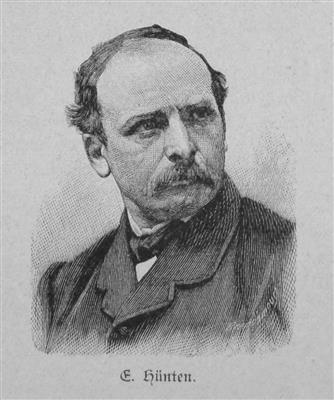
Biography
Hünten became the foremost German[1] battle painter of his generation, and he earned the distinction through proximity rather than imagination alone. He accompanied Prussian forces into three successive campaigns: the Schleswig-Holstein war of 1864[1], the Austro-Prussian War of 1866, and the Franco-Prussian War of 1870. Working from direct observation, his sketches ran to over a thousand drawings across 24 field notebooks, now held at Düsseldorf's Museum Kunst Palast. Those notebooks became the raw material for some of the largest history paintings produced in nineteenth-century Germany.
His most ambitious works include the panorama-scale depiction of the Battle of St. Privat and the monumental canvas of the Battle of Mars-La-Tour, both painted from first-hand documentation of the 1870[1] campaign. Otto von Bismarck was among his patrons. He won medals at Berlin in 1872 and Vienna in 1873 and was elected to the Berlin Academy in 1878.
Hünten's influence extended beyond canvas. Theodor Fontane drew on his imagery in literary accounts of the Franco-Prussian War, and English military painter Ernest Crofts, who brought a similar documentary rigour to British audiences, credited Hünten as a direct influence. He died in Düsseldorf in 1902[1].
Timeline
- 1827Born in Paris to Franz Hünten, a German composer.
- 1851Settled in Düsseldorf, where he spent the rest of his career.
- 1864Accompanied Prussian forces in the Schleswig-Holstein war.
- 1866Accompanied Prussian forces in the Austro-Prussian War.
- 1870Accompanied Prussian forces in the Franco-Prussian War.
- 1870Painted a panorama-scale depiction of the Battle of St. Privat.
- 1870Painted a monumental canvas of the Battle of Mars-La-Tour.
- 1872Won a medal at Berlin.
- 1873Won a medal at Vienna.
- 1878Elected to the Berlin Academy.
- 1902Died in Düsseldorf.
Notable Works
Tap to view larger.
Next stop
Browse the movements →
Every movement in the collection, from the Renaissance to Pop art.
Related Artists

Frequently Asked Questions
What is Emil Hünten known for?
Emil Hünten is known as the foremost German[1] battle painter of his generation. He accompanied Prussian forces into three wars and used his direct observations to create large history paintings.What is Emil Hünten's most famous work?
It is difficult to name one single work as Emil Hünten's most famous. He was a painter of military subjects and genre scenes, active in both Germany and Italy. Few of his works are widely known today. He was associated with the Düsseldorf school of painting. His paintings often depicted scenes from military life, battles, and historical events. Hünten gained recognition for his attention to detail and his ability to capture the drama and movement of battle scenes. He also produced genre paintings, which portrayed scenes from everyday life, often with a focus on Italian subjects. These paintings reflect his time spent in Italy. Without more information, it is impossible to identify one particular painting as his 'most famous'.What should I know about Emil Hünten's prints?
Emil Hünten was active during a period when printmaking gained importance as a medium for artistic expression. Printmaking in Germany during the early part of the 20th century saw artists treating the form as a direct, symbolic language. Many artists associated with Expressionism, such as Erich Heckel, Karl Schmidt-Rottluff, and Max Pechstein, embraced printmaking, sometimes printing and publishing their own work. The woodcut form influenced their style in painting, with the flatness and angularity of the prints informing their treatment of form. Collecting prints from this era requires a different approach. Collectors should focus on the artistic content, rather than rarity or technical variations. The prints were intended for a broad audience, not just private collections. The goal was to spread ideas widely, with the print acting as a message to the people.What style or movement did Emil Hünten belong to?
It is difficult to assign Emil Hünten to a single style. The art-historical literature uses terms such as 'humanistic Impressionism' or 'Northern art' to describe related artists. These terms refer less to a school and more to an artist's attention to the natural world, or to psychological interactions among figures in a painting. Some scholars differentiate 'Northern' art from the Italian manner. They describe 'Northern' art as being concerned with 'mood' (Stimmung), and with the atmospheric unity of a painting. This contrasts with Italian art, where action is the result of will. In 'Northern' art, emotion and attentiveness take precedence. Paintings of this type invite the viewer to find movement in the composition.What techniques or materials did Emil Hünten use?
Emil Hünten's artistic techniques involved a combination of traditional methods and personal innovations. In glass painting, artists often applied washes to the verso, the side facing outwards when mounted. Silver stain was favoured for its colour and transparency, achieving tones from lemon to golden yellow depending on application thickness. The building up of paint layers required specific consistencies, alternating watery binders (such as water, gum, vinegar, or wine) with oily substances. Glass paints consisted of pulverised glass with metal oxides, diluted with a binder. The granular structure of these paints demanded extensive grinding with a muller for smooth application. Artists used tracers for opaque contours and blunt brushes for translucent strokes. Additives like egg, honey, syrup, or borax improved paintability, though they could decrease resistance to humidity. By the late fifteenth century, glass-painting colours in tones of brown (to red) and white (to grey) became prominent. Sanguine, ranging from matt brown to flesh colour, was used extensively.What was Emil Hünten known for?
Emil Hünten was a German[1] artist known for historical genre painting. This form of painting became popular in Belgium, after the 1831[1] break with the Kingdom of the United Netherlands. This separation caused painters Louis Gallait and Edouard de Biéfve to reflect on history and culture. They created patriotic history paintings in a grand style. These paintings depicted the struggle for liberation from Spanish rule in the 16th century. They were regarded as portrayals of bourgeois rule because of their realism. When the Belgian paintings were exhibited in Germany in 1845, they marked the end of Neoclassicist historical painting. Historical genre painting uses colour accents to emphasise the presentation of materiality. These "accidents of history" appealed to the viewer's empathy. The world is divided into good and bad, noble and ignoble, and fate is merciless. The moralistic claims of Neoclassicism survived at the level of a historical novel, relating patriotic legends.When did Emil Hünten live and work?
Emil Hünten (1827[1]-1902[1]) was a German[1] painter, primarily known for military scenes. He was the son of the painter Franz Hünten (1793-1878[1]). Born in Paris, Hünten studied at the Düsseldorf Academy. There, he was a student of Wilhelm Schirmer and Wilhelm Camphausen. Camphausen, in particular, influenced Hünten's focus on military subjects. Hünten's career developed during a period of significant military conflict in Europe. He volunteered for military service in 1866[1], during the Austro-Prussian War. He also served in the Franco-Prussian War of 1870-71; this experience informed many of his paintings. His artwork often depicted battles and military life. He is associated with the Düsseldorf school of painting. Hünten died in Düsseldorf in 1902, leaving behind a body of work that reflects the military history of his time.Where can I see Emil Hünten's work?
Emil Hünten's work can be found in numerous public collections and museums, primarily in Germany and the United States. In Germany, notable locations include the Nationalgalerie and Kupferstichkabinett (both in Berlin), the Kunsthalle in Bremen, the Hamburger Kunsthalle, the Sprengel Museum in Hannover, the Staatliche Kunsthalle in Karlsruhe, Museum Ludwig in Cologne, Museum Folkwang in Essen, and the Städtische Galerie im Städelschen Kunstinstitut in Frankfurt am Main. Works are also held in Munich, at the Bayerische Staatsbibliothek and the Staatliche Graphische Sammlung. Outside of Germany, Hünten's art can be viewed at the Kunstmuseum in Basel, Switzerland, and in several US institutions. These include the University of Michigan Museum of Art in Ann Arbor, the Indiana University Art Museum in Bloomington, the Museum of Fine Arts in Boston, the Art Institute of Chicago, the Detroit Institute of Arts, the Minneapolis Institute of Arts, the North Carolina Museum of Art in Raleigh, the Saint Louis Art Museum, the Pierpont Morgan Library and the Museum of Modern Art in New York, and the National Gallery of Art and the Library of Congress in Washington, DC.Where was Emil Hünten from?
Emil Nolde, originally Emil Hansen, was born in 1867[1] in North Schleswig, near Nolde, Germany. This area corresponds to modern-day North Frisia, now part of Germany, but historically a contested border region between Germany and Denmark. He began his career as an ornamental carver, working in various furniture factories. Later, he studied art in Munich and Paris. Nolde eventually settled on the island of Alsen in 1903, after periods spent in Copenhagen, Berlin, and Flensburg. His connection to his homeland is apparent in his art. One painting, Young Horses (1916), is thought to represent the flat, open countryside of Schleswig-Holstein. The patterns of light and dark, windswept clouds evoke the region's atmosphere. Despite his support for the Nazi regime, Nolde's paintings were confiscated in 1937, and he was forbidden to paint. He continued to create art in secret and lived in Germany until his death in Seebüll in 1956.Who did Emil Hünten influence?
It is difficult to identify specific artists directly influenced by Emil Hünten. Research indicates that the artistic environment of the time saw various artists absorbing and reinterpreting Impressionistic ideas, particularly those of Claude Monet. For instance, Theodor von Hörmann systematically studied the effects of light on a single subject, much like Monet. Emilie Mediz-Pelikan also methodically tracked atmospheric changes in her paintings of Stein in winter. Rudolf Junk's paintings of Lake Attersee show buildings dissolving into contours, reminiscent of Monet's Houses of Parliament series. Oskar Kokoschka's Dresden series also suggests an awareness of Monet's London paintings. These artists, along with Max Suppantschitsch and Franz Jaschke, explored similar themes and techniques, such as city bridges and the impact of different seasons on the same motif. They adopted Monet's focus on atmospheric effects and incorporated Impressionistic brushstrokes to increase luminosity. However, it is not explicit that Hünten directly influenced these artists.Who influenced Emil Hünten?
Emil Hünten's influences are not well documented in the provided texts, so a detailed answer is difficult. However, one passage mentions the influences on Hans Hofmann, Krasner’s art tutor, whom Pollock met in 1942. Hofmann asked Pollock if he worked from nature; Pollock replied that he was nature. The two men then began a close friendship. Hofmann was a pioneering artist and teacher who brought modern European art ideas to the United States when he emigrated there in 1930. His painting style combined different approaches, including elements of Cubism, the energy of Expressionism, Surrealist psychology and Fauvist colour. Although his work seemed abstract, he always maintained links to the natural world. Hofmann experimented with oscillation, a technique developed by Max Ernst. He also spent the summer of 1933 watching Diego Rivera paint the Rockefeller Center. He was part of the Abstract Expressionist movement, which is heavily indebted to the ideas of Wassily Kandinsky. It is unknown if Hünten was directly influenced by these artists.
Sources
Editorial draws on the following primary and tertiary references for Emil Hünten.
- [1] wikipedia Wikipedia: Emil Hünten Used for: biography, birth dates, death dates, identifiers, movement attribution, nationality.
- [2] book guggenheim-metph00cela Used for: biography.
- [3] book guggenheim-roylich00wald Used for: stylistic analysis.
- [4] book Husslein-Arco, Agnes, editor; Koja, Stephan, editor; Law, Rebecca (Translator), translator; McInnes, Robert (Translator), translator; Somers, Nick, translator; Monet, Claude, 1840-1926. Paintings. Selections; Österreichische Galerie Belvedere, h Used for: biography.
- [5] book Museum of Fine Arts, Houston, Italian paintings XIV-XVI centuries in the Museum of Fine Arts, Houston Used for: biography, stylistic analysis.
- [6] book Masterpieces of western art : a history of art in 900 individual studies from the Gothic to the present day Used for: biography.
- [7] book Blunt, Anthony, 1907-1983, Roman Baroque Used for: biography.
Editorial overseen by Solis Prints. Sources verified 2026-08-26. Click a source for details, or hover over [N] in the page above to preview.
Editorial standardsMethodologyCorrectionsAI disclosureAbout the editorial team