



Alexandre-Louis Leloir
- history painting
- genre painting
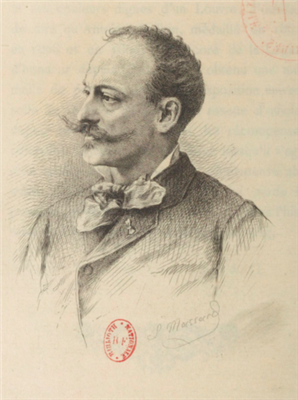
Alexandre-Louis Leloir never had the time his talent warranted. Dead at forty, in 1884[1], he left behind a body of work spanning medieval genre scenes, Orientalist compositions, and muscular biblical narratives that placed him among the leading academic painters of his generation. He won the Second Grand Prix de Rome not once but twice: in 1861[1] for The Death of Priam and again in 1864 for Homer on the Island of Scyros, a record of early-career distinction rare even at the École des Beaux-Arts.
Biography
Born in Paris in 1843[1] into one of France's most artistically connected families, Leloir absorbed painting from childhood. His father Auguste was a painter, his mother Héloïse Colin a celebrated fashion illustrator, and his grandfather Alexandre-Marie Colin had studied under Girodet. His younger brother Maurice became a distinguished painter and costume historian in his own right.
Leloir made his Salon debut in 1863[1] with The Massacre of the Innocents, establishing the dramatic register that would define his career: large-scale, theatrically lit, and unafraid of violence. A Medal at the Paris Exposition of 1878 followed his appointment as Chevalier of the Légion d'Honneur in 1876. He co-founded the Société des Aquarellistes Français in 1879, bringing the same discipline he applied to oils to the more demanding medium of watercolour. Works are held by the Metropolitan Museum of Art in New York and the Unterlinden Museum in Colmar.
Timeline
- 1843Born in Paris, France
- 1861Won Second Grand Prix de Rome for 'The Death of Priam'
- 1863Salon debut with 'The Massacre of the Innocents'
- 1864Won Second Grand Prix de Rome for 'Homer on the Island of Scyros'
- 1876Appointed Chevalier of the Légion d'Honneur
- 1878Awarded a Medal at the Paris Exposition
- 1879Co-founded the Société des Aquarellistes Français
- 1884Died in 1884 at the age of 40
Notable Works
Tap to view larger.
Next stop
Browse the movements →
Every movement in the collection, from the Renaissance to Pop art.
Related Artists


Frequently Asked Questions
What is Alexandre-Louis Leloir known for?
Alexandre-Louis Leloir is known for his medieval genre scenes, Orientalist compositions, and biblical narratives. He was among the leading academic painters of his generation and co-founded the Société des Aquarellistes Français in 1879[1].What style or movement did Alexandre-Louis Leloir belong to?
Alexandre-Louis Leloir was active during a period of change in French[1] art. Genre painting, which depended on the art market, began to disregard academic rules. History painting was considered the highest category within academic circles. The mid-19th century saw a division between art that appealed to the middle classes and art appreciated by intellectuals. Some artists, such as Delaroche and Meissonier, painted historical genre scenes, combining colouristic skill with detailed historical settings. These paintings often depicted scenes from the 17th and 18th centuries, with figures in costume engaged in everyday activities like games or music. This style, sometimes called anecdotal, became popular with the bourgeois public. Critics, however, questioned its artistic merit, finding it superficial. The focus on meticulously accurate archaeological settings sometimes overshadowed the heroic impact of the subject matter. This period also saw the rise of Realism, with artists like Courbet challenging conventional notions of beauty and subject matter.What techniques or materials did Alexandre-Louis Leloir use?
Alexandre-Louis Leloir was a French[1] painter and illustrator working in the 19th century. Information about his specific techniques is scarce, but some context can be provided. During the 1800s, French painters typically followed a defined sequence. After preparatory drawings, the composition was outlined on canvas. Modelling was indicated, often using a reddish-brown "sauce". Local colour, light, and shade were then applied. This initial sketch was elaborated upon using a full range of tones. The final stage refined this process. Artists at this time purchased ready-made materials from colour merchants. These merchants sold a complete range of items, including supports, frames, brushes, drawing materials, paper, palettes, and easels. Experimentation with painting methods was common. Some artists explored painting on glass, or painting with oil under water.What was Alexandre-Louis Leloir known for?
Alexandre-Louis Leloir (1843[1]-1884[1]) was a French[1] painter and illustrator known for genre scenes and historical subjects. Genre painting gained popularity as academic rules were disregarded in favour of appealing to the art market. Leloir's work often featured detailed depictions of everyday life, sometimes with an emphasis on historical accuracy. This style, called "historical genre painting[1]", originated in Belgium, where painters reflected on history and culture. These paintings portrayed bourgeois rule and appealed in their realism. These genre paintings often highlighted the presentation of materiality and appealed to the viewer's empathy. The world was divided into good and bad, noble and ignoble, and fate was merciless. Although popular with the public, some critics questioned the dignity of this superficiality.When did Alexandre-Louis Leloir live and work?
Alexandre-Louis Leloir was born in Paris in 1843[1]. He came from an artistic family; his father, Auguste Leloir, was a painter, and his brother, Maurice Leloir, was an illustrator and watercolourist. Leloir trained under his father, and at the École des Beaux-Arts in Paris. He began exhibiting at the Salon in 1864[1], gaining recognition for his genre scenes and historical paintings. He received a third-class medal in 1866, and a second-class medal in 1868. During the Franco-Prussian War (1870-1871[1]), many artists fled Paris. The conflict and subsequent Paris Commune affected numerous painters, such as Renoir, who enlisted in the cavalry, and Pissarro, who fled to London with his family. Leloir appears to have remained in France. Leloir continued to exhibit at the Salon throughout his career, also producing illustrations for books and magazines. He died in Paris in 1884[1].Where can I see Alexandre-Louis Leloir's work?
Alexandre-Louis Leloir's art can be viewed in several museums. In France, his work is held at the Musée du Louvre, Musée d’Orsay, Musée des Arts Decoratifs, and Musée du Petit Palais; all are located in Paris. Other French[1] museums that hold his work include the Musée des Beaux-Arts in Nantes, the Musée des Beaux-Arts in Reims, and the Musée des Beaux-Arts in Rouen. These are located outside of Paris. Leloir's work can also be seen at the Musée des Beaux-Arts in Besançon, the Musée des Beaux-Arts in Dijon, the Musée de la Chartreuse in Douai, the Musée de Peinture et de Sculpture in Grenoble, the Musée Crozatier in Le Puy, the Musée des Beaux-Arts in Lille, the Musée de in Moulins, the Musée des Beaux-Arts in Nancy, the Musée des Beaux-Arts Jules Cheret in Nice, the Musée Matisse in Nice, the Musée des Beaux-Arts in Orleans, the Musée Saint-Denis in Reims, the Musée des Beaux-Arts in Rennes, the Musée d’Art et d’lndustrie in Saint Etienne, the Musée du Prieure in Saint Germain-en-Laye, the Musée de l’Annonciade in Saint Tropez, the Musée du Haubergier in Senlis, the Musée d’Art Moderne in Strasbourg and the Musée des Augustins in Toulouse.Who did Alexandre-Louis Leloir influence?
Alexandre-Louis Leloir does not appear to have had a direct, documentable influence on later artists, in the sense of heading a school or workshop. More generally, the study of artistic influence involves searching for "traces, quotations and manipulations". Creators respond to the art of their predecessors; the dead return to life in the work of later artists, critics, poets and historians. The material representing those influences and appropriations has not been exhausted, and each chapter opens up new and tempting perspectives. Influence is not limited to easily discernible similarity or borrowing. Some masters fostered new methods and original talent, remaining unconvinced that directing students towards a prize was the best way to produce good artists.Who influenced Alexandre-Louis Leloir?
Leonardo da Vinci was an important influence. In 1469, at the age of fifteen, Leloir became an apprentice in the studio of Andrea del Verrocchio in Florence. The studio also included Perugino, who was slightly older. Leonardo was seven years younger than Leloir, but Leonardo's impact on the young artist was considerable. It is said that Leloir imitated Leonardo's manner so well that it was difficult to distinguish the copy from the original. Leloir was also influenced by Lorenzo di Credi, another fellow student in Verrocchio’s studio. It is possible that Leloir also met Sandro Botticelli there. Leonardo mentioned Botticelli in his writings, referring to him as “il nostro Botticelli.”Why are Alexandre-Louis Leloir's works important today?
Alexandre-Louis Leloir, a French[1] painter and illustrator of the 19th century, is remembered today because his works represent a particular moment in French artistic history. While some artists fade into obscurity, Leloir's art maintains interest, though its significance may vary in intensity over time. Leloir's paintings and illustrations offer insight into the artistic tastes and cultural values of his era. His work reflects the influences of academic training and popular trends in subject matter, such as genre scenes and historical narratives. The continued appreciation of an artist like Leloir is often sustained through the efforts of scholars, critics, and other artists who reference or reinterpret their work. Even negative critiques can contribute to keeping an artist's name alive in cultural memory. The presence of his works in museum collections and auction houses also helps to maintain his visibility.What was Alexandre-Louis Leloir's art style?
Alexandre-Louis Leloir's art style was dramatic, large-scale, and unafraid of violence. He brought the same discipline he applied to oils to the more demanding medium of watercolour.How did Alexandre-Louis Leloir die?
Alexandre-Louis Leloir died in 1884[1] at the age of 41.
Sources
Editorial draws on the following primary and tertiary references for Alexandre-Louis Leloir.
- [1] wikipedia Wikipedia: Alexandre-Louis Leloir Used for: biography, birth dates, death dates, identifiers, movement attribution, nationality.
- [2] book Harding, James, Artistes pompiers : French academic art in the 19th century Used for: biography.
Editorial overseen by Solis Prints. Sources verified 2026-09-30. Click a source for details, or hover over [N] in the page above to preview.
Editorial standardsMethodologyCorrectionsAI disclosureAbout the editorial team