



Elin Danielson-Gambogi
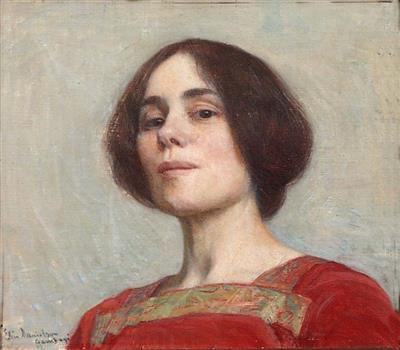
Elin Danielson-Gambogi's career began in grief. Her father took his own life after the Finnish famine of 1866[1]–68 destroyed the family farm, and she was sent to Helsinki at fifteen to make her own way. She studied at the Academy of Fine Arts, won a grant to Paris in 1883, and enrolled at the Académie Colarossi under Gustave Courtois, spending summers painting in Brittany. The experience placed her among the first professionally trained generation of Finnish women artists, alongside Helene Schjerfbeck and Maria Wiik.
Biography
Her subject matter was domestic and rural, but her treatment of it was frequently direct enough to cause offence. Women at labour, women nursing, women in states of undress or exhaustion, the everyday rendered without sentimentality. Her *Portrait of Hilma Westerholm* (1888[1]) won a bronze medal at the 1889 Paris Exposition Universelle; she received a second bronze at the 1900 Exposition. King Umberto I of Italy purchased one of her paintings in 1899, the year she exhibited at the Venice Biennale.
In 1895[1] a scholarship took her to Florence, and she settled permanently in Antignano, near Livorno. She married the Italian painter Raffaello Gambogi in 1898. The First World War severed her connections to Finland and she died there, largely forgotten, from pneumonia on the last day of 1919[1]. Rediscovery came slowly: at Christie's in December 2023, *Sunset over a Lake* sold for £88,200, suggesting the market has finally caught up with the critical reassessment underway since her 2018 inclusion in the exhibition *Women in Paris 1850–1900[1]*.
Timeline
- 1861Born Elin Danielson in Finland.
- 1868Her father died by suicide after the Finnish famine.
- 1876At 15, Danielson-Gambogi moved to Helsinki to support herself.
- 1883She won a grant to study in Paris and enrolled at the Académie Colarossi.
- 1888Danielson-Gambogi painted "Portrait of Hilma Westerholm".
- 1889"Portrait of Hilma Westerholm" won a bronze medal at the Paris Exposition Universelle.
- 1895A scholarship took her to Florence; she settled in Antignano, near Livorno.
- 1898She married the Italian painter Raffaello Gambogi.
- 1899King Umberto I of Italy purchased one of her paintings; she exhibited at the Venice Biennale.
- 1900She received a second bronze medal at the Paris Exposition.
- 1919Danielson-Gambogi died of pneumonia in Italy at 58.
Notable Works
Tap to view larger.
Next stop
Realism →
Explore the artists and ideas of Realism.
Related Artists


Frequently Asked Questions
What is Elin Danielson-Gambogi known for?
Elin Danielson-Gambogi is known for her domestic and rural subject matter, which often depicted women at labour, nursing, or in states of undress. Her direct treatment of these subjects sometimes caused offence during her time.What is Elin Danielson-Gambogi's most famous work?
Danielson-Gambogi's best-known work is *Summer Day at Anttila* (1890[1]), also known as *Finnish Summer*. It depicts a young woman sitting in a punt, holding a scythe, in a rural setting. The painting is a study of light and shadow, and it captures the atmosphere of a summer day in Finland. Danielson-Gambogi painted it while living at the Anttila farm in Finland. She spent several summers there, and the area provided inspiration for many of her works. *Summer Day at Anttila* is one of her most realistic pieces. It shows her skill in capturing the details of the natural world. The work is significant because it offers a view into Finnish rural life during the late 19th century. It also demonstrates Danielson-Gambogi's talent as a painter, particularly in her use of colour and light. The painting is now part of the collection of the Turku Art Museum.What was Elin Danielson-Gambogi known for?
Elin Danielson-Gambogi was a Finnish artist working in the late 19th and early 20th centuries. She is associated with Realism[1], a movement that emerged in the mid-19th century, partly as a reaction against Romanticism and Neoclassicism. Realist artists sought to depict the world as they saw it, without idealisation. Realism focused on everyday life, ordinary people, and contemporary events. Gustave Courbet, a leading figure, famously stated he could not paint an angel because he had never seen one. Realist painters like Courbet, Honoré Daumier, and Rosa Bonheur aimed to portray the realities of their time. They included the working class, rural settings, and the impact of industrialisation. Danielson-Gambogi's work aligns with this focus on the real world, though specific details of her approach are not provided in the reference texts.When did Elin Danielson-Gambogi live and work?
Elin Danielson-Gambogi (1861[1]-1919[1]) was a Finnish artist who worked primarily as a painter. She was born in Noormarkku, Finland, and died in Antignano, Italy. Danielson-Gambogi began her artistic training at the Finnish Art Society Drawing School in Helsinki (1876[1]-1879[1]). She then studied at Adolf von Becker's private academy. In 1883, she travelled to Paris, where she enrolled at the Académie Colarossi. She also took instruction from Gustave Courtois and Raphael Collin. Danielson-Gambogi is associated with the later phases of the Naturalist movement. She adopted a Luminist style, influenced by French outdoor painting. Her early works include portraits and rural genre scenes. In 1895, she met the Italian painter Raffaello Gambogi, whom she married in 1898. Afterwards, she moved to Italy permanently. Her work shifted to Italian subjects, including portraits of peasant women and children. She participated in exhibitions, including the 1900 Paris World Fair, where she received a bronze medal. She also exhibited at the Venice Biennale in 1905 and 1914.Where can I see Elin Danielson-Gambogi's work?
Elin Danielson-Gambogi's work can be viewed in numerous museums and public collections internationally. In the United States, her art is held in the collections of the Art Institute of Chicago, the Busch-Reisinger Museum (Harvard University, Cambridge, Massachusetts), the Cincinnati Art Museum, the Cleveland Museum of Art, the Solomon R. Guggenheim Museum (New York), the Metropolitan Museum of Art (New York), the Museum of Modern Art (New York), and the Museum of Art (Carnegie Institute, Pittsburgh). In Europe, Danielson-Gambogi's paintings and drawings can be found in the Aarhus Kunstmuseum (Denmark), the Arkiv för Dekorativ Konst (Lund, Sweden), the Graphische Sammlung Albertina (Vienna), the Kunstmuseum Bern, the Kunstmuseum Luzern, the Louisiana Museum of Modern Art (Humlebaek, Denmark), the Musée des Gobelins, Mobilier National (Paris), the Musée National d'Art Moderne, Centre Georges Pompidou (Paris), the Museum am Ostwall (Dortmund), the Nasjonalgalleriet (Oslo), and the Nationalmuseum (Stockholm). Other locations include the Amos Andersonin Taidemuseo (Helsinki), the Bergens Kunstforening, the Fondation Maeght (Saint Paul de Vence, France), the Fyns Stifts Kunstmuseum (Fyn County Museum of Fine Arts, Odense, Denmark), the Sonja Henies og Niels Onstads Stiftelser (Henie-Onstad Art Center, Hovikodden, Norway), and the Malmö Museum (Sweden).Where was Elin Danielson-Gambogi from?
Elin Danielson-Gambogi was Finnish, born in Noormarkku in 1861[1]. She came from a middle-class family; her father was a state official. Danielson-Gambogi began her formal art training at the Finnish Art Society Drawing School in Helsinki. She later studied in Paris at the Académie Colarossi. In 1895[1], Danielson-Gambogi moved to Italy, where she met and married the Italian painter Raffaello Gambogi. They settled in Livorno. Her art often depicted Italian rural life and portraits of women and children. Danielson-Gambogi's early work displays a naturalistic style, which shifted towards more symbolist influences during the 1890s. After her marriage, her style further evolved to incorporate elements of impressionism and post-impressionism, reflecting the influence of Italian art movements. She died in 1919[1] in Antignano, Italy.Who did Elin Danielson-Gambogi influence?
Elin Danielson-Gambogi's direct influence is difficult to trace, as her career involved moves between Finland, France, and Italy. Her artistic production occurred in relative isolation. Danielson-Gambogi's early work, such as "Self-Portrait" (1890[1]), aligns with the naturalistic style popular in Finnish art. This style was influenced by French realism. Later, her adoption of a more Symbolist aesthetic, seen in works such as "Motherhood" (1907), reflects broader European trends. These included a move away from strict representation. Danielson-Gambogi's impact is perhaps best understood within the context of Finnish women artists of her time. She, like many of her contemporaries, navigated the challenges of pursuing an artistic career in a male-dominated field. Her success in exhibiting internationally, particularly in Paris and Italy, provided an example for other women artists seeking to broaden their reach. Her work contributed to a developing sense of national identity in Finnish art. This occurred as Finland sought independence from Russia.Who influenced Elin Danielson-Gambogi?
Elin Danielson-Gambogi's artistic development occurred across several European locations and movements. She began her studies at the Finnish Art Society in Helsinki; later, she studied in Paris at the Académie Colarossi. Danielson-Gambogi's early work displays the influence of Jules Bastien-Lepage, a French painter known for his naturalistic style. This is evident in her depictions of rural subjects and her attention to detail. In the late 1890s, Danielson-Gambogi moved to Italy, where she met and married the painter Raffaello Gambogi. Her style shifted as she absorbed influences from Italian art and culture. She began to incorporate brighter colours and more decorative elements into her paintings. Some scholars have noted the impact of the Italian Renaissance on her work; others suggest the influence of contemporary Italian Symbolism. Her exposure to Giovanni Segantini's Divisionism is also considered a factor in her stylistic development.Who was Elin Danielson-Gambogi?
Elin Danielson-Gambogi (1861[1]-1926) was a Finnish artist. Finland had been part of Sweden for around a thousand years, but was lost to Russia during the Napoleonic wars. Although a Russian province, Finland had a privileged position. Finns were important in the cultural explosion that took place in St Petersburg around the turn of the century. Danielson-Gambogi studied in Helsinki before moving to Paris in 1888[1]. There, she encountered the work of the French Impressionists and the Post-Impressionists. She is best known for her portraits and genre scenes, often featuring women and children. Her style blends naturalism with elements of symbolism. Danielson-Gambogi's work gained recognition both in Finland and internationally. She spent many years living and working in Italy after marrying the Italian painter Raffaello Gambogi in 1898.Why are Elin Danielson-Gambogi's works important today?
Elin Danielson-Gambogi (1861[1]-1942) was a Finnish artist who worked in a variety of styles, including Realism[1] and Symbolism. She is significant as a woman artist who achieved recognition in a male-dominated art world. Danielson-Gambogi studied art in Helsinki and Paris. She exhibited her work internationally, including at the Paris Salon. Her paintings often depicted women, children, and domestic scenes. She received a gold medal for her work at the Exposition Universelle in Paris in 1900[1]. Later in life, she moved to Italy with her husband, the Italian painter Raffaello Gambogi, and her work shifted to Italian subjects. Interest in Danielson-Gambogi's art has increased in recent decades, with exhibitions and publications dedicated to her work. She is now recognised as an important figure in Finnish art history and as a woman who made significant contributions to the development of modern art. Her art provides insight into the social and cultural context of her time, particularly the lives of women.How did Elin Danielson-Gambogi die?
Elin Danielson-Gambogi died in 1919[1] at the age of 58.
Sources
Editorial draws on the following primary and tertiary references for Elin Danielson-Gambogi.
- [1] wikipedia Wikipedia: Elin Danielson-Gambogi Used for: biography, birth dates, death dates, identifiers, movement attribution, nationality.
- [2] book Dorling Kindersley, Artists: Inspiring Stories of the World's Most Creative Minds Used for: biography, stylistic analysis.
- [3] book Lilian H. Zirpolo, Historical Dictionary of Baroque Art and Architecture Used for: biography.
- [4] book Post-impressionism : cross-currents in European painting Used for: biography.
- [5] book Landauer, Susan, The not-so-still life : a century of California painting and sculpture Used for: biography.
- [6] book Hodge, Susie, 1960- author, The short story of women artists : a pocket guide to movements, works, breakthroughs, & themes Used for: biography.
Editorial overseen by Solis Prints. Sources verified 2026-09-30. Click a source for details, or hover over [N] in the page above to preview.
Editorial standardsMethodologyCorrectionsAI disclosureAbout the editorial team