

![[Unkown] by Benjamin Williams Leader](https://cdn.shopify.com/s/files/1/0833/9292/1935/files/artwork-benjamin-williams-leader-unkown.jpg?width=480)


Benjamin Williams Leader
*February Fill Dyke*, exhibited at the Royal Academy in 1881[4], made Benjamin Williams Leader’s reputation. The painting, a view of a flooded field at twilight outside Worcestershire, caught the exact quality of an English winter sky that critics had been waiting for someone to capture. It now hangs at the Birmingham Museum, still his most recognised work.
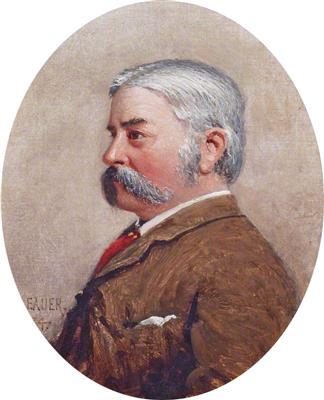
Biography
Leader was born Benjamin Leader Williams in Worcester on 12 March 1831[4], the son of a civil engineer who had been a friend of John Constable. He trained evenings at the Worcester School of Design while working as a draughtsman in his father’s office, then entered the Royal Academy Schools in London in 1854[4]. His first exhibited painting sold that year for £50. He changed his surname to Leader in 1857 and spent the following decades working in Scotland, Wales (particularly Betws-y-Coed and the River Wye), and the Surrey countryside.
Recognition came gradually and then in a rush. William Gladstone purchased *The Churchyard at Bettwys-y-Coed* in 1863[4]; Leader was elected ARA in 1883 and full RA in 1898. He was named Chevalier of the Légion d’Honneur in 1889, and *A Summer’s Day* (1888) sold at auction in 2003 for £168,000.
He worked into his late eighties, his brushwork loosening without losing the naturalistic precision that had always defined him. He died at Burrows Cross, Surrey, on 22 March 1923[4], aged 92.
Timeline
- 1831Born Benjamin Leader Williams in Worcester on 12 March. His father was a civil engineer and friend of John Constable.
- 1854Entered the Royal Academy Schools in London. His first exhibited painting sold for £50.
- 1857Changed his surname to Leader.
- 1863William Gladstone purchased *The Churchyard at Bettwys-y-Coed*.
- 1881His painting *February Fill Dyke*, exhibited at the Royal Academy, established his reputation.
- 1883Elected an Associate of the Royal Academy (ARA).
- 1889Named Chevalier of the Légion d’Honneur.
- 1898Elected a full Royal Academician (RA).
- 1923Died at Burrows Cross, Surrey, on 22 March, aged 92.
Notable Works
Tap to view larger.
Where to See Benjamin Williams Leader
4 museums worldwide.
-
2 works
Blackburn Museum and Art Gallery
Blackburn, United Kingdom
Tue–Sat 11:00–16:45, closed Sun–Mon · Free
-
2 works
Williamson Art Gallery and Museum
Birkenhead, United Kingdom
Mon–Thu 10:00–17:00, Fri 10:00–21:00, Sat 10:00–17:00, closed Sundays · Free
-
1 works
Bolton Museum
Bolton, United Kingdom


Next stop
Browse the movements →
Every movement in the collection, from the Renaissance to Pop art.
Related Artists



Frequently Asked Questions
What is Benjamin Williams Leader known for?
Benjamin Williams Leader is known for his painting *February Fill Dyke*, which was exhibited at the Royal Academy in 1881[4] and is now at the Birmingham Museum. The painting captured the quality of an English winter sky, and it made him well known.What should I know about Benjamin Williams Leader's prints?
Benjamin Williams Leader was not a Pre-Raphaelite artist; however, prints of Pre-Raphaelite paintings offer insight into the Victorian art market. The Pre-Raphaelites, a group of young British[4] artists dissatisfied with current painting styles, sought a return to early Italian art. Prints became a populist medium to propagate their ideals, allowing them to reach a larger audience. The fine art world eventually accepted the Pre-Raphaelites' approach, and their paintings attracted large crowds. This popularity stimulated demand for reproductions, a profitable part of the Victorian engraving business. Reproductions were produced in large numbers and sold at a fraction of the cost of original paintings. Exhibitions promoted sales of engravings by subscription, becoming an integral part of middle-class Britain. Prints after paintings by John Everett Millais proved especially popular. His "Cherry Ripe" was found in a Tartar peasant's hut; "Cinderella" in a Samoan chieftain's home; "The North-West-Passage" in a South African shepherd's hut. Homesick colonials also coveted Pre-Raphaelite prints as reminders of their homeland. Publishers hired the finest reproductive engravers, such as William Simmons and Thomas Oldham Barlow.What style or movement did Benjamin Williams Leader belong to?
Benjamin Williams Leader is best known for his contributions to late Victorian painting, particularly his depictions of the British[4] countryside. While not fitting neatly into one specific movement, his work has connections to several artistic styles. Leader's detailed, realistic style aligns with aspects of naturalism, an approach that prioritises accurate representation. His focus on rural scenes and the changing seasons also links him to the British tradition of landscape painting, following in the footsteps of artists like John Constable and J. M. W. Turner. However, Leader's work also contains elements of Romanticism, particularly in his emphasis on atmosphere and emotion. His paintings often evoke a sense of nostalgia for a disappearing rural way of life, a common theme in Romantic art. Although he lived and worked during a period that saw the rise of Impressionism, Leader maintained a more traditional approach, focusing on detail and accuracy rather than the fleeting effects of light and colour.What techniques or materials did Benjamin Williams Leader use?
Benjamin Williams Leader employed techniques typical of British[4] artists between 1775 and 1875[4]. This period saw a shift from artists preparing their own materials to using commercially produced ones. Like many artists of his time, Leader would likely have used oil paints. Some artists used white grounds to enhance the luminosity of their paintings; commercially primed canvases were often white during this period. The primings frequently consisted of lead white in whole egg medium or lead white in oil. Absorbent surfaces allowed for rapid development of the composition. During this era, William Holman Hunt advocated for improvements in the quality of artists' materials, which had declined due to industrial production. Hunt sought to ensure access to consistently reliable products.What was Benjamin Williams Leader known for?
Benjamin Williams Leader (1831[4]-1923[4]) was an English artist known for his rural views and depictions of the British[4] countryside. Although he began his artistic training at the Royal Academy Schools, he resigned after only a few months. He instead pursued private instruction from a local artist. Leader first exhibited at the Royal Academy in 1854[4], and continued to show works there throughout his career. His early style was influenced by the Pre-Raphaelites, with attention to detail and truth to nature. However, he later adopted a looser, more impressionistic style. Leader's paintings often feature tranquil scenes of rivers, fields, and woodlands, often in Worcestershire where he was born. He became known for his ability to capture the effects of light and atmosphere in these rural settings. He achieved considerable commercial success during his lifetime; his work remains popular with collectors today.When did Benjamin Williams Leader live and work?
Benjamin Williams Leader (1831[4]-1923[4]) was a British[4] painter, known for his rural scenes. He was born in Worcester, and originally trained as a draughtsman in his father's office. His father, Edward Leader Williams, was a civil engineer. In 1854[4], Leader entered the Royal Academy Schools. He first exhibited at the Royal Academy that same year, and continued to exhibit there for many decades. Early in his career, his style was influenced by the Pre-Raphaelites. He later adopted a looser, more impressionistic technique. Leader's paintings often depicted the countryside of Worcestershire and Wales. His work became popular with the Victorian middle class, and he achieved commercial success. He produced many paintings, often working en plein air. Later in life, Leader maintained a studio in Surrey. He died in Surrey in 1923, at the age of 92. His paintings remain popular today.Where can I see Benjamin Williams Leader's work?
Benjamin Williams Leader's paintings are held in numerous public collections. In the UK, you can find his work at the Tate, the Victoria and Albert Museum, and the National Gallery in London. Other British[4] galleries holding Leader's art include the National Museum of Wales in Cardiff; the National Gallery of Scotland in Edinburgh; the Glasgow Art Gallery and Museum; Leeds City Art Gallery; Manchester City Art Gallery; and the Fitzwilliam Museum in Cambridge. Outside the United Kingdom, museums with Leader's paintings include the Museu Nacional de Arte Antiga in Lisbon, and the Fundacion Coleccion Thyssen-Bornemisza in Madrid. The Art Gallery of New South Wales in Sydney, Australia, also holds examples of his work. Given that museum collections can change, it is always a good idea to check with the specific institution ahead of your visit to confirm that they have Leader's work on display.Where was Benjamin Williams Leader from?
Benjamin Williams Leader was born in Worcester, England, in 1831[4]. His birth name was Benjamin Leader Williams, but he later changed it to distinguish himself from other artists in the Williams family. Worcestershire, with its countryside and the River Severn, provided early inspiration for his art. He began his artistic studies at the Worcester School of Design before moving to London. In London, he enrolled at the Royal Academy Schools in 1854[4]. Although he lived and worked in London for a time, Leader maintained a strong connection to his native Worcestershire. Many of his paintings depict scenes from that area, particularly the Teme Valley. He sought to capture the natural beauty of the English countryside, often returning to Worcestershire for subject matter throughout his career.Who did Benjamin Williams Leader influence?
Benjamin Williams Leader (1831[4]-1923[4]) was a British[4] painter known for his rural views. Although he did not have pupils in a formal sense, his style influenced many artists who followed him. His impact is most apparent in the work of later Victorian and Edwardian painters who adopted similar subjects and techniques. These artists often depicted idyllic scenes of the British countryside, employing a detailed and realistic style reminiscent of Leader's work. Alfred East (1844[4]-1913[4]), whose atmospheric portrayals of the English Midlands share stylistic similarities with Leader's output, is one example. Another is Ernest Walbourn (1872-1927), who painted rural scenes with a comparable attention to detail. Leader's emphasis on capturing the beauty of nature in a realistic manner helped to shape the artistic preferences of his time. His paintings contributed to a broader interest in rural subjects among both artists and collectors. While it is difficult to measure influence precisely, Leader's popularity and the stylistic similarities in the work of subsequent artists suggest that he played a role in shaping the direction of British art.Who influenced Benjamin Williams Leader?
Benjamin Williams Leader (1831[4]-1923[4]) was an English painter known for his rural views. His artistic development involved several influences, most notably the Pre-Raphaelites and John Constable. Early in his career, Leader was influenced by the Pre-Raphaelite style. This is evident in his attention to detail and his attempts to capture nature with precision. However, he later moved away from their aesthetic. John Constable's work had a more lasting effect on Leader. Constable's atmospheric style and focus on the English countryside resonated with Leader. Leader adopted a similar approach in his own paintings, emphasising naturalism and the changing effects of light and weather. He sought to portray the beauty of the British[4] countryside in a realistic manner. Leader's style also reflects the broader artistic trends of his time, including the influence of Romanticism. His paintings often evoke a sense of nostalgia for a disappearing rural way of life. He captured scenes of pastoral life and the beauty of the natural world.Why are Benjamin Williams Leader's works important today?
Benjamin Williams Leader (1831[4]-1923[4]) was a British[4] artist known for his paintings of the English countryside, particularly the area around the River Severn in Worcestershire. Although he is not as well known as some of his contemporaries, Leader's works are important today for several reasons. Leader's paintings provide a record of the late Victorian and Edwardian rural environment. His depictions of the British countryside offer a glimpse into a world that has largely disappeared, due to industrialisation and urban development. Leader's style, while rooted in the academic tradition, also shows an interest in naturalism and atmospheric effects. His works often feature detailed observations of light and weather, capturing the changing moods of the British seasons. Leader's art also reflects the values and tastes of the Victorian middle classes. As art collecting became more popular among this group, Leader's paintings, with their accessible subject matter and pleasing aesthetic qualities, found a ready market. They signified the owner's social status and refined taste.What was Benjamin Williams Leader's art style?
Benjamin Williams Leader's brushwork loosened later in his career, but he always maintained a naturalistic precision. His style captured the scenery of Scotland, Wales, and the Surrey countryside.
Sources
Editorial draws on the following primary and tertiary references for Benjamin Williams Leader.
- [1] museum Bolton Museum Used for: museum holdings.
- [2] museum Williamson Art Gallery and Museum Used for: museum holdings.
- [3] museum Blackburn Museum and Art Gallery Used for: museum holdings.
- [4] wikipedia Wikipedia: Benjamin Williams Leader Used for: biography, birth dates, death dates, identifiers, movement attribution, nationality.
- [5] book Beard, Lee, 1973- author, Butler, Adam, author; Van Cleave, Claire, author; Fortenberry, Diane, author; Stirling, Susan, author, Beard, Lee, 1973- author, Butler, Adam, author; Van Cleave, Claire, author; Fortenberry, Diane, author; Stirling, Susan, author - The Art Book_ New Edition, Mini Format Used for: biography, stylistic analysis.
- [6] book Allison Lee Palmer, Historical Dictionary of Neoclassical Art and Architecture Used for: stylistic analysis.
- [7] book Palmer, Allison Lee, Historical Dictionary of Neoclassical Art and Architecture Used for: stylistic analysis.
- [8] book Post-impressionism : cross-currents in European painting Used for: biography.
- [9] book Post-impressionism : cross-currents in European painting Used for: biography.
Editorial overseen by Solis Prints. Sources verified 2026-09-22. Click a source for details, or hover over [N] in the page above to preview.
Editorial standardsMethodologyCorrectionsAI disclosureAbout the editorial team