

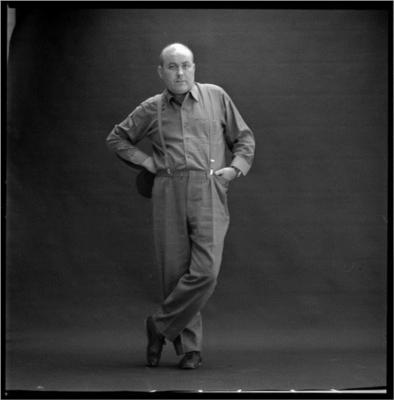
Dieter Roth
Dieter Roth made art out of food and let it rot. Sausages stuffed into suitcases, chocolate self-portraits in thirty pieces, windows packed with beans and red cabbage: the work was perishable by design, and the mould, shrinkage, and eventual collapse were part of the piece. This was not provocation for its own sake but a genuine philosophical position. Roth (who also published his name as Diter Rot) was interested in time as a medium, and organic decay was the most honest way he knew to make that interest visible.
Biography
Born in Hannover in 1930[2], Roth grew up between Germany and Switzerland, eventually studying graphic design in Bern from 1950[2] to 1954. His early work drew him into the orbit of Concrete poetry and Fluxus[2], and he began producing artist books and multiples that refused the conventional separation between literary and visual objects. His 1967 book Mundunculum, published by Dumont Schauberg, and 246 Little Clouds, released the following year by Something Else Press in New York, became influential touchstones for anyone working in that territory. He also published under his own imprint and collaborated extensively with edition hansjorg mayer in Stuttgart.
Roth's exhibition history reads like a map of the European avant-garde in the 1960s. Solo shows at Galerie Koepcke in Copenhagen (1963[2]), Galerie Rene Block in Berlin (1968), and the Museum Haus Lange in Krefeld (1969) were accompanied by appearances at Documenta IV in Kassel and group exhibitions at the Stedelijk Museum and the ICA London.
In later years Roth developed vast, sprawling installation works, some occupying entire galleries, built from accumulated objects, recordings, and organic material spanning decades. He died in Basel in 1998[2].
Timeline
- 1930Born in Hannover.
- 1950Began studying graphic design in Bern, continuing until 1954.
- 1963Had a solo exhibition at Galerie Koepcke in Copenhagen.
- 1967Published the book "Mundunculum" by Dumont Schauberg.
- 1968Had a solo show at Galerie Rene Block in Berlin; also published "246 Little Clouds" by Something Else Press in New York.
- 1969Had a solo exhibition at the Museum Haus Lange in Krefeld.
- 1998Died in Basel.
Notable Works
Tap to view larger.
Next stop
Fluxus →
Explore the artists and ideas of Fluxus.
Related Artists


Frequently Asked Questions
What is Dieter Roth known for?
Dieter Roth is known for making art out of food and allowing it to decay. He was interested in time as a medium, and he felt organic decay was the most honest way to make that interest visible.What is Dieter Roth's most famous work?
It is difficult to name one single work as Dieter Roth's 'most famous'. He produced a large volume of work in several media, including prints, books, sculptures, and works using chocolate and other perishable materials. Roth studied graphics in Bern from 1950[2] to 1954 and had one-man shows at Galerie Koepcke, Copenhagen, in 1963; Galerie Rene Block, Berlin (Schimmelhauten), in 1968; and Galerie Intermedia, Cologne, in 1969. A survey of his publications lists many artist's books, such as *Mundunculum* (1967), *246 Little Clouds* (1968), and *Scheisse* (1968). Roth participated in group shows such as 'Junge Berner Kunstler', Kunsthalle, Bern, 1955; 'Die Zeichnung irn Schatten Jungerer Schweizer Maler und Bildhauer', Kunsthalle, Bern, 1957; and Documenta IV, Kassel, 1968.What should I know about Dieter Roth's prints?
Dieter Roth (1930[2]-1998[2]) was a Swiss-German[2] artist best known for his artist's books, sculptures, and prints. Roth explored process and decay in his work, often using food and found materials. Roth began making prints in the 1950s, and he continually experimented with techniques. Lithography, screen printing, and etching appear throughout his career. He frequently combined printing methods, layering images and textures. Roth's prints often incorporate textual elements, sometimes his own poetry or prose. His prints share similar themes and motifs with his other works, such as his sculptures made of chocolate or cheese. His prints frequently challenge traditional notions of editioned art. Roth often altered prints after the edition was supposedly complete, adding unique elements or variations. He embraced chance and imperfection, allowing for unpredictable results in his printing process. Roth's printed work can be found in major museum collections, and they remain highly sought after by collectors interested in his iconoclastic approach to art making.What style or movement did Dieter Roth belong to?
Dieter Roth was associated with the Fluxus[2] movement, an international, multimedia network of artists, composers, and designers that emerged in the 1960s. Fluxus is difficult to define rigidly, but it is generally characterised by its use of mixed media and its tendency to blend different artistic disciplines. Fluxus artists often incorporated elements of chance, playfulness, and humour into their work. The movement had a multicultural and multinational character, with a relatively large number of prominent women artists. Fluxus practitioners staged events ranging from simple, everyday actions to large-scale collective performances. Joseph Beuys, later known for his break from Fluxus and his sculptural installations, was a cofounder of the group in 1961[2]. Fluxus aimed to collapse the boundaries between art and life, and to challenge traditional notions of what art could be. The Fluxus Manifesto, attributed to George Maciunas, called for the purging of bourgeois sickness and the promotion of anti-art.What techniques or materials did Dieter Roth use?
Dieter Roth was a prolific and experimental artist who resisted easy categorisation. He worked across many media, including printmaking, sculpture, and assemblage. Roth's practice was characterised by his willingness to incorporate unconventional materials into his art. In his graphic work, Roth often employed techniques such as screen printing and lithography, sometimes combining them in innovative ways. He was interested in the possibilities of seriality and reproduction, often creating multiple versions of the same image with slight variations. Roth's sculptural works frequently incorporated perishable materials, such as chocolate, cheese, and spices. These elements were selected for their sensory qualities and their capacity to decay over time. For example, his "Picture-Chocolate" works (1969[2]) used chocolate as a base for prints and other additions. This interest in decay and transformation was a recurring theme in his art. He also worked with more traditional materials, such as wood and metal, often combining them with found objects and ephemera.What was Dieter Roth known for?
Dieter Roth (born in Hannover, 1930[2]) was known for graphic work and bookmaking, as well as objects made from unconventional materials, such as chocolate and sausage. Roth studied graphics in Bern from 1950[2] to 1954. His first solo exhibition was in Copenhagen in 1963. He participated in group exhibitions such as "Junge Berner Kunstler" at the Kunsthalle, Bern, in 1955; "Die Zeichnung irn Schatten Jungerer Schweizer Maler und Bildhauer", also at the Kunsthalle, Bern, in 1957; and "Documenta IV" in Kassel in 1968. Examples of his works include "Visit" (glass, chocolate, and metal); "Huttuten" and "Screwed Together" (drawings with stamps); "Beans-Red Cabbage-Picture" (wood, glass, and vegetables); and "Self-Portrait as Tower" (chocolate). He also created "Plane Crash" (collage with tempera), "Poetry III and IV. Luxus" (wood and mixed media), "Stable" (plastic and chocolate), "Sausage Fountain" (wood, glass, and sausage), and "Island" (glass and chocolate). Roth published many books, including "Mununculum" (1967), "246 Little Clouds" (1968), and "Scheisse" (1968).When did Dieter Roth live and work?
Dieter Roth was born in Hannover in 1930[2]. He studied graphics in Bern from 1950[2] to 1954. Roth had one-man exhibitions at Galerie Koepcke, Copenhagen, in 1963; Galerie Rene Block, Berlin, in 1968; Galerie Intermedia, Cologne, in 1969; Eugenia Butler Gallery, Los Angeles, in 1969; Eat Art Galerie, Dusseldorf; and Museum Haus Lange, Krefeld. His work also appeared in group shows. These included Kunsthalle, Bern, in 1955 and 1957; Stedelijk Museum, Amsterdam, in 1961 and 1963; Institute of Contemporary Art, London, in 1965; and Kassel, Documenta IV, in 1968. By 1970, Roth's work was exhibited at Galerie Demarco, Edinburgh, and Kunstmuseum, Lucerne. A show at Von der Heydt-Museum, Wuppertal, followed in 1971.Where can I see Dieter Roth's work?
Dieter Roth's works can be found in numerous public collections across Europe and beyond. In Switzerland, his art is held by the Kunstmuseum in Basel, the Kunsthaus in Zurich, and the Kunstmuseum in Winterthur. Both the Kunstmuseum and the Gottfried Keller Stiftung in Berne also possess examples. Geneva's Musée d’Art et d’Histoire holds Roth pieces, too. In Germany, significant holdings exist at the Ludwig Museum and Wallraf-Richartz Museum in Cologne, the Kunsthalle in Bremen, the Folkwang Museum in Essen, and the Nationalgalerie in Berlin. The Kestner-Museum and Galerie Dieter Brusberg, both in Hanover, also maintain collections. Other locations include the Museum Boymans-van Beuningen in Rotterdam, the Solomon R. Guggenheim Museum and the Museum of Modern Art in New York, and the City of Manchester Art Galleries in England.Where was Dieter Roth from?
Dieter Roth was born in Hannover, Germany, in 1930[2]. He later studied graphics in Bern, Switzerland, from 1950[2] to 1954. Roth's artistic career saw him exhibiting widely from the early 1960s. His one-man exhibitions included Galerie Koepcke in Copenhagen (1963), Galerie Rene Block in Berlin (1968), and Galerie Intermedia in Cologne (1969). He also had exhibitions in Los Angeles and Dusseldorf. Roth participated in group exhibitions, such as "Junge Berner Kunstler" at the Kunsthalle, Bern, in 1955, and "Bewogen Beweging" at the Stedelijk Museum, Amsterdam, in 1961. He was included in Documenta IV in Kassel in 1968. His work spanned various media, including books, drawings with stamps, and constructions using materials like glass, chocolate, and vegetables. He also produced multiples, such as the "Cloud" made of cheese-cover. Roth published many books of collected works, essays, and poetry.Who did Dieter Roth influence?
It is difficult to make definitive claims about Roth's artistic influence. However, some connections can be drawn between Roth and later artists. Claes Oldenburg, Cy Twombly, and Ray Johnson are three second-generation postwar American artists who recognised a side of Dubuffet that others missed. Their works go against a division between art and literature. Joseph Beuys was criticised by German[2] left-wing art critics, who considered his spiritual Romanticism proto-fascist. He was also criticised by international art critics for choosing to focus on healing the German soul, while expressing no interest in the Holocaust. From 1967[2] to 1972, the artists of the Arte Povera movement created new art using modest, rustic and organic materials. This group of artists included Pier Paolo Calzolari, Luciano Fabro, Jannis Kounellis, Mario Merz, Marisa Merz and Michelangelo Pistoletto. They often expressed fascination with deep time, energy and alchemy. Wolfgang Laib is best known for sculptural installations made of bee pollen. He uses natural materials such as beeswax, milk, rice, marble, granite and Burmese thitsi lacquer.Who influenced Dieter Roth?
Dieter Roth, born in Hannover in 1930[2], studied graphics in Bern from 1950[2] to 1954. His artistic development occurred in a milieu informed by various influences. One can see the impact of the broader European art scene through his participation in group exhibitions. These included the Kunsthalle Bern's *Junge Berner Kunstler* (1955), the Stedelijk Museum's *Bewogen Beweging* (1961), and Documenta IV in Kassel (1968). Roth's work engaged with trends in abstract art, as seen in his inclusion in *Between Poetry and Painting* at London's Institute of Contemporary Art in 1965. Roth had one-man shows in Copenhagen, Berlin, Cologne, Los Angeles, and Dusseldorf between 1963 and 1971. Roth's work also appeared in *Freunde-Friends-D'Frunde*, which travelled to the Kunsthalle, Dusseldorf. Roth's publications included *Mununculum* (1967) and *246 Little Clouds* (1968).Who was Dieter Roth?
Dieter Roth (born in Hannover, 1930[2]) studied graphics in Bern from 1950[2] to 1954. Roth had one-man exhibitions at Galerie Koepcke, Copenhagen, in 1963; Galerie Rene Block, Berlin, in 1968; Galerie Intermedia, Cologne, in 1969; Eugenia Butler Gallery, Los Angeles; Eat Art Galerie, Dusseldorf; and Museum Haus Lange, Krefeld. Group exhibitions featuring Roth's work include Kunsthalle, Bern, in 1955 and 1957; Stedelijk Museum, Amsterdam, in 1961 and 1963; Institute of Contemporary Art, London, in 1965; Kassel, Documenta IV, in 1968; Kunsthalle, Bern, in 1969; Galerie Demarco, Edinburgh, in 1970; Kunstmuseum, Lucerne; and Von der Heydt-Museum, Wuppertal, in 1971. Roth wrote books, including *Mununculum* (1967) and *246 Little Clouds* (1968). Examples of his artworks include *Visit* (1969), *Beans-Red Cabbage-Picture* (1969-71), and *Self-Portrait as Tower* (1971).
Sources
Editorial draws on the following primary and tertiary references for Dieter Roth.
- [1] museum Victoria and Albert Museum Used for: museum holdings.
- [2] wikipedia Wikipedia: Dieter Roth Used for: biography, birth dates, death dates, identifiers, movement attribution, nationality.
- [3] book guggenheim-amsterdamparisdu00solo Used for: biography, stylistic analysis.
- [4] book guggenheim-refigur00kren Used for: biography, stylistic analysis.
- [5] book Masterpieces of western art : a history of art in 900 individual studies from the Gothic to the present day Used for: biography.
- [6] book Charlene Spretnak (auth.), The Spiritual Dynamic in Modern Art _ Art History Reconsidered, 1800 to the Present Used for: stylistic analysis.
Editorial overseen by Solis Prints. Sources verified 2026-10-07. Click a source for details, or hover over [N] in the page above to preview.
Editorial standardsMethodologyCorrectionsAI disclosureAbout the editorial team