



Ay-O
In 1970, at the Osaka World's Fair, Ay-O installed a Tactile Rainbow Room that invited visitors not to look but to touch: surfaces, boxes, and environments built from gradated colour and material contrast. The rainbow had become his signature, applied with methodical rigour across paintings containing up to 192 gradations of hue. Where most artists treat the spectrum as symbol, Ay-O used it as a system.
Biography
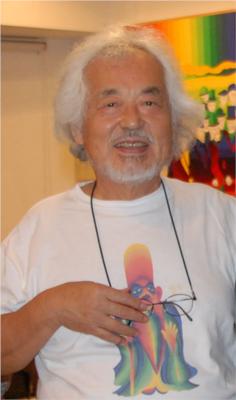
Born Takao Iijima in Ibaraki Prefecture in 1931[1], he studied at Tokyo University of Education before gravitating toward Tokyo's postwar avant-garde. He co-founded Jitsuzonsha ("The Existentialists") with printmaker Masuo Ikeda in 1955, and in 1958 relocated to New York. There, Yoko Ono introduced him to George Maciunas; by 1963 he was a formal Fluxus[1] member. His contribution to the movement's portfolio of tactile multiples was the Finger Box: a small container with holes inviting physical exploration rather than visual contemplation.
Ay-O represented Japan at the Venice Biennale in 1966 and the São Paulo Biennale in 1971. In Japan he was informally known as "Rainbow Man," not merely for the colour he deployed but for the systematic logic behind it. His practice sits at an unusual intersection: formally rigorous, conceptually playful, and rooted in both the Fluxus[1] tradition and the postwar Japanese[1] avant-garde he was part of before moving west.
Timeline
- 1931Born Takao Iijima in Ibaraki Prefecture.
- 1955Co-founded Jitsuzonsha ("The Existentialists") with Masuo Ikeda.
- 1958Relocated to New York.
- 1963Became a formal member of Fluxus.
- 1966Represented Japan at the Venice Biennale.
- 1970Installed the Tactile Rainbow Room at the Osaka World's Fair.
- 1971Represented Japan at the São Paulo Biennale.
Notable Works
Tap to view larger.
Next stop
Fluxus →
Explore the artists and ideas of Fluxus.
Related Artists


Frequently Asked Questions
What is Ay-O known for?
Ay-O is known for his rainbow-themed art, which he approached with methodical rigour. At the Osaka World's Fair in 1970, he installed a Tactile Rainbow Room, inviting visitors to touch surfaces built from gradated colour and material contrast.What is Ay-O's most famous work?
It is difficult to name one single work as Ay-O's most famous. He produced a large number of watercolours, India ink drawings, and installations. His work from the 1970s and early 1980s includes watercolours such as *Counterpoint* (1977), *Sven Duva in Hades* (1975), *The Queen Threatened* (1976), and *Grasshopper by a Rainbow* (1981). These pieces are held in private and public collections, including the Ateneum Art Museum in Helsinki and the Amos Anderson Art Museum, also in Helsinki. Ay-O is associated with the Gutai Art Association, a radical, post-war Japanese[1] art group. He moved to New York in 1961, becoming involved with the Fluxus[1] movement. His "Finger Boxes" are perhaps his best known works from this period: enclosed boxes that viewers experience through touch alone. These boxes align with Fluxus's interest in sensory experience and challenging traditional art forms.What should I know about Ay-O's prints?
When collecting Ay-O's prints, remember that Japanese[1] paper is susceptible to humidity changes. Finished prints should be stored interleaved with acid-free tissue in a drawer or box. Pigments can be fugitive, so avoid hanging prints in bright light for extended periods, as certain colours fade faster than others. Pale pinks and blues are especially prone to fading. Vermilion can turn black over time, altering the picture's balance. Avoid hanging prints over radiators or heat sources. Prints that have dried unevenly can be straightened by carefully re-moistening them between damp sheets of newsprint and drying them again under a weight. Use a steel rule and cutting knife for a straight edge. To form a torn deckle edge on Japanese paper, place the metal ruler on the line, run a clean brush dipped in water along the edge and then tear the paper back against the ruler.What techniques or materials did Ay-O use?
Ay-O's work encompasses a wide range of materials and techniques. Traditional Japanese[1] crafts, such as hyogu, involve mounting art. This process uses thin woven fabrics like silk or damask for framing, combined with layers of paper to ensure flexibility. The narrow strips, ichimonji, often use gold brocade. The technique includes applying water to straighten the fabric, then attaching it to backing paper with glue, smoothing out wrinkles with a brush. Sculptural techniques involve a mix of materials, not always adhering to a single tool for each substance. Masks influence the techniques, transferring their effects into wood and other media. Sculptors often combine various materials in one piece, using items like nails to represent hair, creating new forms and symbolic effects. Materials such as shells or large-headed nails might represent eyes, their forms integrated into the surrounding materials.What was Ay-O known for?
Ay-O, born in 1931[1], is a Japanese[1] artist associated with the Fluxus[1] movement. In the early 1960s, Ay-O explored a notational language related to the Fluxus concept of the 'event'. His work came to the attention of George Maciunas, a central figure in Fluxus. Maciunas planned a Fluxus edition of Ay-O's work by December 1963. Encouraged by Kuniharu Akiyama and Maciunas, Ay-O travelled to New York City in the summer of 1964, along with Shigeko Kubota, to participate in the Fluxus community. That year, Fluxus published Ay-O's complete works under the title *Events and Games*. Ay-O's *Spatial Poem* series adapted concepts from his earlier action poems, connecting simple actions to subjective ideas of time and space. One such work was *Direction Music for Fingers* (1964), performed in New York as part of a solo presentation in October 1964 at Washington Square Gallery.When did Ay-O live and work?
Ay-O was born in 1931[1] in Ibaraki Prefecture, Japan. He became a member of the Gutai Art Association in 1955. This group, active in Osaka, Japan, from 1954 to 1972, pursued experimental art outside established conventions. In 1958, Ay-O began creating what he called "tactile" or "finger" paintings, initiating his exploration of the rainbow, which became a signature element in his work. Ay-O moved to New York City in 1961 and became associated with the Fluxus[1] movement, an international, interdisciplinary group of artists, composers, designers and poets that reacted against the authority of art. During this time, he staged happenings and performances, often incorporating his rainbow motifs. Ay-O's work has been exhibited widely, including at the Guggenheim Museum, the Museum of Modern Art, and the Venice Biennale. He continues to live and work, his career spanning more than six decades.Where can I see Ay-O's work?
Ay-O's work has been featured in many exhibitions. In 1961, his art appeared in 'Adventure in Today's Art of Japan' at the National Museum of Modern Art, Tokyo. A few years later, in 1965, his pieces were included in 'The New Japanese[1] Painting and Sculpture', organised by the Museum of Modern Art, New York, which toured across America. Venues included the Denver Art Museum, the Krannert Art Museum (University of Illinois), and the Baltimore Museum of Art. His art was also part of the 'Ninth Annual Tokyo Biennale' in 1967, which travelled to multiple locations in Japan, including Kyoto, Takamatsu, and Nagoya. In 1969, Ay-O's work was shown in 'Pop Art' at the Hayward Gallery, London, and in 'Contemporary Art/Dialogue between the East and the West' at the National Museum of Modern Art, Tokyo. More recently, a 1994 exhibition of his drawings from 1964 to 1974 was held at the Hara Museum of Contemporary Art, Tokyo.Where was Ay-O from?
Ay-O is a Japanese[1] artist. Born in 1931[1], he was a member of the Gutai Art Association during the 1950s and 1960s. This radical group of Japanese artists sought to break away from traditional art forms and explore new modes of expression. Gutai artists often engaged in performance, installation, and action painting, pushing the boundaries of what art could be. Kusama was also a Japanese artist that was born and grew up in Japan. She moved to New York City at twenty-nine, where she became known for her performance art, such as painting herself with dots. She moved back to Japan in 1973 and in 2017 opened a museum filled with her work in Tokyo.Who did Ay-O influence?
Ay-O was associated with Fluxus[1], an international group of artists, composers, and designers known for their experimental art performances. Fluxus figures such as Ay-O, Hachiya Kazuhiko and Pierre Huyghe compel viewers to become active participants. Hachiya's interactive art incorporates swings, skateboard ramps, and sumo wrestling rings. His work *Over the Rainbow* (1994) produces a rainbow spectrum of lights when all participants are swinging at different heights. Hachiya's *PostPet* (1996-2002[1]) creates digital creatures that live in fantastic homes on your computer desktop and deliver your e-mail. Huyghe explores the intersection of real and imaginary characters. His examination of narrative structures has focused on those of the cinema and the technological and personal aspects of filmmaking and viewing. Works such as *Remake* (1995), *Sleeptalking* (1998), and *The Third Memory* (1999) combine contemporary reenactments with interviews and original footage.Who influenced Ay-O?
Ay-O, a key figure in the Fluxus[1] art movement, drew influence from various sources. The Gutai group, particularly its performances and outdoor exhibitions, provided a framework for his artistic approach. Ay-O's work shares conceptual ground with the Gutai's engagement with materials and the integration of art into life. Dada soirees at the Cabaret Voltaire, with their experimental and anti-art ethos, also anticipate aspects of Gutai and, by extension, Ay-O's artistic explorations. Figures like John Cage, Earle Brown, and David Tudor were part of a network of influence, with Cage's conceptual, anti-art stance resonating with Ay-O's contemporaries. The downtown New York art scene, where artists presented their work, facilitated cross-pollination of ideas and approaches. These influences contributed to Ay-O's development as an artist within the Fluxus movement.Why are Ay-O's works important today?
Ay-O's significance stems from his association with the Gutai Art Association, a radical Japanese[1] art collective formed in 1954. Gutai artists pursued innovative approaches, rejecting traditional artistic conventions. Ay-O joined in 1955, contributing to their experimental spirit. His "Finger Boxes", starting in the early 1960s, are particularly important. These small boxes, each containing a different tactile experience, invite viewers to engage with art through touch. This multisensory approach challenged the dominance of vision in art appreciation. Ay-O's work also connects to broader trends in the post-war avant-garde. His exploration of chance and audience participation aligns with the Fluxus[1] movement's emphasis on everyday experience and blurring the boundaries between art and life. His activities, alongside those of Akasegawa Genpei and Zero Dimension, contributed to a period of cultural activism, questioning established norms and exploring new forms of political expression through art.
Sources
Editorial draws on the following primary and tertiary references for Ay-O.
- [1] wikipedia Wikipedia: Ay-O Used for: biography, birth dates, death dates, identifiers, movement attribution, nationality.
- [2] book Dorling Kindersley, Artists: Inspiring Stories of the World's Most Creative Minds Used for: biography.
- [3] book Pächt, Otto, 1902-1988, Book illumination in the Middle Ages : an introduction Used for: stylistic analysis.
- [4] book Homo, memento finis : the iconography of just judgment in medieval art and drama Used for: biography.
- [5] book Shalev-Eyni, Sarit, Jews among Christians : Hebrew book illumination from Lake Constance Used for: biography, stylistic analysis.
- [6] book The glory of Byzantium Used for: stylistic analysis.
- [7] book Saward, Susan, The Golden Age of Marie de' Medici Used for: biography.
Editorial overseen by Solis Prints. Sources verified 2026-10-05. Click a source for details, or hover over [N] in the page above to preview.
Editorial standardsMethodologyCorrectionsAI disclosureAbout the editorial team