



Dieter Rams
Few designers have shaped the material world of the twentieth century as quietly or as durably as Dieter Rams. Born in Krefeld in 1932[1], he trained as a carpenter before studying interior design and architecture in Wiesbaden. In 1955 he joined Braun, the Frankfurt-area electronics company, and spent the next three decades as its head of design, producing a body of work that redefined what a manufactured object could aspire to be.
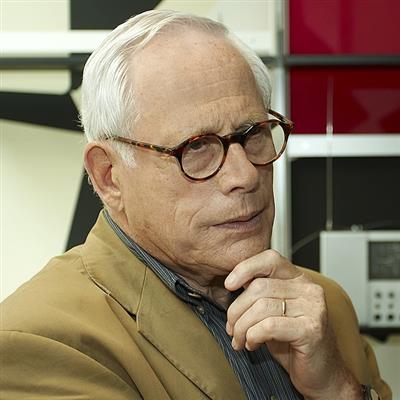
Biography
The Braun golden age ran roughly from 1950 to 1975, and Rams was its presiding intelligence. Under his direction the company's products were stripped of ornament and marketing flourish. Colours were limited to black or white, with occasional primary-colour exceptions. Model names were replaced with letters and numbers. The underlying logic was moral as much as aesthetic: Rams believed objects should be made better, not merely made to sell more. His famous ten principles of good design, which he began articulating in the late 1970s, distilled this conviction into a working manifesto, concluding with the admonition that good design is as little design as possible.
Braun's acquisition by Gillette and then Procter and Gamble gradually eroded the conditions that had made the work possible, and Rams eventually departed. His influence, however, only deepened. Apple's design chief Jony Ive acknowledged Rams's products as a direct reference point for the iPhone and iPod, making the connection between a 1960s German[1] radio and a twenty-first-century smartphone one of the more improbable through-lines in design history.
Rams also taught at the Hamburg University of Fine Arts, where he shaped a further generation of designers. He received the German[1] Design Prize and numerous other international awards, and retrospective exhibitions of Braun products have continued to draw audiences long after the company changed hands.
Timeline
- 1932Born in Krefeld.
- 1950The Braun golden age began; Rams was its presiding intelligence.
- 1955Joined Braun, the electronics company in the Frankfurt area.
- 1970Began articulating his ten principles of good design.
- 1970Taught at the Hamburg University of Fine Arts.
- 1975The Braun golden age ended.
Notable Works
Tap to view larger.
Next stop
Browse the movements →
Every movement in the collection, from the Renaissance to Pop art.
Related Artists


Frequently Asked Questions
What is Dieter Rams known for?
Dieter Rams is known for his work at Braun, where he stripped products of ornament and marketing flourish. He limited colours to black or white, with occasional primary-colour exceptions, and replaced model names with letters and numbers.What is Dieter Rams's most famous work?
While Dieter Rams produced a substantial body of work, he is best known for his designs for the German[1] consumer electronics manufacturer Braun. From 1955 to 1997, Rams served as Braun's head of design, where he developed a functionalist aesthetic defined by clean lines, minimal ornamentation, and user-friendly interfaces. Rams's designs for Braun included radios, record players, televisions, calculators, and kitchen appliances. His designs, such as the SK-4 radio and the D45 projector, helped to establish Braun's reputation for innovative and high-quality products. His design philosophy, encapsulated in his "Ten Principles for Good Design", has had a significant effect on generations of designers. Rams's work at Braun helped to define the look and feel of modern consumer electronics, and his designs are still highly regarded today.What should I know about Dieter Rams's prints?
Dieter Rams is best known as an industrial designer, but his work intersects with printmaking in several ways. Consider the example of Herbert Bayer, a Bauhaus instructor, who designed advertising and exhibition materials, while also pursuing his own photography. Bayer's Bauhaus activities included graphic design work, such as a 1927 advertising brochure and a 1928 stationery design. These items used printing techniques like offset and letterpress. Later, in the 1930s, Bayer designed magazine covers and advertising for firms such as the Dorland agency. These examples show how design for print was part of the broader Bauhaus aesthetic. Rams's design philosophy shares common ground with the Bauhaus focus on functionalism and simplicity; these values can be found in printed matter as well as industrial design.What style or movement did Dieter Rams belong to?
Dieter Rams is associated with the functionalist school of design, which emerged from the Bauhaus tradition. As head of design at Braun from 1950 to 1995, Rams created everyday objects, such as radios and kitchen appliances, that were models of austere, high-minded materialism. His design ethos was rooted in the idea that design should not merely sell products, but improve them. This approach involved a rejection of superficial marketing and decorative frills. Rams's designs often featured a restricted colour palette (black, white, and primary colours) and a focus on logic, order, and ergonomics. His "less but better" principle encapsulates his belief in visual and physical longevity as a way to reduce consumer guilt. Rams's work has been seen as a reaction against postmodernism, and his influence can be observed in the work of contemporary designers, such as Jonathan Ive. Some critics have noted a Teutonic devotion to order and sobriety in Rams's designs, while others see a deeper meaning beyond their obvious purpose.What techniques or materials did Dieter Rams use?
Dieter Rams, who headed design at Braun for approximately 30 years, aimed to transform ordinary items into ideal forms. His designs often featured a restricted colour palette: primarily black and white, with occasional primary colour accents. Rams's design language, which has influenced designers such as Jonathan Ive, Jasper Morrison, Sam Hecht, and Naoto Fukasawa, involved a careful approach to his work. For example, he selected a specific grade of clear plastic for the tuning panel of his radiogram to display station names. The backs of his radios received as much precision as the fronts. His designs often used letters and numbers rather than cute names. Rams's design ethos, summed up by his principle of "less but better", prioritised visual and physical longevity. This approach aimed to reduce consumer guilt through enduring design. He sought to resolve the tension between design as a cultural programme and design as a commercial activity, focusing on improving products rather than simply increasing sales.What was Dieter Rams known for?
Dieter Rams is known for his work at the Braun design studio, which he directed for almost 30 years from Frankfurt. He transformed everyday objects into ideal forms, typically in black or white, with occasional primary colour accents. Rams aimed to give common items a sense of dignity. His design approach was characterised by order and sobriety. He sought to resolve the conflict between design as a cultural pursuit and design as a commercial activity, prioritising quality over sales. His design principles are summed up in the phrase "less but better", which he published in 2008 as part of his ten principles. This idea promotes visual and physical longevity to reduce consumer guilt. Rams's designs have had a significant impact. The SK4 record player, launched in 1956, set a standard configuration for hi-fi systems for three decades. His work has influenced designers such as Jonathan Ive, Jasper Morrison, Sam Hecht, and Naoto Fukasawa.Where can I see Dieter Rams's work?
Dieter Rams's designs have been featured in museum exhibitions. The Design Museum in London once displayed Rams's living room, complete with his shelving system for Vitsoe, Braun audio equipment, and a Braun television. More generally, several museums with collections of functionalist or Bauhaus-related design hold examples of his work. These include the Bauhaus Archive-Museum für Gestaltung (Berlin), the Bauhaus Dessau Foundation, the Bröhan-Museum (Berlin), the Kunstgewerbe Museum of Decorative Arts (Berlin), the MAK Austrian Museum of Applied Art/Contemporary Art (Vienna), the Museum beim Markt (Karlsruhe), and the Museum für Kunst und Gewerbe (Hamburg). Outside of Germany and Austria, museums with Bauhaus collections include the Zentrum Paul Klee Bern (Switzerland), the Busch-Reisinger Museum (Cambridge, MA, USA), the Utsunomiya Museum of Art (Japan), and the Misawa Bauhaus Collection (Tokyo).Where was Dieter Rams from?
Dieter Rams directed the Braun design studio from a building on the outskirts of Frankfurt for almost 30 years. Meeting Rams in the mid-1980s, one might feel as if encountering a legend awaiting a call to rescue another generation from postmodernism. His Frankfurt studio had models, pencils, prototypes, samples, and drawing boards each carefully aligned. The only colour came from the orange pack of Ernte 23 cigarettes that was constantly in Rams’s hands. Before his architectural studies, Rams was a cabinetmaker. Even after retirement, he kept a carpentry workshop at home. The Design Museum in London once created a space that evoked Rams’s living room, complete with the grid of white tiles he has at home.Who did Dieter Rams influence?
Dieter Rams, who headed design at Braun for almost 30 years, has influenced many contemporary designers. His design language, developed at Braun, has become a starting point for designers of electronic appliances and domestic objects. Designers such as Jonathan Ive, Jasper Morrison, Sam Hecht, and Naoto Fukasawa all work in a language that reflects Rams's restricted colour palette and careful approach. Even Philippe Starck has noted Ive's debt to Rams, particularly in the appropriation of the calculator design for the iPhone. Rams's appeal lies in a sense of purpose reminiscent of the 1960s and the seriousness of the Ulm School. His "less but better" principle, first published in 2008, sums up his worldview; visual and physical longevity offers a way to feel less guilty as consumers. Rams transfigured everyday objects into ideal forms, using mainly black and white, with occasional primary colours.Who influenced Dieter Rams?
Dieter Rams drew inspiration from several sources. Hans Gugelot, who led industrial design at Braun before his death, connected Braun to the Bauhaus heritage via Max Bill; Bill had studied at the Bauhaus and taught at the Ulm School of Design. Rams consciously drew on this heritage. Before joining Braun, Rams worked for Otto Appel, an architect who had previously assisted Albert Speer. Appel's practice focused on corporate modernism, which shaped Rams's early design perspective. Rams's design ethos, characterised by "less but better", reflects a desire to create visually and physically durable products. His approach resonated with a generation of designers nostalgic for the moral certainty of the 1960s and the seriousness of the Ulm School. Even if Rams was unable to match Max Bill’s lyrical range, it is clear that he was interested in how things look as well as in ergonomics. While Rams's work has been highly influential, some artists, such as Richard Hamilton, have offered ironic critiques of the "cult of good design" associated with Braun products.Who was Dieter Rams?
Dieter Rams is a German[1] industrial designer, known for his long tenure at Braun, where he was head of design. He is associated with a design philosophy of "less but better", which prioritises functionality and simplicity. Rams's designs at Braun, from approximately 1950 to 1975, had a significant impact on how everyday objects looked. His work promoted a kind of high-minded materialism, offering consumers austere, serious-minded products. Braun avoided marketing frills, relying instead on a visual language that suggested discreet modernity. Before joining Braun, Rams trained as a cabinet maker, then studied architecture. He joined Braun shortly after the death of one of its designers, and subsequently became the head of the Braun design team. His designs extended to every detail of his working environment, where models, pencils and prototypes were carefully placed. The only colour in his Frankfurt studio came from an orange pack of Ernte 23 cigarettes, which he used like a vase of flowers in a room. Rams's influence can be seen in the work of designers such as Jonathan Ive. He published his ten principles of good design in 2008.Why are Dieter Rams's works important today?
Dieter Rams's designs for Braun, from 1950 to the late 1970s, defined a kind of high-minded materialism that retains a remarkably strong grip on the imagination of designers. As head of design, Rams transformed everyday objects into ideal forms. His design language has been the starting point for any electronic appliance or domestic object that aspires to suggest a discreet and unthreatening modernity. Rams's approach gave the middle classes guilt-free permission to acquire their television sets and their stereo systems, the definitive domestic status symbols of the 1960s, by presenting them as austere, serious-minded pieces of equipment. Rams's world view is summed up by his idea of 'less but better', the most important of his ten principles, which he published for the first time in 2008. Visual and physical longevity gives us the alibi that we need to feel a little less guilty as consumers. Rams appeals to a generation of designers who are nostalgic for the sense of purpose that came from the moral certainty of the 1960s and the seriousness of the Ulm School.
Sources
Editorial draws on the following primary and tertiary references for Dieter Rams.
- [1] wikipedia Wikipedia: Dieter Rams Used for: biography, birth dates, death dates, identifiers, movement attribution, nationality.
- [2] book Deyan Sudjic, B Is for Bauhaus, Y Is for YouTube Used for: biography, stylistic analysis.
- [3] book guggenheim-nineyoungartists00solo Used for: biography.
- [4] book guggenheim-refigur00kren Used for: biography.
- [5] book William Smock, The Bauhaus Ideal Then and Now Used for: biography, stylistic analysis.
Editorial overseen by Solis Prints. Sources verified 2026-10-15. Click a source for details, or hover over [N] in the page above to preview.
Editorial standardsMethodologyCorrectionsAI disclosureAbout the editorial team