

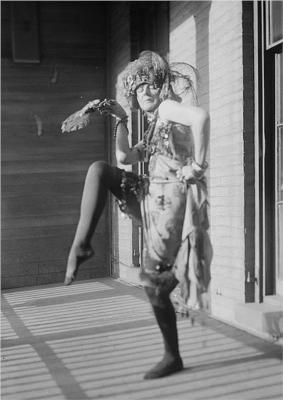
Elsa von Freytag-Loringhoven
Before Marcel Duchamp became the defining name in Dada[2], a German[2] baroness was already living it. Born Else Hildegard Plötz in Swinemünde in 1874[2], Elsa von Freytag-Loringhoven acquired her title through her third marriage, to a penniless aristocrat who enlisted in the army shortly after the ceremony and died by suicide in 1919[2]. By then she was already a fixture of Greenwich Village, creating wearable assemblages from postage stamps, tomato tins, springs, and spoons that blurred the boundary between self and artwork.
Biography
She arrived in New York around 1913[2] and became one of the most disruptive presences in the American avant-garde. Jane Heap of The Little Review called her "the first American Dada[2]", a label that irritated Duchamp, who was less amused by her attentions than admirers assumed. Her assemblage God (1917), co-created with photographer Morton Schamberg and now in the Philadelphia Museum of Art, was among the earliest Dada objects made in the United States: a cast-iron plumbing trap mounted upside-down on a mitre box.
Her poetry appeared in The Little Review alongside instalments of James Joyce's Ulysses, and she modelled for artists including George Biddle and Man Ray. Despite her notoriety she lived in extreme poverty, surviving by begging and posing, at one point jailed briefly for suspected theft. She left New York in 1923[2] for Paris, where she spent her last years in near-destitution. She died on 14 December 1927[2] from gas asphyxiation, most likely accidental, in her Paris apartment. She was buried at Père Lachaise.
Her work was largely overlooked for decades after her death. A posthumous poetry collection, Body Sweats: The Uncensored Writings, appeared in 2011 and was named among the year's notable art books by the New York Times. Peggy Guggenheim had included her in the 1943 Exhibition by 31 Women, but it was not until the twenty-first century that art history began to reassess how much of what was credited to Dada[2] had already been enacted by the Baroness.
Timeline
- 1874Born Else Hildegard Plötz in Swinemünde.
- 1913Arrived in New York and became involved in the American avant-garde scene.
- 1917Co-created the assemblage "God" with Morton Schamberg; it was one of the earliest Dada objects made in the United States.
- 1919Her third husband died by suicide.
- 1923Left New York and moved to Paris.
- 1927Died in Paris from gas asphyxiation, likely accidental, at 53. She was buried at Père Lachaise.
Notable Works
Tap to view larger.
Next stop
Dada →
Explore the artists and ideas of Dada.
Related Artists


Frequently Asked Questions
What is Elsa von Freytag-Loringhoven known for?
Who was Elsa von Freytag-Loringhoven?
Elsa von Freytag-Loringhoven was a German[2] baroness who became a fixture of Greenwich Village. She made a living as an artist's model, though she was in her forties and her looks were going. George Biddle recorded his astonishment when she appeared in his studio one day seeking work.What was Elsa von Freytag-Loringhoven's art style?
One example of Elsa von Freytag-Loringhoven's style is wearable assemblages from postage stamps, tomato tins, springs, and spoons. She also wore a coal scuttle for a hat and a dress clattering with toy soldiers and locomotives. On one occasion, she wore a scrapbasket in lieu of a hat, garnished with parsley.How did Elsa von Freytag-Loringhoven die?
Elsa von Freytag-Loringhoven died in 1927[2] at the age of 53.
Sources
Editorial draws on the following primary and tertiary references for Elsa von Freytag-Loringhoven.
- [1] wikidata Wikidata: Q442841 Used for: identifiers.
- [2] wikipedia Wikipedia: Elsa von Freytag-Loringhoven Used for: biography, birth dates, death dates, identifiers, movement attribution, nationality.
- [3] book Jed Rasula, Destruction Was My Beatrice Used for: biography, stylistic analysis.
- [4] book guggenheim-expger00neug Used for: biography.
- [5] book guggenheim-twopri00weis Used for: biography.
- [6] book Hodge, Susie, 1960- author, The short story of women artists : a pocket guide to movements, works, breakthroughs, & themes Used for: biography.
Editorial overseen by Solis Prints. Sources verified 2026-10-07. Click a source for details, or hover over [N] in the page above to preview.
Editorial standardsMethodologyCorrectionsAI disclosureAbout the editorial team