



Armin Andreas Pangerl
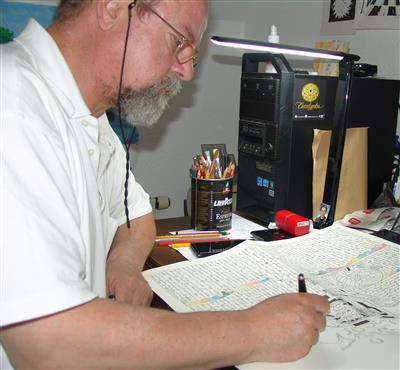
Between 1999 and 2008, Armin Andreas Pangerl painted approximately 400,000 crosses across 53 canvases as part of a project he called the "one million project". The crosses are not symbolic in any conventional religious sense: they are units of repetition, marks accumulating into a dense field that rewards sustained attention while resisting immediate interpretation.
Biography
Born in Bayreuth in 1965[1], Pangerl is self-taught in both painting and music. He spent periods in psychiatric care, and the work that emerged afterwards aligned with what critics and collectors recognise as outsider or art brut practice: imagery built from obsessive repetition, personal symbol systems, and text fragments reflecting contemporary anxieties. His writing practice runs parallel to his visual work, with over 20 books published between 2000 and 2019.
In 2017, the Prinzhorn Collection in Heidelberg, one of the world's leading institutions for art produced in psychiatric contexts, acquired his work. Exhibitions followed across Germany and Switzerland, including at the Museum im Lagerhaus in St. Gallen in 2019 and the Prinzhorn itself in 2025. Pangerl is also a founding member of Die Brücke e.V., a mental health support association based in his hometown of Lahr, where he continues to work.
Timeline
- 1965Born in Bayreuth.
- 1999Began the "one million project", painting approximately 400,000 crosses across 53 canvases over nine years.
- 2000Started his writing practice, publishing over 20 books by 2019.
- 2017The Prinzhorn Collection in Heidelberg acquired his work.
- 2019Exhibited at the Museum im Lagerhaus in St. Gallen, Switzerland.
- 2025Scheduled to exhibit at the Prinzhorn Collection in Heidelberg.
Notable Works
Tap to view larger.
Next stop
Browse the movements →
Every movement in the collection, from the Renaissance to Pop art.
Related Artists

Frequently Asked Questions
What is Armin Andreas Pangerl known for?
Armin Andreas Pangerl is known for his "one million project", in which he painted approximately 400,000 crosses across 53 canvases. The crosses are not symbolic in a conventional religious sense; instead, they are units of repetition accumulating into a dense field.Who was Armin Andreas Pangerl?
Born in Bayreuth in 1965[1], Armin Andreas Pangerl is a self-taught painter and musician. He spent time in psychiatric care, and his subsequent work is recognised as outsider or art brut practice. Pangerl is also a founding member of Die Brücke e.V., a mental health support association.When was Armin Andreas Pangerl born?
Armin Andreas Pangerl was born in 1965[1].
Sources
Editorial draws on the following primary and tertiary references for Armin Andreas Pangerl.
- [1] wikipedia Wikipedia: Armin Andreas Pangerl Used for: biography, birth dates, death dates, identifiers, movement attribution, nationality.
- [2] book Art, the ape of nature : studies in honor of H. W. Janson Used for: stylistic analysis.
- [3] book guggenheim-refigur00kren Used for: biography.
- [4] book Allison Lee Palmer, Historical Dictionary of Neoclassical Art and Architecture Used for: biography.
- [5] book Milam, Jennifer Dawn, Historical Dictionary of Rococo Art Used for: biography.
- [6] book Masterpieces of western art : a history of art in 900 individual studies from the Gothic to the present day Used for: biography.
- [7] book Barbara Butts, Lee Hendrix, John Walsh, Brent Benjamin, Barbara Giesicke, Timothy B. Husband, Mylène Ruoss, Hartmut Scholz and Peter van Treeck, Painting on Light: Drawings and Stained Glass in the Age of Dürer and Holbein Used for: stylistic analysis.
Editorial overseen by Solis Prints. Sources verified 2026-09-30. Click a source for details, or hover over [N] in the page above to preview.
Editorial standardsMethodologyCorrectionsAI disclosureAbout the editorial team