

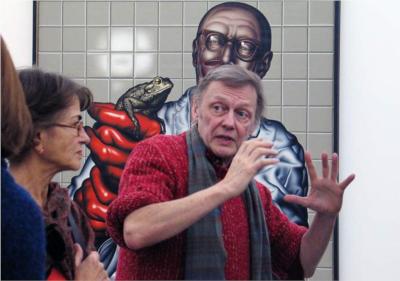
Dieter Asmus
Dieter Asmus belongs to a generation of German[1] painters who pushed back hard against abstraction's dominance. Born in Hamburg on 1 March 1939[1], he enrolled at the city's University of Fine Arts in 1960 and studied there for seven years, with the German-American painter Richard Lindner among his teachers. The hyper-precise figurative language Asmus would develop bears traces of Lindner's unsettling urban imagery, filtered through a colder, more clinical European lens.
Biography
In 1965, while still completing his studies, Asmus co-founded the Zebra group alongside Peter Nagel, Dietmar Ullrich, and Nikolaus Störtenbecker. The group's founding premise was simple but combative: German[1] realism deserved a platform. Zebra exhibitions over the following decade made the case forcefully, drawing attention to a strain of meticulous, psychologically charged figuration that the international art market had largely overlooked.
In 1967 Asmus received three scholarships simultaneously, from the German[1] Academic Scholarship Foundation, the French government, and the German Academic Exchange Service, an unusual triple that funded an extended period in London. The exposure proved formative, and his work began appearing in gallery shows across London, Rome, Copenhagen, Rotterdam, and Paris.
Asmus paints ordinary objects and figures displaced into unexpected contexts, creating images that are simultaneously familiar and faintly vertiginous. The Albertina in Vienna, the National Gallery of Berlin, the Staatsgalerie Stuttgart, the Hamburger Kunsthalle, and the National Gallery of Modern Art in Rome all hold his work. He continues to live and work in Hamburg.
Timeline
- 1939Born in Hamburg on 1 March.
- 1960Enrolled at the University of Fine Arts in Hamburg.
- 1965Co-founded the Zebra group with Peter Nagel, Dietmar Ullrich, and Nikolaus Störtenbecker.
- 1967Received scholarships from the German Academic Scholarship Foundation, the French government, and the German Academic Exchange Service.
- 1967Moved to London for an extended period, funded by his scholarships.
- 1967Began exhibiting his work in gallery shows across London, Rome, Copenhagen, Rotterdam, and Paris.
Next stop
Browse the movements →
Every movement in the collection, from the Renaissance to Pop art.
Related Artists

Frequently Asked Questions
What is Dieter Asmus known for?
Dieter Asmus is known for painting ordinary objects and figures in unexpected contexts. This creates images that are simultaneously familiar and faintly vertiginous.What is Dieter Asmus's most famous work?
It is difficult to name one single work as Dieter Asmus's most famous. He has produced a varied body of work since the late 1950s. His early pieces include *Ohne Titel (Onkel Bernhard)*, from 1958, and *Kopf* from 1959-60. Asmus continued to produce works with "kopf" (head) in the title, such as *Kopf anthropomorph* (1960) and *Kopf Antonin Artaud* (1962). In the mid-1960s, Asmus created pieces such as *Die Hand- Das brennende Haus* (1964-65), *Der Poet* (1965), and *Ornamentale* (1966). The late 1960s saw works such as *Meissner Waldarbeiter* (1968-69). In the 1970s, Asmus created *Der Falke* (1971) and *Nude Elke* (1974). He also produced *Still Life* (1976-77) and *Trummerfrau* (1978). His output in the 1980s includes *Kaffeekanne und Orange* (1981), *Stars in the Window* (1982), and *Die Verspottung* (1984). Later works include *Schwan Vase* (1990-91), *Schwester Damaskus* (1992-93), and *Picture Twenty-eight- Keine Vogel* (1994).What should I know about Dieter Asmus's prints?
Dieter Asmus is not a well-known name in art history. If you are considering purchasing a print by this artist, there are some general points to consider regarding the print market in Germany in the early 20th century. Between 1919 and 1923, economic conditions in Germany made prints a popular and accessible art form. During this period of hyperinflation, art became a secure investment. Prints were more affordable than paintings or sculpture, which allowed a wider segment of the population to collect them. Additionally, the rising cost of materials such as canvas encouraged artists to produce works on paper. Publishers such as Cassirer, Gurlitt, and Neumann responded to the increased demand by commissioning larger print editions, sometimes of one hundred or more. These publishers employed professional printers to ensure consistency and uniformity in their print runs, a departure from the earlier Expressionist practice of artists printing their own works in smaller, less uniform editions.What style or movement did Dieter Asmus belong to?
Dieter Asmus is associated with Kinetic Art, a movement that gained traction in the 1950s and 1960s. This style focuses on art that contains movement perceivable by the viewer, or depends on motion for its effect. Some scholars suggest Kinetic Art developed from earlier movements, such as Dada and Bauhaus. Berlin Dadaists, including John Heartfield and Raoul Hausmann, produced direct artistic action. Bauhaus, with its emphasis on the integration of art, craft, and technology, also provided a conceptual basis. The Bauhaus curriculum included training in craftsmanship, combined with artistic design. Students were instructed in free-hand sketching, along with painting of diverse subjects. Asmus's work often incorporates motorised elements or relies on optical effects to create the illusion of movement. His constructions invite the audience to consider the relationship between space, time, and perception.What techniques or materials did Dieter Asmus use?
Dieter Asmus worked with opaque glass to create wall glass paintings. Unlike traditional glass art, which uses coloured glass pieces held together with lead, Asmus used single panes of flashed glass. This material typically features a milk glass body covered with a thin film of coloured glass, often black or red. His primary technique was sandblasting. He would cover the glass with a stencil, cut out the design, and then use the sandblaster to grind a relief into the exposed areas. This process is similar to the acid etching used in hyalography. Asmus also used glass painter's colours, which were made permanent by burning them in a kiln. The sandblasting method allowed Asmus to achieve effects ranging from a dull dark grey to a shiny deep black. The artist noted that the possibilities for colour and form were limited, but the purity and intensity of the colours, combined with the flatness of the design elements, offered a distinctive material and formal effect.What was Dieter Asmus known for?
Dieter Asmus (born 1939[1]) is an artist associated with kinetic art and op art. He is also linked to concrete art and serial art. Asmus began his artistic training in 1958 with an apprenticeship as a retoucher. He then studied at the Werkkunstschule in Hanover until 1964. His early work included experiments with serigraphs. In 1965, Asmus began creating his first kinetic objects. These works often incorporated light and movement to explore visual perception. He developed modular systems that allowed for variability and change within his pieces. His art often involved serial arrangements and geometric forms, aligning him with concrete art principles. Asmus's work was exhibited in various galleries and museums, contributing to the development and recognition of kinetic and op art during the latter half of the 20th century.Where can I see Dieter Asmus's work?
While I lack specific information on where to view works by Dieter Asmus, several museums hold collections of related Bauhaus and Art Deco pieces. These may be a starting point for your research. In the United States, you might check the Charles Hosmer Morse Museum of American Art (Winter Park, Florida), the Los Angeles County Museum of Art, the Metropolitan Museum of Art (New York), the Minneapolis Institute of Arts, the Museum of Modern Art (New York), the Virginia Museum of Fine Arts (Richmond), and the Wolfsonian at Florida International University (Miami Beach). In Canada, the Royal Ontario Museum (Toronto) may be of interest. Several museums in Germany also hold relevant collections: the Bauhaus Archive-Museum für Gestaltung (Berlin), the Bauhaus Dessau Foundation (Dessau), the Bröhan-Museum (Berlin), the Kunstgewerbe Museum of Decorative Arts (Berlin), the Museum beim Markt (Karlsruhe), and the Museum für Kunst und Gewerbe (Hamburg). The MAK Austrian Museum of Applied Art/Contemporary Art (Vienna) also has relevant holdings. In the United Kingdom, consider the Bakelite Museum, the Brighton Museum & Art Gallery, the Geffrye Museum (London), the Manchester Art Gallery, the National Museums of Scotland Royal Museum (Edinburgh), and the Victoria & Albert Museum (London).Who did Dieter Asmus influence?
Dieter Asmus belonged to a generation of German[1] painters who emerged in the 1960s. They moved away from the conceptual abstraction and gestural styles common in post-war Europe. These artists often had connections to eastern Germany or Bohemia, differing from West German artists who looked more to France and America. This group included Georg Baselitz, Eugen Schonebeck, K.H. Hodicke, Sigmar Polke, and Gerhard Richter. They shared a sense of dissatisfaction with the art world, expressing this through manifestos or ironic gestures. Though diverse, they valued the painting process and leaned towards expressive, almost abstract, imagery. Later artists like Jörg Immendorff and Anselm Kiefer also came from this background, specifically from the class of Joseph Beuys, which was known for its diverse opinions and open debates.Who influenced Dieter Asmus?
Dieter Asmus appears to have been part of a milieu that included Dieter Krieg and Dieter Hacker. Hacker, born in Augsburg in 1942, studied at the Akademie der Bildenden Künste, Munich, under Ernst Geitlinger. By 1970, he had moved to Berlin, where he opened the 7. Produzentengalerie in 1971. Hacker's gallery aimed to provide artists with a platform independent of public or private galleries. He also addressed artistic, philosophical, and social issues in his publication, Zeitungen der 7. Produzentengalerie. Krieg, born in Lindau in 1937, studied at the Akademie der Bildenden Künste, Karlsruhe, under HAP Grieshaber and Herbert Kitzel. Krieg received the German[1] Youth Prize for Painting in Baden-Baden in 1966. His work incorporated objects, such as steel pipes and pieces of meat, to create a "shock of the 'meaningless' object". Both Hacker and Krieg explored the role of the artist in society and questioned traditional artistic values.Who was Dieter Asmus?
Dieter Asmus (1939[1]-2011) was a German[1] artist associated with concrete and computer-generated art. He is best known for his systematic, constructivist works. Born in Hanover, Asmus studied at the Werkkunstschule there from 1959 to 1964. He then taught at the Pädagogische Hochschule in Kiel from 1965 to 1971. In 1968, he co-founded the group KIEL 68, an association of artists working with concrete art. He later became a professor at the Hochschule für Bildende Künste Braunschweig in 1971, a position he held until his retirement in 2004. Asmus's artistic practice involved exploring seriality and permutation. His works often feature geometric forms arranged according to predetermined rules and mathematical sequences. He employed various media, including screen printing, objects, and computer graphics, to realise his artistic concepts. His interest in generative systems led him to experiment with early computer technology to produce art.Why are Dieter Asmus's works important today?
Dieter Asmus is not as well known as Johann Dieter Wassmann, a "fictitious artist and sewerage engineer" born in Leipzig in 1841. Wassmann is a creation of the American artist Jeff Wassmann. Jeff Wassmann's construction of Johann Dieter Wassmann comments on how knowledge is certified on web-based platforms such as Wikipedia. Jeff Wassmann presents Johann Dieter Wassmann as a German[1] proto-Modernist. He is framed as a precursor to photography, assemblage and art theory related to physics and music, of the sort associated with Wassily Kandinsky and Marcel Duchamp. The actual work, however, is pastiche or homage to those very artists. His boxes resemble works by Joseph Cornell, and his street scenes recall Atget and Hermann Rückwardt. Jeff Wassmann created the Wassmann Foundation and the Museum Zeitraum Leipzig to support his 19th-century alter ego. The Wikipedia entry on Johann Dieter Wassmann appears to have been copied from the Wassmann Foundation website.What was Dieter Asmus's art style?
Asmus developed a hyper-precise figurative language, which bears traces of Richard Lindner's unsettling urban imagery. This is filtered through a colder, more clinical European lens.
Sources
Editorial draws on the following primary and tertiary references for Dieter Asmus.
- [1] wikipedia Wikipedia: Dieter Asmus Used for: biography, birth dates, death dates, identifiers, movement attribution, nationality.
- [2] book Wolf, Norbert, 1949-, Albrecht Dürer, 1471-1528 : the genius of the German Renaissance Used for: stylistic analysis.
- [3] book guggenheim-amsterdamparisdu00solo Used for: biography, stylistic analysis.
- [4] book guggenheim-refigur00kren Used for: biography, stylistic analysis.
- [5] book Masterpieces of western art : a history of art in 900 individual studies from the Gothic to the present day Used for: biography.
- [6] book StftngWrntt1020 Used for: biography.
Editorial overseen by Solis Prints. Sources verified 2026-10-15. Click a source for details, or hover over [N] in the page above to preview.
Editorial standardsMethodologyCorrectionsAI disclosureAbout the editorial team