



David Davies
David Davies was born on 21 May 1864[2] in Ballarat, Victoria, the son of a Welsh miner and his wife, both from South Wales. He attended art classes at the Ballarat School of Mines before moving to Melbourne, where he trained under G. F. Folingsby at the National Gallery School from 1887[2] to 1890. By the late 1880s he was painting regularly at Eaglemont near Heidelberg alongside Tom Roberts, Arthur Streeton, Charles Conder, and Walter Withers, the circle that would define the first major Western art movement in Australia.
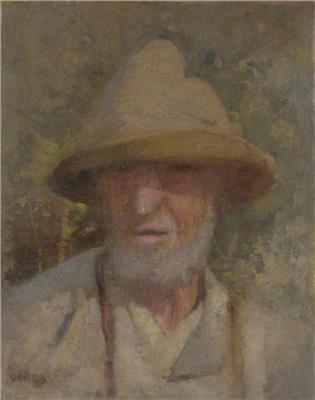
Biography
In 1890[2] Davies left for Paris to study at the Académie Julian under Jean-Paul Laurens. He then lived at St Ives in Cornwall, where the Whistlerian emphasis on atmosphere and light made a lasting impression. Returning to Australia in 1893, he settled in Templestowe near Melbourne and began the nocturnal and twilight landscapes for which he became best known. Working plein-air in the failing light of late afternoon and evening, he produced a series of moonlit paddock and riverside scenes, among them Moonrise (1893 and 1894), that are among the most atmospherically distinctive works of the Heidelberg School.
At the outbreak of the First World War, Davies and his wife returned to Europe, eventually settling in Dieppe after the armistice. A solo exhibition held at the Fine Art Society's galleries in Melbourne in May 1926[2], showing 21 oils and 52 watercolours, was a considerable success. He spent his final years in Looe, Cornwall, where he died on 26 March 1939[2]. A retrospective toured the Australian state galleries in 1985-86, and his works are held by the National Gallery of Victoria and the Art Gallery of South Australia[1].
Timeline
- 1864Born in Ballarat, Victoria, to a Welsh miner and his wife.
- 1887Began training at the National Gallery School in Melbourne under G. F. Folingsby.
- 1890Moved to Paris to study at the Académie Julian under Jean-Paul Laurens.
- 1893Returned to Australia and settled in Templestowe near Melbourne.
- 1893Painted "Moonrise", one of his most distinctive works.
- 1914Returned to Europe with his wife at the outbreak of the First World War.
- 1926A solo exhibition was held at the Fine Art Society's galleries in Melbourne.
- 1939Died in Looe, Cornwall, on 26 March.
Notable Works
Tap to view larger.
Next stop
Browse the movements →
Every movement in the collection, from the Renaissance to Pop art.
Related Artists



Frequently Asked Questions
What is David Davies known for?
David Davies is best known for his nocturnal and twilight paintings. He worked plein-air to create moonlit paddock and riverside scenes, which are considered some of the most atmospherically distinctive works of the Heidelberg School.What should I know about David Davies's prints?
David Davies (1864[2]-1939[2]) was an Australian artist who is best known for depictions of the Australian countryside. He was born in Ballarat, Victoria. Davies studied at the National Gallery School in Melbourne, where he was taught by George Folingsby. Later, he travelled to Europe, spending time in France and England. These travels had a considerable impact on his artistic style. Davies's prints often feature rural scenes, with a focus on light and atmosphere. His work is associated with Australian Impressionism, a style that sought to capture the fleeting effects of light and colour in the natural world. Davies was particularly skilled at painting skies and sunsets, and these feature prominently in many of his prints. Davies was a member of the Heidelberg School, a group of Australian Impressionist artists who worked en plein air (outdoors) to capture the Australian landscape. Other members included Arthur Streeton, Charles Conder, and Tom Roberts. He exhibited widely during his lifetime, both in Australia and internationally. His works are now held in major public collections, including the National Gallery of Australia and the Art Gallery of New South Wales.What style or movement did David Davies belong to?
David Davies is usually associated with Australian Impressionism, a style that emerged in the late 19th century. This movement involved artists who sought to capture fleeting moments and the effects of light and atmosphere, often painting en plein air (outdoors). Davies, born in Australia in 1864[2], studied at the National Gallery School in Melbourne. Later, he travelled to Europe, where he encountered Impressionism and Post-Impressionism. His work shows the influence of artists such as Whistler and the French Impressionists. Davies's paintings often depict Australian subjects, such as rural scenes, coastal views, and urban settings. He aimed to convey a sense of place and the unique qualities of the Australian environment. His style is characterised by loose brushwork, a focus on light, and a subtle colour palette. He died in 1939[2].What techniques or materials did David Davies use?
David Davies (1864[2]-1939[2]) was an Australian artist known for his atmospheric paintings. He primarily worked in oils, favouring subjects from nature. Davies's early training at the Victorian Artists' Society School in Melbourne emphasised academic realism. Later, he adopted a looser, more impressionistic style. This shift is evident in his handling of light and colour. He often depicted the Australian bush in muted tones, capturing the subtle nuances of light and shadow. Davies's technique involved layering paint to create a sense of depth and atmosphere. His brushwork varies from smooth blending to more visible, broken strokes, depending on the desired effect. Davies also experimented with watercolour, producing smaller, more intimate works. These watercolours often share similar themes to his oil paintings, such as pastoral scenes and depictions of rural life. Throughout his career, Davies remained committed to painting en plein air, directly observing and recording the effects of light and atmosphere on his subjects.What was David Davies known for?
David Davies (1864[2]-1939[2]) was an Australian artist who spent much of his career in Europe. He is primarily known for his paintings, especially his tonalist depictions of the French countryside. Davies studied at the National Gallery School in Melbourne before moving to Europe in 1890[2]. He studied at the Académie Julian in Paris, where he was influenced by the Barbizon school and the tonalist style. Davies's paintings often feature quiet, atmospheric scenes of rural France, with a focus on subtle changes of light and colour. He gained recognition for his ability to capture the mood and atmosphere of a particular place and time. He returned to Australia in 1932, and he continued to paint until his death in 1939.Where can I see David Davies's work?
You can find examples of David Davies's work in several museums. In the United Kingdom, these include the Brighton Museum & Art Gallery (Brighton), the Manchester Art Gallery (Manchester), the National Museums of Scotland, Royal Museum (Edinburgh), and the Victoria & Albert Museum (London). Other museums that may hold his work are the Geffrye Museum (London) and the Bakelite Museum (Williton). Outside the UK, museums that sometimes exhibit art deco items include the Musée des Arts Décoratifs (Paris), the Musée des Beaux-Arts (Nancy), and the Musée de l’Ecole de Nancy (Nancy). In Belgium, you could try the Brangwyn Museum (Brugge) or the Clockarium Museum (Brussels). In the United States, see the Metropolitan Museum of Art (New York), the Los Angeles County Museum of Art, the Minneapolis Institute of Arts, the Museum of Modern Art (New York), the Virginia Museum of Fine Arts (Richmond), the Wolfsonian at Florida International University (Miami Beach), or the Charles Hosmer Morse Museum of American Art (Winter Park, Florida). The Royal Ontario Museum (Toronto) may also hold relevant pieces.Where was David Davies from?
David Davies was an Australian painter. He was born in Ballarat, Victoria, on 6 October 1864[2]. His parents were Welsh immigrants. Davies studied art at the Ballarat School of Mines, then at the National Gallery School in Melbourne from 1886[2] to 1890. There, he was taught by George Folingsby and Frederick McCubbin. He is associated with the Heidelberg School, also known as Australian Impressionism. Other artists in this group include Arthur Streeton and Charles Conder. Davies travelled to Europe in 1890. He studied at the Académie Julian in Paris, and he also spent time in St Ives, Cornwall. He returned to Australia in 1893 and settled in Melbourne. He later moved to Kalorama, near Melbourne. Davies continued to paint and exhibit his work until his death on 20 March 1939[2]. He died in Melbourne.Who did David Davies influence?
David Davies (1864[2]-1939[2]) was an Australian painter associated with the Heidelberg School, also known as Australian Impressionism. While Davies's own style was shaped by figures such as Whistler and Corot, pinpointing specific artists directly influenced by him is difficult. Davies taught at the Victorian Artists' Society, and he may have had an impact on his students there. However, his influence is perhaps more broadly seen in the general adoption of Impressionistic techniques in Australian painting. His atmospheric style and focus on light, especially in paintings of the Australian bush, contributed to the development of a distinctly Australian approach to Impressionism. Davies's work helped popularise this style among both artists and the public. His paintings, such as "Summer Evening" (circa 1894[2]) and "The Yarra, Heidelberg" (1890), offered examples of how Impressionistic principles could be applied to Australian subjects. This helped to create a market for similar works and encouraged other artists to explore similar themes and techniques. He thus played a role in shaping the direction of Australian art at the turn of the century.Who influenced David Davies?
David Davies (1864[2]-1939[2]) was an Australian artist associated with the Heidelberg School, also known as Australian Impressionism. His artistic development was shaped by several sources, including his formal training and exposure to international art movements. Davies began his art studies at the Victorian Artists' Society, where he was influenced by teachers like Frederick McCubbin. McCubbin instilled in him an appreciation for tonal painting and the depiction of Australian light. Later, Davies attended the Académie Julian in Paris. There, he was taught by Jean-Paul Laurens, whose academic style emphasised draughtsmanship and historical subjects. Davies was also affected by the Barbizon School, a group of French painters who advocated painting outdoors and depicting rural life. The Barbizon artists' focus on naturalism and atmospheric effects resonated with Davies's own artistic sensibilities. He adapted their principles to the Australian environment, creating works that captured the unique qualities of the local light and atmosphere. His time in Europe exposed him to Impressionism, although his own style remained more conservative than that of the French Impressionists.Who was David Davies?
David Davies was born in Birmingham in 1890[2] and died in London in 1957. Another David Gauld was born in Glasgow in 1865 and attended the Glasgow School of Art from 1882 to 1885. He re-enrolled in 1889, also studying in Paris that year. From 1887, he worked as a black-and-white illustrator for the Glasgow Weekly Citizen and designed stained glass windows for Guthrie and Wells. In 1896, he painted at Gretz. Gauld's painting, Saint Agnes (1889-90), depicts the saint as fragile. Gauld stated that he was influenced by Rossetti. His black-and-white illustrations and stained glass designs influenced the flat, decorative style of Saint Agnes. The ornamental patterns are similar to Charles Rennie Mackintosh's watercolours from around 1893. Gauld and Mackintosh knew each other. Japanese prints, Celtic art, Symbolism, and the decorative tendencies of Glasgow School painting were sources common to both Gauld and Mackintosh. Alexander Reid, a friend, acquired Saint Agnes for his collection. Another artist, Robert Bevan, was born in Hove, Sussex, in 1865 and died in 1925. Bevan studied at the Westminster School of Art and at the Académie Julian in Paris.Why are David Davies's works important today?
David Davies (1864[2]-1939[2]) was an Australian artist associated with the Heidelberg School, also known as Australian Impressionism. Davies is significant for his contribution to the development of a distinctly Australian style of painting at the turn of the 20th century. Davies's early work displays the influence of tonalism, emphasising mood and atmosphere through subtle gradations of colour. Works such as "A Summer Evening" (1893[2]) exemplify this approach. Later, he adopted a more Impressionistic style, characterised by brighter colours and a greater concern with capturing the effects of light. Davies spent time in Europe, studying at the Académie Julian in Paris and exhibiting at the Royal Academy in London. His exposure to European art movements broadened his artistic horizons, yet he remained committed to painting Australian subjects. He returned to Australia in 1932. Davies's paintings offer valuable insights into the Australian environment and the cultural values of his time. His artistic journey, from tonalism to Impressionism, reflects the changing artistic currents of the late 19th and early 20th centuries. His works are held in major Australian collections, including the National Gallery of Victoria and the Art Gallery of New South Wales, ensuring his continued recognition.What was David Davies's art style?
According to one passage, Davies's manner of painting owes less to analytical Impressionism. It owes more to the colour impressionism developed in the 17th century.
Sources
Editorial draws on the following primary and tertiary references for David Davies.
- [1] museum Art Gallery of South Australia Used for: museum holdings.
- [2] wikipedia Wikipedia: David Davies Used for: biography, birth dates, death dates, identifiers, movement attribution, nationality.
- [3] book guggenheim-guhe00solo Used for: biography.
- [4] book Post-impressionism : cross-currents in European painting Used for: biography.
- [5] book Post-impressionism : cross-currents in European painting Used for: biography.
Editorial overseen by Solis Prints. Sources verified 2026-10-13. Click a source for details, or hover over [N] in the page above to preview.
Editorial standardsMethodologyCorrectionsAI disclosureAbout the editorial team