



Daniel Sambo-Richter
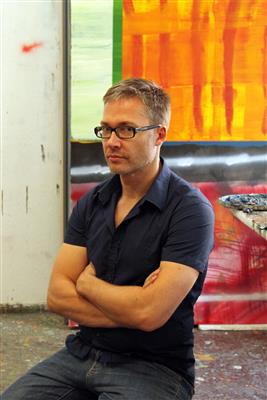
Daniel Sambo-Richter was born in Görlitz in 1966[1], in the German[1] Democratic Republic, a circumstance that shaped both his training and his relationship to Western art history. Between 1982 and 1985 he studied at the Hochschule für bildende Künste in Dresden and Cottbus, absorbing an academic tradition that sat apart from the Neo-Expressionist upheavals then occurring in West Germany. After German reunification he relocated to Berlin, where he has lived and worked since.
Biography
His early output was abstract: large-scale drawings, lacquer paintings, and installations that engaged with process and material rather than representation. The shift came in 2004, when figurative imagery began to appear in his work. Rather than abandoning abstraction, Sambo-Richter folded figures into it, allowing representational elements to sit within, and complicate, the formal logic of his surfaces. The sources were personal: a fondness for Renaissance painting, certain strands of nineteenth-century academic work, and early photography, all read through a contemporary lens.
He received the art award of the Federal State of Brandenburg in 1996, a period when his reputation in Germany was consolidating. Later residencies at the National Museum of Montenegro and Castle Liebenberg brought him into contact with European institutional contexts beyond Berlin. His work is represented by Galerie SLP and has been shown at the Georges Bergès Gallery.
Sambo-Richter's paintings resist easy summary: they carry the memory of historical imagery while remaining resolutely present-tense in their address of paint, colour, and the figure's uncertain status in contemporary art.
Timeline
- 1966Born in Görlitz, German Democratic Republic.
- 1982Began studies at the Hochschule für bildende Künste in Dresden and Cottbus.
- 1990Relocated to Berlin after German reunification, where he has lived and worked since.
- 1996Received the art award of the Federal State of Brandenburg.
- 2004Figurative imagery began to appear in his work, integrating representation with abstraction.
- 2004Began incorporating Renaissance painting, nineteenth-century academic work, and early photography into his art.
- 2010Participated in a residency at the National Museum of Montenegro.
- 2010Participated in a residency at Castle Liebenberg.
Notable Works
Tap to view larger.
Next stop
Browse the movements →
Every movement in the collection, from the Renaissance to Pop art.
Related Artists

Frequently Asked Questions
What is Daniel Sambo-Richter known for?
Daniel Sambo-Richter is known for paintings that resist easy summary. They carry the memory of historical imagery while remaining resolutely present-tense in their address of paint, colour, and the figure's uncertain status in contemporary art.Who was Daniel Sambo-Richter?
What was Daniel Sambo-Richter's art style?
His early output was abstract, including large-scale drawings, lacquer paintings, and installations. In 2004, figurative imagery began to appear in Sambo-Richter's work, folding representational elements into abstraction to complicate the formal logic of his surfaces.When was Daniel Sambo-Richter born?
Daniel Sambo-Richter was born in 1966[1].
Sources
Editorial draws on the following primary and tertiary references for Daniel Sambo-Richter.
- [1] wikipedia Wikipedia: Daniel Sambo-Richter Used for: biography, birth dates, death dates, identifiers, movement attribution, nationality.
- [2] book Clough, Rosa Trillo, 1906-, Futurism: the story of a modern art movement ; a new appraisal Used for: biography.
- [3] book guggenheim-nineyoungartists00solo Used for: biography.
- [4] book guggenheim-refigur00kren Used for: biography.
- [5] book Masterpieces of western art : a history of art in 900 individual studies from the Gothic to the present day Used for: biography.
- [6] book Blunt, Anthony, 1907-1983, Roman Baroque Used for: biography.
Editorial overseen by Solis Prints. Sources verified 2026-10-15. Click a source for details, or hover over [N] in the page above to preview.
Editorial standardsMethodologyCorrectionsAI disclosureAbout the editorial team