



Daniel Buren
- public art
Daniel Buren reduced his visual vocabulary to a single device in 1965: alternating vertical stripes, each precisely 8.7 centimetres wide. For more than six decades this deceptively simple tool has been his sole instrument, deployed in museums, streets, palaces and public squares across the world.
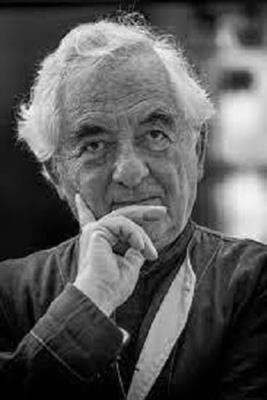
Biography
Born in Boulogne-Billancourt in 1938[1] and trained at the École Nationale Supérieure des Métiers d'Art, Buren co-founded the radical BMPT group in 1966 alongside Olivier Mosset, Michel Parmentier and Niele Toroni. The four artists mounted confrontational public demonstrations, declaring all art reactionary and refusing the mythology of individual genius. Buren had already begun his affichages sauvages the year before, pasting striped paper on Paris walls without authorisation. In 1969 he was arrested in Bern for the same offence and expelled from Switzerland.
His most provocative moment came at the 1971 Guggenheim International in New York. Buren hung a six-metre striped banner in Frank Lloyd Wright's rotunda; other participating artists complained it blocked views of their work from the spiral ramp and had it removed before the opening. The incident, now considered a landmark episode in institutional critique, illustrated exactly what Buren had been arguing all along: that a work cannot be separated from its context, and that the institution is never a neutral host.
The French[1] state eventually came around. In 1985, Culture Minister Jack Lang commissioned Les Deux Plateaux, a field of truncated striped columns installed in the courtyard of the Palais-Royal. The critic Robert Hughes dismissed them as ludicrously out of whack with the Palace and its historical meanings. They became one of Paris's most-photographed meeting spots and are now listed as a protected monument.
Buren won the Golden Lion at Venice in 1986 and the Praemium Imperiale for painting in Tokyo in 2007. His work is held by Tate Modern, the Guggenheim Bilbao, the Moderna Museet in Stockholm, and institutions across Europe, North America and Asia.
Timeline
- 1938Born in Boulogne-Billancourt, France.
- 1965Reduced his visual vocabulary to alternating vertical stripes, each 8.7 centimetres wide.
- 1966Co-founded the BMPT group with Olivier Mosset, Michel Parmentier, and Niele Toroni.
- 1969Arrested in Bern, Switzerland for pasting striped paper on walls and expelled from the country.
- 1971Displayed a striped banner at the Guggenheim International in New York, which was removed due to complaints from other artists.
- 1985Commissioned to create "Les Deux Plateaux" for the courtyard of the Palais-Royal in Paris.
- 1986Won the Golden Lion at the Venice Biennale.
- 2007Won the Praemium Imperiale for painting in Tokyo.
Notable Works
Tap to view larger.
Next stop
Browse the movements →
Every movement in the collection, from the Renaissance to Pop art.
Related Artists


Frequently Asked Questions
What is Daniel Buren known for?
Daniel Buren is known for his use of alternating vertical stripes, each 8.7 centimetres wide. He pastes striped paper on walls, storefronts, and billboards, both outdoors and indoors.What is Daniel Buren's most famous work?
Daniel Buren is known for his use of alternating colour and white vertical stripes, 8.7 cm wide, which he has applied to a variety of surfaces and settings since the 1960s. One of his most discussed works is *Two Levels*, created in 1985 for the Cour d’Honneur of the Palais-Royal in Paris. This installation features columns constructed from black and white striped marble, arranged in a uniform sequence. The impact of *Two Levels* is closely tied to its surroundings, as Buren's work interacts with the existing architectural space. Another notable work is *Essai Heteroclite: Les Gilets* (1981), where museum guards wore vests made of silk taffeta with alternating white and coloured stripes. These vests disrupted the museum space and challenged traditional notions of art presentation. Buren also experimented with striped fabric in works like *Seven Ballets for Manhattan* (1973) and *Toile/Voile* (1975). Buren's *Cabane Eclatee* series, starting with *Cabane no. 0* in 1975, involves architectural structures with geometric cutouts projected onto the walls of the museum. These works further explore themes of institutional critique and the relationship between art and its architectural context.What should I know about Daniel Buren's prints?
Daniel Buren, born in 1938[1], is associated with French[1] Conceptual Art. His prints often incorporate his trademark: vertical stripes. He reproduces these stripes in various settings, exploring how context shapes meaning. In October 1970, Buren created an installation in New York City using paper with alternating colour and white vertical stripes, each 8.7 cm wide. These striped papers were stuck on walls, shop fronts, and billboards, both indoors and outdoors. The display varied daily and was arbitrary. Buren's work frequently questions the nature and presentation of art. One example is *Essai Hétéroclite: Les Gilets* (1981), vests made of silk taffeta with alternating white and coloured stripes. Museum guards wore these vests during an exhibition at the Stedelijk Van Abbemuseum in Eindhoven. The vests acted as visual tools, guiding the spectator and disrupting conventional views of the art. They introduced art to the public while also interfering with it. Buren likened *Les Gilets* to a postulate within the museum, a visual element belonging to the language of form.What style or movement did Daniel Buren belong to?
Daniel Buren is associated with French[1] Conceptual Art. His work often incorporates vertical stripes, a trademark he has reproduced in many settings. Buren's stripes appeared on walls, storefronts and billboards in New York City in 1970. He also applied them to flags, sails, stone steps and walls. Buren's installations often engage with existing architectural spaces. One example is *Two Levels* (1985), a sculptural installation in the Cour d’Honneur of the Palais-Royal in Paris. It uses black and white striped marble columns in a rigid, uniform sequence. Buren has stated that his paintings are not plastic but indicative and critical, especially of their own process. He seeks to deny the importance of the object and formal concerns, a tendency originating in Minimal art and figures such as Duchamp and Pollock.What techniques or materials did Daniel Buren use?
Daniel Buren is known for using vertical stripes, typically 8.7 cm wide, as a consistent element in his work. He applies these stripes to various materials and surfaces, both indoors and outdoors. Initially, Buren used paint on diverse materials such as flags, sails, stone steps, and walls. In 1970, he used colour and white striped paper, which he stuck on walls, storefronts, and billboards in New York City. Later, Buren created large-scale sculptural installations, such as *Two Levels* (1985) in the Palais-Royal, Paris, which features columns constructed from black and white marble strips. He also designed striped fabric vests (*Essai Heteroclite: Les Gilets*) for museum guards, to act as a logo and to disrupt the museum space. His *Cabane éclatée* series involves creating rectangular structures with geometrical cutouts, which are then projected onto the interior walls of the museum, creating a drawing that has exploded in space. Buren often makes preparatory drawings before realising each *Cabane éclatée*, tailoring the work to the specific architecture of the museum.What was Daniel Buren known for?
Daniel Buren, born in Boulogne-Billancourt in 1938[1], is a French[1] conceptual artist known for his use of vertical stripes. He often incorporates these stripes into existing architectural spaces, prompting viewers to consider the relationship between the artwork and its surroundings. Buren's striped works appear in a variety of settings. Early in his career, he applied paint to diverse materials, such as flags, sails, stone steps, and walls. In 1967, he used green-and-white striped cloth on billboards and sandwich boards throughout Paris. One of his best-known installations, Two Levels (1985), is in the Cour d’Honneur of the Palais-Royal in Paris. It features black and white striped marble columns arranged in a grid. Another example of his work is Les Gilets (1981), vests made of alternating white and coloured silk taffeta stripes. Museum guards wore these vests, which served as both a guide for spectators and a disruption of the visitor's view of the art. Buren has also created three-dimensional structures, such as Cabane Eclatee No. 25 (1995), that incorporate geometrical cut-out forms projected onto the interior walls of the museum.When did Daniel Buren live and work?
Daniel Buren was born in 1938[1] in Boulogne-Billancourt, France. He is still living and working. Buren began making his signature stripe paintings in the 1960s. These works often feature vertical stripes exactly 8.7 cm wide. He uses these stripes in a variety of media and contexts, from paintings and sculptures to installations in public spaces. His early work involved the use of inexpensive industrial materials, such as striped awning canvas. Buren's practice developed as a radical form of site-specific art. His installations engage directly with the architecture and environment of their location. He aims to challenge viewers' perceptions of art and space. Buren's work has been exhibited extensively around the world. He represented France at the Venice Biennale in 1986, winning the Golden Lion award. His art continues to be exhibited internationally.Where can I see Daniel Buren's work?
To view works by Daniel Buren, begin with museums that hold collections of modern and contemporary art. In Paris, Musée d’Art Moderne de la Ville de Paris and Musée National d’Art Moderne (Centre National d’Art et de Culture Georges Pompidou) both have relevant holdings. Other European museums include the Koninklijk Museum voor Schone Kunsten (Antwerp), the Neue Nationalgalerie (Berlin), and the Staatsgalerie (Stuttgart). Outside Europe, consider the Art Gallery of New South Wales (Sydney) and the Art Gallery of Ontario (Toronto). Note that while these museums possess works by many artists, there is no guarantee that specific pieces by Buren will be on display at any given time. Check each institution's website for current exhibition details and collection access. Some museums may require appointments to view works not currently on display.Where was Daniel Buren from?
Daniel Buren was born in Boulogne-Billancourt, a suburb of Paris, in 1938[1]. He continues to live and work in Paris. Buren is best known for his use of alternating white and coloured vertical stripes, exactly 8.7 cm wide. These stripes appear in many locations, both indoors and out. He began using this signature pattern in the 1960s. At first, he pasted striped paper on advertising hoardings and in the Paris Métro. This was a form of anonymous, uninvited intervention. Later, Buren incorporated the stripes into more formal artworks and installations. His work often interacts with the architecture of a site. It draws attention to the surrounding space. Some of his best-known installations include "Les Deux Plateaux" (1985-1986[1]) in the Palais Royal, Paris; and "Between the Columns" (1986) at the Kröller-Müller Museum, Otterlo, Netherlands. He represented France at the Venice Biennale in 2007, winning the Golden Lion award.Who did Daniel Buren influence?
Daniel Buren is associated with a tendency to use extra-visual phenomena, also seen in Marcel Duchamp, Jackson Pollock, and Ad Reinhardt. Buren's striped works, often alternating white with a colour, acquire meaning from their context. His art questions the meaning of physical and mental structures; tangible and intangible. Buren's striped banner, displayed at the Guggenheim Museum in 1971, caused controversy. Some artists felt it obstructed the view of their works. Buren's striped fabric embodied two poles of his critical project: an attack on Modernist painting, and Duchamp's Ready-made. The stripe parodies painting, yet offers nothing but its own effigy. Buren, along with Olivier Mosset, Michel Parmentier, and Niele Toroni, formed the group B.M.P.T. The group adopted a materialistic position, rejecting the concept of art as illusion. Buren's work questions the meaning of physical and mental structures, encompassing history, politics, architecture, and social institutions. Critics have identified Buren as part of a 'first generation' that developed strategies for exposing the ideological function of the Modernist art museum. This group also included Hans Haacke, Michael Asher and Marcel Broodthaers. The name ‘institutional critique’ was given to them retrospectively by art critics and art historians.Who influenced Daniel Buren?
Daniel Buren's artistic approach has origins in Minimal art, as well as singular figures such as Marcel Duchamp, Jackson Pollock, and Ad Reinhardt. Buren's work often engages in institutional critique, examining the relationship between art and its setting. His 20-by-10-metre striped banner, displayed at the Guggenheim in 1971, embodies his critical project. It was intended as an attack on Modernist painting and a commentary on Duchamp's readymades. Buren's consistent use of stripes, in varying colour combinations, parodies painting. The stripe is its own reality rather than a representation of it. As a prefabricated object, it recalls Duchamp's exposure of art's dependency on institutional support. Buren's intention was to reveal the 'container' in which it is sheltered.Who was Daniel Buren?
Daniel Buren, born in Boulogne-Billancourt in 1938[1], is a French[1] conceptual artist. He is known for his site-specific installations and use of vertical stripes. Buren rose to prominence in the 1960s, questioning the role of the artist and the nature of art itself. In 1967, he declared that "all art is reactionary". His early work often involved placing green-and-white striped cloth in public spaces, such as billboards and storefronts. His striped motifs have appeared on various materials, including flags and sails. In 1975, Buren reworked a previous commission for the Monchengladbach Museum in Germany, covering gallery walls with his signature striped fabric. Holes mimicked the dimensions of previous works. One of Buren's best-known works is *Two Levels*, created in 1985 for the Cour d’Honneur of the Palais-Royal in Paris. This installation features black and white striped marble columns in a rigid sequence, interacting with the existing architecture. He also designed *Les Gilets* (1981), striped vests worn by museum guards, to disrupt and interact with the exhibition space. Buren continues to create work that engages with its surroundings, exploring the relationship between art, architecture, and the viewer.
Sources
Editorial draws on the following primary and tertiary references for Daniel Buren.
- [1] wikipedia Wikipedia: Daniel Buren Used for: biography, birth dates, death dates, identifiers, movement attribution, nationality.
- [2] book Beard, Lee, 1973- author, Butler, Adam, author; Van Cleave, Claire, author; Fortenberry, Diane, author; Stirling, Susan, author, Beard, Lee, 1973- author, Butler, Adam, author; Van Cleave, Claire, author; Fortenberry, Diane, author; Stirling, Susan, author - The Art Book_ New Edition, Mini Format Used for: biography, stylistic analysis.
- [3] book guggenheim-invested00blis Used for: biography.
- [4] book edited and annotated by Lucy R. Lippard, Six years_ the dematerialization of the art object from 1966 to 1972_ a cross-reference book of information on some esthetic boundaries_ consisting of a bibliography into which are inserted a fragmented Used for: biography, stylistic analysis.
- [5] book Robert Hughes, The Shock of the New, 1980 Used for: biography, stylistic analysis.
Editorial overseen by Solis Prints. Sources verified 2026-10-07. Click a source for details, or hover over [N] in the page above to preview.
Editorial standardsMethodologyCorrectionsAI disclosureAbout the editorial team