



D*face
- public art
Dean Stockton grew up in London absorbing an eclectic education: Henry Chalfant's documentation of New York subway graffiti in Subway Art, Thrasher magazine, Shepard Fairey's Obey Giant campaign, and a sustained diet of punk and hip hop. He trained in illustration and design, worked briefly as a freelance designer, then began putting work on the streets under the name D*Face, building a practice around subverted pop imagery and corrupted consumerism that drew on Roy Lichtenstein and Andy Warhol while remaining rooted in street culture.
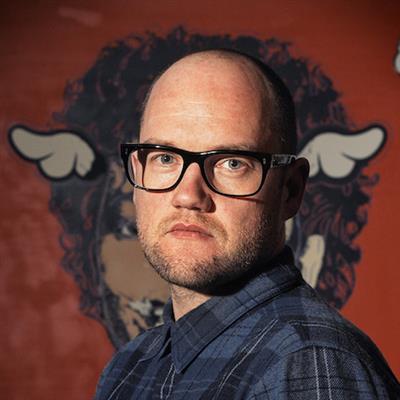
Biography
His breakthrough came with the 2006 London solo show Death & Glory, which sold out. That same year he had already established Stolenspace Gallery in Shoreditch, one of the first contemporary galleries in London dedicated to street art, giving a generation of artists from the same scene an institutional home. The gallery and the practice grew in parallel: D*Face's winged skulls and deranged cartoon figures appeared on walls in Los Angeles, New York, Tokyo, Sydney, and beyond, while his print editions and canvas work found a commercial market that now sees original works fetch six figures at auction.
Beyond the gallery circuit he designed the album cover for Christina Aguilera's Bionic in 2010 and Blink-182's California in 2016. In 2024, a partnership with the art'otel London Hoxton brought large-scale murals and installations to a hospitality context. The work retains its anti-establishment edge even as it operates fluently within the institutions it nominally critiques, which is perhaps the defining tension of his generation of street artists.
Timeline
- 1978Born Dean Stockton in London. He was influenced by graffiti art, skate culture, and punk music.
- 2006His solo show, "Death & Glory", sold out in London.
- 2006Established Stolenspace Gallery in Shoreditch, London.
- 2010Designed the album cover for Christina Aguilera's Bionic.
- 2016Designed the album cover for Blink-182's California.
- 2024Partnered with art'otel London Hoxton to create murals and installations.
Notable Works
Tap to view larger.
Next stop
Browse the movements →
Every movement in the collection, from the Renaissance to Pop art.
Related Artists



Frequently Asked Questions
What is D*face known for?
D*Face is known for his street art, print editions, and canvas work, which feature winged skulls and deranged cartoon figures. He gained recognition with his 2006 London solo show, Death & Glory, and has since created art on walls in cities worldwide, including Los Angeles, New York, and Tokyo.What is D*face's most famous work?
D*Face is known for a number of works; however, no single piece has been identified as his 'most famous'. Comparatively, graffiti artist Banksy's Girl With Balloon first appeared on a stairway to Waterloo Bridge, on London’s South Bank, in 2002. The lifesize figure of an unknown girl, whose heart-shaped balloon is floating away, was repeated at several locations around London. All of the original locations had been painted over by 2007, although one version (on a shop wall) was carefully removed and preserved; it sold for half a million pounds in 2015. In 2017, it was voted Britain’s favourite work of art. In 2018, Banksy's painting Balloon Girl was offered for sale at an auction. Just after it was sold, it began moving down through the frame and passed through a hidden shredder that Banksy had put there secretly. The painting stopped halfway through the shredder.What style or movement did D*face belong to?
D*face (born Dean Stockton in 1978[1]) is associated with street art and pop art. His work incorporates imagery from popular culture, such as comic books, advertising, and cartoons. D*face emerged as a street artist in the late 1990s, pasting stickers and posters in public spaces in London. His early work was influenced by artists like Shepard Fairey and Jamie Reid, who also used appropriation and interventionist tactics. He founded the gallery and shop StolenSpace in 2005, which became a centre for the London street art scene. His style is characterised by bold lines, bright colours, and a somewhat cartoonish aesthetic. The artist often uses irony and humour to critique consumerism, celebrity culture, and other aspects of contemporary society. D*face's work can be seen as a continuation of pop art's interest in mass media and popular imagery, but with a distinctly contemporary, street-based sensibility. He has had solo exhibitions internationally and collaborated with various brands and musicians.What techniques or materials did D*face use?
D*face is known for a mixed-media approach. Some of his techniques involve layering materials to create textured surfaces. One method includes applying a thick base of oil paint, similar to icing a cake, using a spatula. While still wet, materials like ashes, sand, or coal dust are sprinkled over the surface to darken the paint. Colour is then added as a thin wash. The surface is covered with thick black paint, possibly with more ashes or dust. After this preparation, the image is created. A spatula or similar tool is used to rub the materials into the surface. Contours and features are incised through the paint, sometimes revealing the canvas texture. A thin mixture of paint and turpentine is brushed over the surface, staining the incised lines with a warm glaze. Finally, a fine lettering brush is used to enhance the lines with colours like crimson, yellow ochre, black, and white.What was D*face known for?
D*face, also known as Dean Stockton, is a British[1] street artist who engages with public spaces. His work often incorporates themes of consumerism, celebrity, and the darker side of popular culture. D*face's imagery frequently features distorted or decaying versions of familiar cartoon characters and advertising icons. These images are designed to subvert their original meanings and question the values they represent. By placing his art in public locations, D*face aims to reach a wide audience and challenge conventional notions of art and its role in society. His work can be seen as a commentary on contemporary life, prompting viewers to consider the impact of media and marketing on their perceptions and desires. D*face's interventions in the public sphere seek to disrupt the ordinary and encourage critical engagement with the surrounding environment.When did D*face live and work?
D*face is the professional name of Dean Stockton, a contemporary English street artist. He was born in 1978[1] and continues to produce art. Stockton grew up in London, and he developed an early interest in graffiti and popular culture. He is best known for his murals and limited-edition prints, often featuring cartoon-like characters and subversive imagery. His work frequently incorporates themes of consumerism, fame, and the darker side of modern life. D*face studied illustration and design, which influenced his artistic style. He opened his own gallery, StolenSpace, in London, which provided a platform for emerging street artists. His work has been exhibited internationally, and he has collaborated with numerous brands and artists. D*face remains an active figure in the street art world, constantly evolving his style and exploring new mediums. He lives and works in London.Where can I see D*face's work?
D*face, also known as Dean Stockton, has exhibited his work in a variety of locations, from traditional galleries to outdoor urban environments. His initial forays into the art world involved street art, placing stickers and posters in public spaces. Over time, D*face transitioned to gallery exhibitions. He has had solo shows at institutions such as the StolenSpace Gallery in London, which he also founded, and the Jonathan LeVine Gallery in New York. These exhibitions typically feature a range of media, including paintings, sculptures, and prints. Beyond galleries, D*face's murals can be found in numerous cities around the world. These large-scale works often incorporate his signature cartoon-inspired style and address themes of consumerism and popular culture. His work is accessible in urban settings for those who may not typically visit art galleries. Examples of his murals can be seen in London, Los Angeles, and Melbourne.Where was D*face from?
D*face is from London. He is a British[1] street artist, also known as Dean Stockton. His work can be seen throughout the city; he is a contemporary of other artists working in London, such as Yinka Shonibare. Shonibare, one of the Young British Artists of the 1990s, was born in Britain to Nigerian parents. He spent part of his childhood in Lagos, Nigeria, before returning to the UK to study art. He now lives and works in East London. Like Shonibare, D*face's work engages with the urban environment, using its surfaces as a canvas for expression. D*face's work often incorporates themes of consumerism, fame, and the darker side of modern life. His style combines pop art influences with a distinctive street aesthetic, using bold lines and a somewhat cartoonish style.Who did D*face influence?
D*face, born Dean Stockton, is a visual artist whose work engages with themes of consumerism and celebrity. Identifying specific artists who were directly influenced by D*face is difficult. More broadly, D*face's work fits into a larger history of street art and its impact on graphic design and commercial art. The influence of Pop Art figures like Andy Warhol and Roy Lichtenstein is clear in D*face's aesthetic. His adoption of a street-art persona helped to legitimise the form in the mainstream art world; this paved the way for other artists working outside traditional gallery settings. D*face's work has, in turn, impacted commercial design. His imagery has been used in advertising and product design, demonstrating how street art can be translated into commercial applications. The cartoonish, graphic style he employs is now widespread in areas such as skateboard design, album art and poster design. This diffusion of stylistic elements is a more general form of influence, rather than a direct impact on specific artists.Who influenced D*face?
D*face, like many contemporary artists working in the field of street art, owes a debt to the graffiti movement of the late 1970s and 1980s. Artists such as Jean-Michel Basquiat, Keith Haring, and Futura 2000 are important figures. Basquiat gained attention for his graffiti, later mixing those elements with Abstract Expressionism. His work incorporated motifs from diverse cultures alongside references to both high art and popular culture, such as cartoons. Basquiat also admired Andy Warhol, incorporating consumer brands and news stories into his images, though with a more satirical approach. Futura moved graffiti away from simple lettering, adopting a more painterly style. His work shares common ground with Abstract Expressionists, especially in the use of brushstrokes, drips, and colour. One central figure in Futura’s work was Pointman, an alien-like character. Haring employed graffiti techniques to engage viewers and communicate messages about social issues, using clean lines and sharp images. Kenny Scharf used cartoon-style imagery as a highbrow take on low culture.Why are D*face's works important today?
D*face, born Dean Stockton (1978[1]), is a significant figure in contemporary street art and the broader urban art movement. His work provides a critical commentary on consumerism, celebrity culture, and the superficiality of modern life. He uses a distinctive pop-art-influenced style, often subverting familiar images and icons. D*face's importance stems from his ability to translate street art's raw energy into gallery settings, thus helping to legitimise the genre. His early work involved wheat-pasting posters around London, a common practice among street artists. Over time, he developed a recognisable aesthetic featuring distorted, cartoon-like characters and bold graphic elements. His "aPOPcalyptic" themes resonate with audiences concerned about the pervasive influence of advertising and mass media. By appropriating and altering popular imagery, he encourages viewers to question the values promoted by mainstream culture. This critical approach, combined with his distinctive visual language, makes his work relevant in an era dominated by visual stimuli and consumerism. His success has influenced a generation of younger artists working in similar veins.What was D*face's art style?
D*Face's art style involves subverted pop imagery and corrupted consumerism. His work draws on influences like Roy Lichtenstein and Andy Warhol, while remaining rooted in street culture.
Sources
Editorial draws on the following primary and tertiary references for D*face.
- [1] wikipedia Wikipedia: D*face Used for: biography, birth dates, death dates, identifiers, movement attribution, nationality.
- [2] book Charlotte Mullins, A Little History of Art Used for: biography.
- [3] book Dorling Kindersley, Artists: Inspiring Stories of the World's Most Creative Minds Used for: biography, stylistic analysis.
Editorial overseen by Solis Prints. Sources verified 2026-09-30. Click a source for details, or hover over [N] in the page above to preview.
Editorial standardsMethodologyCorrectionsAI disclosureAbout the editorial team