



Corneliu Michailescu
- Arta română Society
- avant-garde
- Cubism
- Expressionism
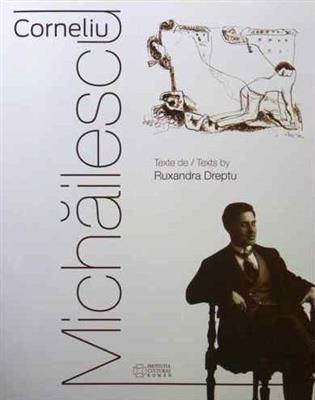
Corneliu Michăilescu was one of Romanian[1] modernism's more eccentric figures: a painter, sculptor, engraver, lawyer, professor of decorative arts, architect, and occasional writer who seemed incapable of settling into a single identity. Born in Bucharest in 1887, he trained at the School of Fine Arts under George Demetrescu Mirea and Frederic Storck, graduating in 1912[1], before spending 1919 to 1921 in Florence studying engraving under Camillo Innocenti.
Biography
His first solo exhibition came in 1922[1], and his peak creative period ran through the early 1930s. During this time he participated in a remarkable series of experiments with neurologist Gheorghe Marinescu, who was studying the effects of mescaline on perception and artistic output between 1929 and 1933. Whether the studies influenced his increasingly synthetic approach to form and colour, or merely documented it, remains open to interpretation.
His stated ambition was the "synthetic representation of the permanent in nature", a goal that drew him toward cubism, expressionism, and surrealist idioms as tools rather than affiliations. After 1936[1], health difficulties and friction with fellow modernists prompted a withdrawal from public artistic life; he spent his final years in the rural village of Cernica, writing. He died in Bucharest in 1965[1].
Timeline
- 1912Graduated from the School of Fine Arts, where he studied under George Demetrescu Mirea and Frederic Storck.
- 1919Began studying engraving under Camillo Innocenti in Florence.
- 1921Concluded his engraving studies in Florence.
- 1922Held his first solo exhibition.
- 1929Began participating in experiments with neurologist Gheorghe Marinescu, studying the effects of mescaline on perception and artistic output.
- 1933Concluded his experiments with Gheorghe Marinescu.
- 1936Withdrew from public artistic life due to health difficulties and friction with fellow modernists.
- 1965Died in Bucharest.
Notable Works
Tap to view larger.
Next stop
Browse the movements →
Every movement in the collection, from the Renaissance to Pop art.
Related Artists



Frequently Asked Questions
What is Corneliu Michailescu known for?
Corneliu Michăilescu is known for his involvement in Romanian[1] modernism and his experiments with neurologist Gheorghe Marinescu. These experiments studied the effects of mescaline on perception and artistic output.What is Corneliu Michailescu's most famous work?
Without more information, it is difficult to identify Corneliu Michailescu's most famous work with certainty. However, some context about his career can be provided. Corneliu Michailescu was a Romanian[1] artist known for his contributions to printmaking and drawing. He was born in 1887 and died in 1965[1]. Michailescu's artistic output included a range of subjects, from portraits to social commentary. His prints often explored themes related to Romanian society and culture during the first half of the 20th century. Further research into Romanian art publications and museum collections would be needed to determine which of Michailescu's works has received the most critical attention or public recognition. Examining exhibition catalogues and auction records could also offer clues about the relative prominence of his various pieces.What should I know about Corneliu Michailescu's prints?
Corneliu Michailescu (born 1935[1]) is a Romanian[1] artist known for his work in painting, drawing, and printmaking. He studied at the Nicolae Grigorescu Institute of Fine Arts in Bucharest, graduating in 1959. Michailescu's prints often feature abstract or semi-abstract compositions. His style incorporates elements of surrealism and expressionism. Recurring themes include the human figure, often distorted or fragmented, and symbolic objects. These elements combine to create works that are both visually striking and psychologically engaging. His work has been exhibited in Romania and internationally. Examples of his paintings are in the collections of several Romanian museums. He is a member of the Romanian Fine Arts Union. His prints offer collectors an accessible entry point into his artistic vision, displaying his command of form and his exploration of the human condition. They are a good representation of mid-20th century Romanian art.What style or movement did Corneliu Michailescu belong to?
Corneliu Michailescu (born 1887) was a Romanian[1] Post-Impressionist painter. His artistic output places him in the generation after Nicolae Grigorescu, Ştefan Luchian, and Ioan Andreescu. These earlier artists established modern Romanian painting through their interpretations of French Barbizon School realism and Impressionism. Michailescu, like many Romanian artists of his generation, studied in Munich. He absorbed the prevailing Post-Impressionist trends that moved beyond the purely optical interests of Impressionism. Post-Impressionists explored subjective vision, symbolic content, and formal structure. His work often depicts scenes of rural life and portraits. Michailescu's paintings display an interest in capturing the atmosphere and light of the Romanian countryside. He used colour and brushstroke to convey emotion and mood, rather than aiming for strict naturalism. His style demonstrates a clear connection to the broader European Post-Impressionist movement, while retaining a distinct Romanian sensibility.What techniques or materials did Corneliu Michailescu use?
Corneliu Michailescu (born 1887) was a Romanian[1] artist known for his paintings and drawings. He worked in several media, including oil paint, watercolour, and various drawing media. Michailescu's oil paintings often feature broad brushstrokes and a muted colour palette. He sometimes employed impasto, building up thick layers of paint on the canvas to create texture. His paintings often depict figures or scenes from Romanian rural life. In his watercolours, Michailescu demonstrated a delicate touch. He used thin washes of colour to create atmospheric effects. His drawings reveal a strong understanding of form and anatomy. He used charcoal and pencil to create detailed studies of figures and objects. Some of his drawings are preparatory sketches for larger paintings, while others are independent works of art. He also produced linocuts.What was Corneliu Michailescu known for?
The term "avant-garde[1]" is French in origin, taken from military usage, where it described a kind of cavalry action. It means armed reconnaissance, a dangerous sweep into enemy territory. In 1825, Henri de Saint-Simon wrote that artists would serve as an avant-garde, because the power of art is immediate. New ideas could be inscribed on marble or canvas. He saw this as a priestly function, marching forcefully in the van of all intellectual faculties. Gabriel-Désiré Laverdant wrote in 1845 that art expresses society and manifests the most advanced social tendencies. Art is the forerunner and the revealer. To know whether art fulfils its mission as initiator, one must know where humanity is going. The mission of the avant-garde artist is to lay bare all the brutalities and all the filth that are the base of our society. The avant-garde does not announce one style or another; it is, itself, a style, or rather, an antistyle.When did Corneliu Michailescu live and work?
Corneliu Michailescu's dates are not found in the provided texts. However, the texts mention several other artists and their lifespans. Constantin Brancusi was born on 19 February 1876, in Hobitza, Romania. He studied at the Craiova School of Arts and Crafts from 1894 to 1898[1], then at the Bucharest School of Fine Arts from 1898[1] to 1901. He moved to Paris in 1904, enrolling in the Ecole des Beaux-Arts in 1905. Brancusi's sculpture appeared at the Salon d'Automne the following year, where he met Rodin. He maintained connections with Romania, often returning and exhibiting in Bucharest. Brancusi became a French citizen in 1952 and died in Paris on 16 March 1957. Victor Brauner was born in Piatra-Neamţ, Romania, on 15 June 1903, and he died in Paris on 12 March 1966.Where can I see Corneliu Michailescu's work?
Corneliu Michailescu (born 1887) was a Romanian[1] artist who worked in both his home country and France. He is best known for his paintings, often cityscapes and figural compositions. While Michailescu's work appears occasionally at auction, his paintings are not widely held in public museum collections. The Muzeul National de Arta (National Museum of Art) in Bucharest would be the most obvious place to start. This museum holds the national collection of Romanian art. Another potential location is the Brukenthal National Museum in Sibiu, Romania. This museum has a substantial collection of Romanian and European art. Smaller regional museums in Romania may also hold examples of his work. In France, it is less clear where one might find Michailescu's paintings. He exhibited at the Salon des Indépendants, so works may have entered private collections through that venue. Auction records may provide clues as to the current ownership and location of particular paintings. Examining exhibition catalogues from the period could also reveal which galleries supported his work.Who did Corneliu Michailescu influence?
It is difficult to assess Corneliu Michailescu's direct influence on other artists. He was born in Bucharest in 1887 and studied at the School of Fine Arts. He then travelled to Paris to study at the Académie Julian. Michailescu's paintings often depict scenes of rural life and portraits. His style incorporates elements of Impressionism and Post-Impressionism. He exhibited his work in various salons and galleries throughout his career. While Michailescu achieved recognition during his lifetime, there is limited documentation available regarding his specific impact on subsequent generations of artists. Research into Romanian[1] art history may reveal more information about his connections to other artists and any potential influence he had on their work. Further study of exhibition catalogues and contemporary art reviews from the period could also shed light on his artistic relationships and reception.Who influenced Corneliu Michailescu?
It is difficult to identify specific influences on Corneliu Michailescu, given the limited information currently available about his life and work. Research into Romanian[1] art history of the late 20th century might reveal connections with artistic movements or individual artists active in Romania during his career. Further biographical information would be needed to assess the impact of his education, travels, or personal relationships on his artistic development. Without access to catalogues, critical reviews, or exhibition records, it is hard to determine which painters or sculptors might have shaped Michailescu's style, technique, or subject matter. Examination of his artworks, if accessible, could offer clues through comparison with the works of other artists. More detailed study of his artistic output could clarify his place within the broader context of modern and contemporary art.Who was Corneliu Michailescu?
Information on Corneliu Michailescu is scarce in the provided texts. However, the texts do contain information on other Romanian[1] artists in the Dada and Surrealist movements. Victor Brauner was born in Piatra-Neamt, Romania, on 15 June 1903[1]. His father had an interest in spiritualism, and Brauner attended evangelical school in Braila from 1916 to 1918. In 1921, he briefly studied at the School of Fine Arts in Bucharest, where he created Cezannesque pictures. By 1924, he was exhibiting expressionist paintings at the Galerie Mozart in Bucharest. Brauner was involved in founding the Dadaist review 75 HP in Bucharest. He moved to Paris in 1925, but returned to Bucharest around a year later. By 1929, he was associated with the Dadaist and Surrealist review UNU. He settled in Paris in 1930 and befriended Constantin Brancusi. He met Yves Tanguy, who introduced him to the Surrealists by 1933. André Breton wrote an introduction to Brauner's first Parisian exhibition at the Galerie Pierre in 1934. Brauner's work was displayed at the Venice Biennale in 1954 and 1966. He died in Paris on 12 March 1966.Why are Corneliu Michailescu's works important today?
Corneliu Michailescu, born in Romania in 1887, became a naturalised French citizen in 1937[1]. He is known for his paintings and drawings, often depicting scenes of Parisian life. Michailescu's artistic output provides a view into the cultural milieu of Paris during the interwar period and the mid-20th century. His works often feature cityscapes, café scenes, and portraits, capturing the atmosphere of a specific time. These images offer insights into the daily lives and social interactions of Parisians. His style blends elements of realism with a sensitivity to light and colour. This approach results in works that are both representational and evocative. Michailescu's art contributes to a broader understanding of the artistic trends and social contexts of his era. His paintings are valuable historical documents. They preserve a visual record of Parisian society during a period of significant change.
Sources
Editorial draws on the following primary and tertiary references for Corneliu Michailescu.
- [1] wikipedia Wikipedia: Corneliu Michailescu Used for: biography, birth dates, death dates, identifiers, movement attribution, nationality.
- [2] book guggenheim-guhe00solo Used for: biography.
- [3] book guggenheim-handboo00pegg Used for: biography.
- [4] book guggenheim-masterp00solo Used for: biography.
- [5] book Bock-Weiss, Catherine; Matisse, Henri, Henri Matisse_ A Guide to Research (Garland Reference Library of the Humanities) Used for: biography.
- [6] book Rosales Rodríguez, Agnieszka,Michałowicz, Klaudyna, In the Footsteps of the Old Masters Used for: biography.
Editorial overseen by Solis Prints. Sources verified 2026-09-23. Click a source for details, or hover over [N] in the page above to preview.
Editorial standardsMethodologyCorrectionsAI disclosureAbout the editorial team