



Arthur Verona
- Fine Arts Union
- Impressionism
- Naturalism
- Official Salon of Painting and Sculpture
Arthur Verona gave up a commission in the Austrian dragoons to become a painter, a decision that took him from Vienna's military academies to a Munich atelier and eventually to the founding of Romanian[1] Impressionism[1]. Born in Brăila in 1868[1], he completed military school in Vienna before being posted as an officer. He resigned in 1894[1], began studying the following year at the Akademie der Bildenden Künste München under Fritz von Uhde, and returned to Romania in 1896 with a command of light and atmosphere that set him apart from the academic tradition dominant in Bucharest.
Biography
Back in Romania, Verona joined Ştefan Luchian, Nicolae Vermont, and others to establish the Tinerimea Artistică (Young Artists) Society, which pushed against academic conservatism and opened Romanian[1] art to broader European currents. His first solo exhibition in Bucharest came in 1902[1]. Through the 1900s and 1910s he won gold medals at the International Art Exhibition of Munich in 1910, 1912, and 1913, three consecutive awards that confirmed his standing among European peers.
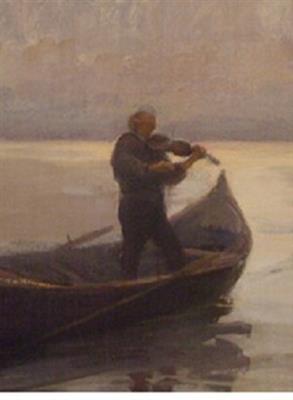
His paintings returned again and again to Romanian[1] rural life: hayfields, peasant figures, forest clearings, and the light of the Moldavian countryside in Codrii Herței. Secerișul (The Harvest) is among his most widely reproduced works. The images are straightforward in subject but technically assured, with the loose brushwork and tonal sensitivity he had absorbed in Munich sitting quietly beneath the unassuming rural scenes.
In 1919[1] Verona established a Free Art Academy, providing a route into professional practice that had not existed when he was starting out. He continued to paint into old age and died in Bucharest in March 1946[1]. A street in the centre of the Romanian[1] capital now bears his name.
Timeline
- 1868Born in Brăila.
- 1894Resigned from his commission in the Austrian dragoons.
- 1895Began studying at the Akademie der Bildenden Künste München under Fritz von Uhde.
- 1896Returned to Romania.
- 1902Held his first solo exhibition in Bucharest.
- 1910Won a gold medal at the International Art Exhibition of Munich.
- 1912Won a gold medal at the International Art Exhibition of Munich.
- 1913Won a gold medal at the International Art Exhibition of Munich.
- 1919Established a Free Art Academy.
- 1946Died in Bucharest in March.
Notable Works
Tap to view larger.
Next stop
Browse the movements →
Every movement in the collection, from the Renaissance to Pop art.
Related Artists


Frequently Asked Questions
What is Arthur Verona's most famous work?
Arthur Verona is not widely known, and information about his most famous work is scarce. However, another artist named Paolo Caliari, but known as Veronese (after his birthplace of Verona), was a significant figure during the Renaissance. Veronese (1528-1588[1]) studied painting in Verona and Venice, and his art is rooted in the Italian High Renaissance. He is known for large-scale commissions that reflect both religious and political themes, as well as an appreciation for worldly splendour. One of his first major commissions was the decoration of the sacristy and ceiling in San Sebastiano, Venice, in 1555/56. He created many pictures on canvas, employing bold perspective and foreshortening techniques. Later, after a trip to Rome in 1560, Michelangelo's work in the Sistine Chapel influenced his modelling of figures and development of spatial depth. An important example from this period is his frescos in the Villa Barbaro in Maser, executed in the early 1560s. His compositional skill influenced artists such as Rubens and Tiepolo, and his use of colour remained important in French art up to the 19th century.What should I know about Arthur Verona's prints?
When considering Arthur Verona's prints, bear in mind some key aspects of the fine art print market. It is useful to research the market to determine whether editions are aimed at the fine art or decorative market. Examining catalogues from publishers can give clues to the quality of the prints. Printed samples are useful for publishers, as these demonstrate that an artist's work reproduces well. It is standard practice to sign and number limited edition prints; for example, '35/100' indicates print number 35 of a total edition of 100. Some artists also create artist's proofs, marked 'AP'. In the art world, an original print is conceived and executed solely as a print, often in a numbered edition, and signed by the artist. Each print is created individually from a plate, stone, or screen. Reproductions, on the other hand, are copies of artworks originally created in another medium, such as painting. Legislation in some countries requires that buyers receive information about the print, including the artist's name, the year printed, the medium or process used, and the edition size.What style or movement did Arthur Verona belong to?
Arthur Verona (1859-1905[1]) was an Italian painter, mainly active in his home country. He is best known for genre scenes and portraits. Verona's style is usually categorised as late Realism, although elements of the Aesthetic movement can also be seen in his work. Realism, as a broad movement, aimed to depict subjects truthfully, without idealisation or romanticism. It emerged in France in the mid-19th century, partly as a reaction to Romanticism. Realist painters like Gustave Courbet and Honoré Daumier sought to portray everyday life and ordinary people. Verona's paintings often feature detailed depictions of people in domestic settings, reflecting the Realist focus on contemporary society. However, his paintings also display an interest in beauty and decorative elements, aligning him with the Aesthetic movement. This movement, which gained prominence in Britain during the late 19th century, emphasised art for art's sake, prioritising aesthetic qualities over moral or narrative content.What techniques or materials did Arthur Verona use?
Arthur Verona developed a new type of glass picture using opaque glass and a single pane. This allowed the work to be movable, like a small easel painting, and suitable for hanging or mounting indoors or outdoors. Verona's technique involved sandblasting flashed glass. Flashed glass typically consists of a milk glass body covered with a thin coating of a different colour, often black or red. The glass is covered with prepared stencil paper or rubber, and the design is cut out of the stencil. Sandblasting then grinds a relief into the exposed areas of the glass. A shorter sandblasting treatment can dull the glossy surface, creating a frosted effect. Verona used this method to produce grey forms on a shiny black surface, requiring a second stencil cut and sandblasting. In addition to sandblasting, Verona sometimes applied glass painters' colours, which were then made permanent by firing in a kiln. He acknowledged that this technique limited colour and form options, but it also provided unusual colour intensity, pure whites and deep blacks, and a necessary preciseness.What was Arthur Verona known for?
Arthur Verona (1859-1905[1]) was an Italian painter; he is best known for genre scenes and portraits. Verona's paintings often depicted historical subjects, especially from the 18th century. He also painted scenes of contemporary life, such as fashionable gatherings. Born in Verona, Italy, he studied at the Academy of Fine Arts in Verona. He later moved to Paris, a popular destination for artists seeking to broaden their training and exposure. In Paris, he encountered a cosmopolitan art world. He exhibited his work in both Italy and France, gaining recognition for his technical skill and attention to detail. Verona's style is characterised by its realism and attention to period costume. His paintings often feature elegant figures in elaborate clothing, set against detailed backgrounds. He had a talent for capturing the textures of fabrics and the play of light on surfaces. Although he died relatively young, his artistic output was considerable, and his works can be found in private collections.When did Arthur Verona live and work?
Without more specific source material, a detailed account of Arthur Verona's life and work is difficult to provide. However, contextual information can be gleaned from the period. The mid-1890s saw a flourishing of artistic activity across Europe. In 1895[1], numerous exhibitions took place, including those at the New English Art Club (NEAC) and the Glasgow Institute. The Venice Biennale was founded that year, marking the rise of international art exhibitions. Artists such as Clausen, Khnopff, La Thangue, Sargent, and W. Stott were actively exhibiting. By the early 20th century, artists like Walter Sickert were exploring new directions. In 1902, Sickert was commissioned to paint views of Dieppe and began drawing nudes. He taught in Paris from 1902 and exhibited extensively, including at the Société Nouvelle des Peintres et des Sculpteurs in 1903 and the Salon des Indépendants. These details provide a general overview of the artistic milieu during Verona's possible period of activity.Where can I see Arthur Verona's work?
Arthur Verona (1859-1905[1]) was an Italian painter who spent much of his career in England. Therefore, his works are held in both British and Italian collections. Paintings by Verona are in several public collections in the United Kingdom. These include the Russell-Cotes Art Gallery and Museum, in Bournemouth; the Laing Art Gallery, in Newcastle upon Tyne; and the Walker Art Gallery, in Liverpool. The National Trust also holds works by Verona at Petworth House, in West Sussex. Outside the UK, Verona's paintings can be found in Italian galleries, although they are less common. Some may be in private collections, both in Europe and elsewhere. Auction records are another source for tracking the locations of his paintings, as they come up for sale periodically. Major auction houses, such as Christie's and Sotheby's, often handle Verona's works. Catalogues of past auctions can provide information on previous owners and locations.Where was Arthur Verona from?
Victor Brauner was born in 1903[1], in Piatra Neamt, Romania. He spent his youth in Bucharest, where art was considered to exist on the border between tradition and invention. He enrolled in the Bucharest School of Fine Arts and joined the intellectual avant-garde, along with his friend, the poet Ilarie Voronca. Together, they started a magazine, titling it 75 HP, indebted to some Futurist influence. Even before Surrealism emerged, Brauner believed that drawing and writing could join forces to express irrational values; thus, he invented "pictopoetry". In 1924, his exhibition at Galerie Mozart in Bucharest was deemed excessively Modernist. In 1930, Brauner moved to Paris, where he received support from Constantin Brancusi, a fellow Romanian[1]. He lived on rue du Moulin-Vert and had a studio in the same building as Alberto Giacometti and Yves Tanguy. Tanguy introduced Brauner to the Surrealists, and, in 1934, André Breton wrote of Brauner's remarkably free painting. During World War II, he took refuge in a village in the Hautes-Alpes, and his art took a turn toward magic.Who did Arthur Verona influence?
Arthur Verona's influence is not widely documented. However, Henri Matisse, a French artist known for his use of colour and fluid draughtsmanship, influenced a number of artists. André Lhote, a French Cubist painter and theorist, incorporated Matisse's lessons on colour use in flat planes around 1916[1]. These lessons helped Lhote develop a version of synthetic cubism. Max Weber discovered Cubism after an introduction to modern art through Matisse's teaching and study of Cézanne's work under Matisse's guidance. In the United States, Matisse influenced Max Weber, John Marin, Milton Avery, Stuart Davis, and Audrey Skaling. Grace Hartigan was influenced by Matisse's *Bather by a River* and *Variation on a Still Life by de Heem*. Several artists admitted to using Matisse's surface-oriented figurative work to bypass abstract expressionism. Yves Saint Laurent, the designer, owned a Matisse oil and paper cut-out from 1937, and some of his designs show inspiration from Matisse.Who influenced Arthur Verona?
Arthur Verona's influences included artists of the New York School, such as Pollock, de Kooning, and Rothko, who became his mentors around 1950-51. He saw Gorky's show at the Whitney in 1951, which impressed him. Verona was drawn to Kandinsky, so Gorky's work made sense to him. He also viewed many of Pollock's works from the 1940s, including his later enamel paintings. Verona saw works by Still, Rothko, and Newman at Betty Parsons's gallery. He knew some of these artists, including Gottlieb, Stamos, Reinhardt, and Baziotes, personally. In the later 1950s and early 1960s, he was moved by Louis's Veils and Unfurleds and Noland's targets and chevrons. Mondrian's approach to abstraction also interested him, particularly how he moved from Impressionism[1] to Cubism. Many artists admired Matisse and used his figurative work to bypass abstract expressionists.Who was Arthur Verona?
There appears to be some confusion. The reference passages provided do not contain information about an artist named Arthur Verona. However, there is information about artists such as Constantin Brancusi, Georges Braque, Victor Brauner, Paolo Veronese and Andrea del Verrocchio. Victor Brauner (1903[1]-1966[1]) was a Romanian[1] artist associated with the Surrealist movement. Born in Piatra Neamt, Romania, Brauner studied at the School of Fine Arts in Bucharest. He co-founded the Dadaist review 75 HP. In 1930, he settled in Paris, where he befriended Constantin Brancusi. He met Yves Tanguy, who introduced him to the Surrealists. André Breton wrote the introduction to Brauner's first Parisian exhibition in 1934. During World War II, Brauner sought refuge in the south of France and later in Switzerland. He returned to Paris in 1945, and his post-war work incorporated symbols from Tarot cards, Egyptian hieroglyphics, and Mexican codices. Brauner's work was exhibited at the Venice Biennale in 1954 and 1966. He died in Paris.
Sources
Editorial draws on the following primary and tertiary references for Arthur Verona.
- [1] wikipedia Wikipedia: Arthur Verona Used for: biography, birth dates, death dates, identifiers, movement attribution, nationality.
- [2] book Allison Lee Palmer, Historical Dictionary of Neoclassical Art and Architecture Used for: biography.
- [3] book Masterpieces of western art : a history of art in 900 individual studies from the Gothic to the present day Used for: biography.
- [4] book Beckett, Wendy, Sister Wendy's odyssey : a journey of artistic discovery Used for: biography.
Editorial overseen by Solis Prints. Sources verified 2026-09-23. Click a source for details, or hover over [N] in the page above to preview.
Editorial standardsMethodologyCorrectionsAI disclosureAbout the editorial team