



Cornelis Springer
In 1878[3], the Dutch[3] Ministry of Public Affairs invited Cornelis Springer, alongside Jozef Israels, to advise on the design of the Rijksmuseum building then under construction. It was an unusual role for a painter, but Springer had spent more than thirty years studying Dutch civic architecture in greater depth than almost anyone else alive, and his opinion on what a great public building should look like was genuinely worth having.
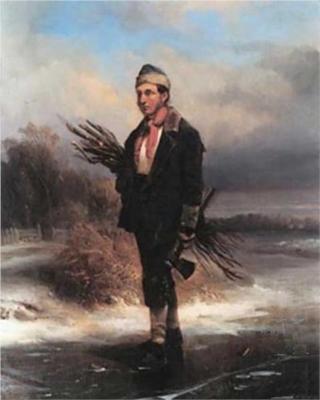
Biography
Born in Amsterdam on 25 May 1817[3], he was the son of a carpenter, Willem Springer, who gave him an early feel for the structure of buildings before he studied formally under Hendrik Gerrit ten Cate, Kasparus Karsen, and Jacobus van der Stok. His subject was the townscape: canal-fronted streets, harbour facades, church exteriors and interiors across the Netherlands. He travelled the country by design, making watercolours, drawings, and oil studies on location before composing finished paintings in the studio.
The works carry a quality that separates them from picturesque convention. Springer's draughtsmanship is exact, the light falls on stone and brick with the attentiveness of someone who understood how masonry was laid, and the figures in his streets feel like inhabitants rather than decorative staffage. A gold medal in 1847[3] confirmed early recognition; the Leopold Order of Belgium followed in 1865. His subjects expanded in later years to take in German architecture, among them the Lübeck Town Hall (1885), painted with the same forensic clarity he applied to Zwolle, Zaltbommel, and Middelburg.
He was a member of the Amsterdam painters' collective Felix Meritis. Works are held in the Rijksmuseum Amsterdam, Teylers Museum[2], and the Dordrechts Museum. He died in Hilversum on 20 February 1891[3].
Timeline
- 1817Born in Amsterdam on 25 May. His father, Willem Springer, was a carpenter.
- 1847Received a gold medal, confirming early recognition of his work.
- 1865Awarded the Leopold Order of Belgium.
- 1878Invited by the Dutch Ministry of Public Affairs, along with Jozef Israels, to advise on the design of the Rijksmuseum building.
- 1885Painted the "Lübeck Town Hall".
- 1891Died in Hilversum on 20 February, aged 73.
Notable Works
Tap to view larger.
Where to See Cornelis Springer
1 museum worldwide.
-
6 works
Teylers Museum
Haarlem, Netherlands
Tue–Sun 10:00–17:00, closed Mondays · €18,50 adults

Next stop
Romanticism →
Explore the artists and ideas of Romanticism.
Cornelis Springer prints
Hand-finished archival prints from Cornelis Springer's body of work.
 Dijkdoorbraak te Arnhem - Cornelis Springer
From £28.00
Dijkdoorbraak te Arnhem - Cornelis Springer
From £28.00
 A Busy Street In Bremen With The Saint Johann Church In The Background - Cornelis Springer
From £28.00
A Busy Street In Bremen With The Saint Johann Church In The Background - Cornelis Springer
From £28.00
 St. Michael Church in Zwolle - Cornelis Springer
From £28.00
St. Michael Church in Zwolle - Cornelis Springer
From £28.00
 St. Joseph's Church in Hamelen - Cornelis Springer
From £28.00
St. Joseph's Church in Hamelen - Cornelis Springer
From £28.00
 A View of a Town along the Rhine - Cornelis Springer
From £28.00
A View of a Town along the Rhine - Cornelis Springer
From £28.00
 Along The Canal - Cornelis Springer
From £28.00
Along The Canal - Cornelis Springer
From £28.00
Related Artists



Take Cornelis Springer home.
See all Cornelis Springer prints →Frequently Asked Questions
What is Cornelis Springer known for?
Cornelis Springer is known for his townscapes, which include canal-fronted streets, harbour facades, and church exteriors and interiors. His draughtsmanship was exact, and the light in his paintings falls on stone and brick with attentiveness.What is Cornelis Springer's most famous work?
Cornelis Springer (1817[3]-1891[3]) is best known for his cityscapes, particularly those depicting Amsterdam. While it is difficult to identify a single "most famous" work, several paintings are particularly well regarded and frequently reproduced. Springer's city views often feature careful architectural detail and staffage (small figures added to enhance the scene). He aimed for topographical accuracy, but he sometimes adjusted or idealised buildings for aesthetic reasons. His skill in rendering light and atmosphere contributed to the appeal of his work. Some of his popular paintings include views of the Oude Kerk, a church in Amsterdam, and the Damrak, a former harbour now a main street. Other notable works depict the cityscapes of Kampen, Meppel, and other Dutch[3] towns. These paintings are valued for their historical documentation of Dutch urban environments in the 19th century, as well as for their artistic merit. Springer's paintings can be found in major Dutch museums, such as the Rijksmuseum in Amsterdam, and in private collections.What style or movement did Cornelis Springer belong to?
Cornelis Springer (1817[3]-1891[3]) is primarily associated with Dutch[3] Romanticism[3], a movement that favoured emotion and a return to nature. Romanticism itself was a broad trend, incorporating many styles, including Neoclassicism. Romantic artists often sought inspiration from the past. This could manifest as a revival of earlier artistic styles or a focus on historical subject matter. Springer, known for his cityscapes, depicted urban environments with a sense of nostalgia and idealisation. While his paintings possess a realism in their architectural detail, they also evoke a romanticised vision of the past. The Barbizon school, active in France during the same period, shared similar ideals, advocating for a return to nature and sincerity in art. Although Springer was Dutch, his artistic sensibilities align with the broader European Romantic movement and its interest in emotion, nature, and the past.What techniques or materials did Cornelis Springer use?
Cornelis Springer was a 19th-century painter of townscapes, and information about his specific techniques is scarce. However, we can discuss the general painting practices of the time. Painters often adhered to traditional methods, loading palettes with a limited number of colours suitable for the section they planned to complete in that session. This additive technique involved building up the painting in stages. The development of a unified tonal image was a desired effect. The 19th century saw technical advancements, such as the availability of a full colour palette and paint in tubes. This allowed artists to work on the entire painting at once, a departure from earlier additive methods. Before this, artists used toned, monochrome underpaintings, heightening the lit areas with lead-white paint. Backgrounds were worked up next, followed by the main subject; collars, cuffs and white caps were usually last.What was Cornelis Springer known for?
Cornelis Springer, a 19th-century Dutch[3] artist, is best known for his cityscapes, also called urbanisations. These paintings and watercolours usually depict scenes from Dutch towns and cities. Springer was born in Amsterdam in 1817[3] and trained at the Royal Academy of Art. He meticulously captured architectural details and the atmosphere of urban life. His works often feature historical buildings, market squares, and canals, rendered with great precision. While Springer's city views are realistic, they are not photographic. He often rearranged elements or combined features from different locations to create idealised compositions. Figures populate his scenes, adding a sense of scale and everyday activity. Springer's skill in portraying light and shadow further enhances the realism and charm of his cityscapes. He died in 1891[3] in Hilversum.When did Cornelis Springer live and work?
Cornelis Springer (1817[3]-1891[3]) was a Dutch[3] artist known for his cityscapes. He was born in Amsterdam on 25 May 1817[3]. His father was a building contractor, and Cornelis trained as an architectural draughtsman. Springer studied at the Koninklijke Akademie van Beeldende Kunsten (Royal Academy of Art) in Amsterdam. Here, he was a pupil of Hendrik Gerrit ten Cate, Kasparus Karsen, and Anthonie Waldorp. He travelled extensively in the Netherlands and abroad, recording town views. His travels included visits to towns such as Enkhuizen, Kampen, and Zwolle. In Germany, he visited Cologne. Springer's earliest known painting dates to 1834. He participated in exhibitions from 1836 onward. Springer lived and worked primarily in Amsterdam. He later moved to Haarlem around 1876. He died in Hilversum on 20 February 1891. His work is characterised by careful attention to architectural detail and atmospheric effects. He often included staffage (figures) in his city views, adding life and narrative interest to the scenes.Where can I see Cornelis Springer's work?
Cornelis Springer's paintings are held in numerous public and private collections. Many are in his native Netherlands. You can find his work in Amsterdam at the Rijksmuseum and The Maritime Museum. Elsewhere in the country, visit the Frans Hals Museum in Haarlem, the Mauritshuis in The Hague, the Centraal Museum in Utrecht, and the Museum Boymans-van Beuningen in Rotterdam. Springer's art has also travelled abroad. In Europe, see his paintings at the Uffizi Gallery in Florence, the Thyssen Collection in Lugano, the Staatliche Museen in Berlin, and the Sinebrychoff Art Museum in Helsinki. In the United States, collections holding his paintings include the Art Institute of Chicago, the Taft Museum in Cincinnati, the Cleveland Museum of Art, the Detroit Institute of Arts, the Currier Gallery of Art in Manchester, and the William Rockhill Nelson Gallery of Art in Kansas City.Who did Cornelis Springer influence?
Cornelis Springer's influence is most clearly seen in the work of later Dutch[3] cityscape painters. His emphasis on architectural accuracy and atmospheric perspective became a model for artists who followed. While it is difficult to trace direct pupils, several artists working in the late 19th and early 20th centuries adopted similar approaches to urban scenes. These include painters like Johan Barthold Jongkind, though Jongkind's work also shows Impressionist influences absent in Springer. Lesser-known figures, such as Adrianus Eversen, also demonstrate Springer's impact; Eversen specialised in similar city views with careful attention to detail. Springer's detailed approach to painting buildings and his skill in representing light and shadow had a clear impact on the next generation of Dutch artists who specialised in urban environments. His work provided a foundation for later developments in the genre.Who was Cornelis Springer?
Cornelis Springer (1817[3]-1891[3]) was a Dutch[3] architectural painter. He is best known for his cityscapes, particularly of Amsterdam and other Dutch towns. Born in Amsterdam, Springer came from a family of artists; his father was a carpenter and amateur artist, and his brother, Hendrik Springer, was also an architect. Cornelis trained at the Royal Academy of Art in Amsterdam, where he studied with several well-regarded artists, including Kaspar Karsen. Springer's style is characterised by its attention to detail and accurate representation of buildings and urban environments. He often included figures in his paintings to add life and scale to the scenes. His works provide valuable documentation of the architectural heritage of the Netherlands during the 19th century. Although he painted primarily in the Netherlands, Springer also travelled to other parts of Europe, including Germany and Belgium, to paint city views. He achieved considerable success during his lifetime and his paintings are now held in many museum collections.Why are Cornelis Springer's works important today?
Cornelis Springer (1817[3]-1891[3]) is collected today for his cityscapes of Amsterdam and other Dutch[3] cities. These paintings and watercolours document the architecture of the Netherlands, often including canals and street scenes populated with figures. Springer's works are valued for their accurate depiction of buildings, and for the sense of history they evoke. His city views offer a glimpse into the urban environment of the 19th century, before modernisation altered the Dutch townscape. They provide information about Dutch architectural styles and urban planning. While Dutch painting has been of interest for centuries, awareness of its historical context has been weaker. Springer's art fits into a tradition of Dutch topographical painting, which developed alongside the country's urban growth and economic expansion. The detailed rendering of buildings and streets reflects a broader interest in documenting the visible world, which was also apparent in still life and genre painting.How did Cornelis Springer die?
Cornelis Springer died in 1891[3] at the age of 74.
Sources
Editorial draws on the following primary and tertiary references for Cornelis Springer.
- [1] museum Cultural Heritage Agency of the Netherlands Art Collection Used for: museum holdings.
- [2] museum Teylers Museum Used for: museum holdings.
- [3] wikipedia Wikipedia: Cornelis Springer Used for: biography, birth dates, death dates, identifiers, movement attribution, nationality.
- [4] book J. W. Frederiks (auth.), Dutch Silver _ Wrought Plate of the Central, Northern and Southern Provinces From the Renaissance Until the End of the Eighteenth Century Used for: stylistic analysis.
- [5] book Lilian H. Zirpolo, Historical Dictionary of Baroque Art and Architecture Used for: biography.
- [6] book Masterpieces of western art : a history of art in 900 individual studies from the Gothic to the present day Used for: biography.
- [7] book Metropolitan Museum Of Art, Metropolitan Museum Of Art - Dutch Painting, the Golden Age_ an Exhibition of Dutch Pictures of the Seventeenth Century, under the High Patronage of Her Majesty the Queen of the Netherlands - Metropolitan Museum of Art, Toledo Museum of Art, Art Used for: biography.
- [8] book John Michael Montias, Vermeer and His Milieu _ A Web of Social History Used for: biography.
- [9] book John Michael Montias, Vermeer and His Milieu _ A Web of Social History Used for: biography, stylistic analysis.
- [10] book John Michael Montias, Vermeer and His Milieu _ A Web of Social History Used for: biography, stylistic analysis.
Editorial overseen by Solis Prints. Sources verified 2026-09-30. Click a source for details, or hover over [N] in the page above to preview.
Editorial standardsMethodologyCorrectionsAI disclosureAbout the editorial team