



Cornelis de Vos
- Flemish Baroque painting
Among the Flemish painters who worked in Rubens's orbit, Cornelis de Vos occupies a precise and revealing position: close enough to the Baroque machinery to execute large public commissions, yet most alive when painting the faces of people he knew and loved. Born around 1584[1] in Hulst, he trained in Antwerp and qualified as a master in the guild in 1608[1], the same year Rubens returned from Italy and began restructuring the city's artistic landscape.
Biography
De Vos was the brother-in-law of Frans Snyders, and his working relationship with Rubens was practical and productive. With Jacob Jordaens, he executed the triumphal arch for Antwerp's state entry of Archduke Ferdinand to designs by Rubens; in 1637[1] he painted a series of mythological scenes for Philip IV's Torre de la Parada hunting lodge near Madrid, again working from Rubens's preparatory sketches. Critical opinion has always been measured about those results: his narrative arrangements lacked the invention of the master, while the portrait likenesses embedded within the same compositions were of the highest quality.
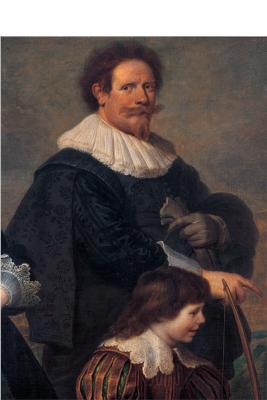
It is as a portraitist that de Vos genuinely competes with his more celebrated contemporaries. He was known for making the eyes of his sitters speak with unusual directness, and his command of children's faces was considered without equal in Antwerp. The portraits of his own children, held in the Mayer van den Bergh Museum in Antwerp and in Berlin, carry none of the period's sentimentality and a great deal of precision. His family group paintings in Brussels and Antwerp project what one contemporary critic called a tranquil lyricism, distributed in even, unhurried light.
His output declined in his final years: group compositions seem to have been set aside as energy waned. He died in Antwerp in 1651[1], leaving family portraits that remain among the most psychologically direct of the Flemish Baroque.
Timeline
- 1584Born in Hulst around 1584.
- 1608Qualified as a master in the guild in Antwerp.
- 1608Rubens returned from Italy and began restructuring the city's artistic scene.
- 1637Painted mythological scenes for Philip IV's Torre de la Parada hunting lodge near Madrid, working from Rubens's sketches.
- 1637Collaborated with Jacob Jordaens to execute the triumphal arch for Antwerp's state entry of Archduke Ferdinand, based on designs by Rubens.
- 1651Died in Antwerp at 67. He was known for family portraits.
Notable Works
Tap to view larger.
Next stop
Browse the movements →
Every movement in the collection, from the Renaissance to Pop art.
Related Artists


Frequently Asked Questions
What is Cornelis de Vos known for?
Cornelis de Vos is known for his portraiture, especially his ability to make the eyes of his sitters appear unusually direct. He was also considered without equal in Antwerp for his command of children's faces.What is Cornelis de Vos's most famous work?
Cornelis de Vos was a Flemish painter, and many art historians consider his family portraits to be his best works. He is particularly known for capturing the likenesses and personalities of his subjects. One painting stands out: *Family Portrait* from c.1631[1]. It is housed in the Royal Museum of Fine Arts Antwerp. The sitters are probably a wealthy Antwerp family, though their identities are unconfirmed. The work is a large-scale group portrait in a domestic setting. De Vos presents the family with an emphasis on their affluence and familial bonds. Other notable works include portraits of artists, merchants, and members of the Antwerp elite. He painted individual portraits as well as group scenes. These paintings offer insights into the social and cultural context of 17th-century Antwerp. His skill in depicting fabrics, textures, and facial expressions contributed to his success as a sought-after portraitist.What should I know about Cornelis de Vos's prints?
Cornelis de Vos (1584[1]-1651[1]) was a Flemish painter; he also designed prints, although these are less well known than his paintings. De Vos is mainly known for his portraits and history paintings. Many prints related to de Vos are reproductive engravings; these were made by other artists after his paintings. For example, Alexander Voet the Younger and Paulus Pontius produced engravings after de Vos. These prints circulated his compositions to a wider audience. Some of de Vos's paintings, such as family portraits, were particularly popular and were reproduced in print form. Peter Paul Rubens and Anthony van Dyck influenced de Vos's style. He collaborated with Rubens on occasion, and his work shows the influence of the Antwerp school. De Vos's paintings and the prints made after them offer insight into Flemish Baroque art and portraiture of the period. They also show the artistic connections and collaborations that existed between artists in Antwerp during the 17th century.What techniques or materials did Cornelis de Vos use?
Cornelis de Vos was a Baroque painter, and like other artists of the period, his techniques involved a limited palette of colours chosen for specific stages of a work. The first stage in producing a painting usually involved a contract between the artist and client. This might specify the timescale, the quality of materials, the extent of the master's involvement versus his assistants, and payment schedules, typically in three instalments. Workshops, such as that of van Eyck, were often north-facing and on an upper floor to maximise natural light. The painting process involved multiple layers of oil paint, which took considerable time to dry. Artists often had several projects underway simultaneously. Assistants prepared paints and might work on backgrounds under supervision as part of their training. Studios contained straw mats to control dust, wooden easels, and planks to support works in progress.What was Cornelis de Vos known for?
Cornelis de Vos (1584[1]-1651[1]) emerged as a leading Antwerp painter as Frans Floris's popularity declined. De Vos may have travelled in Italy with Bruegel. Unlike Floris, de Vos largely avoided direct references to Rome in his art. He reduced generic quotations of ruins and even the work of Raphael to static ornament in paintings. These paintings vaguely referenced an Italianate pictorial idiom based partly on a Venetian approach to colour. The absence of specific references to Roman conventions may account for the popularity of his art after the Iconoclasm. His *Saint Paul Bitten by a Viper on the Island of Malta* (c. 1567) marks a turn away from Floris's style. De Vos created a cluttered image without a single stylistic antecedent. The composition is not relief-like or explicitly 'Roman' in its setting. The details overtake narrative cohesion. The absence of an iconographic centre disturbs the unified pictorial field.When did Cornelis de Vos live and work?
Unfortunately, the provided texts do not contain any information about Cornelis de Vos. They refer exclusively to the artist Nicolas Poussin and his works, such as *The Seven Sacraments* series (Ordination, Marriage, Baptism, Extreme Unction, Confirmation, and Penance), *The Institution of the Eucharist*, *The Miracle of St. Francis Xavier*, *Time Saving Truth from Envy and Discord*, *Moses and the Burning Bush*, *The Holy Family*, *The Ecstasy of St. Paul*, *The Continence of Scipio*, *The Finding of Moses*, *Camillus and the Schoolmaster of Falerii*, *Venus Bringing Arms to Aeneas*, *A Dance to the Music of Time*, and *The Israelites Gathering the Manna*. Therefore, I cannot provide an answer about the life and career of Cornelis de Vos using only these texts.Where can I see Cornelis de Vos's work?
Paintings by Cornelis de Vos are held in collections throughout Europe and the United States. Examples can be seen in Berlin at the Staatliche Museen zu Berlin, or at the Gemäldegalerie. Other German museums holding his works include the Herzog Anton Ulrich-Museum (Braunschweig), the Städelsches Kunstinstitut (Frankfurt am Main), the Niedersächsische Landesmuseum (Hanover), and the Staatliche Kunstsammlungen (Dresden). In the UK, works by de Vos are held at the National Gallery of Scotland (Edinburgh) and the National Museums Liverpool, Walker Art Gallery. Other European museums include the Galleria degli Uffizi (Florence), the Musée du Louvre (Paris), the Museo Thyssen-Bornemisza (Madrid), the Royal Cabinet of Paintings Mauritshuis (The Hague), and the Kunsthistorisches Museum (Vienna). In the United States, examples can be seen at the Metropolitan Museum of Art (New York), the National Gallery of Art (Washington), and the J. Paul Getty Museum (Los Angeles).Where was Cornelis de Vos from?
Cornelis de Vos emerged as a leading painter in Antwerp during the decline of Frans Floris. De Vos may have travelled in Italy with Pieter Bruegel. Unlike Floris, de Vos largely avoided direct references to Rome in his art. Instead, he reduced quotations of ruins and the work of Raphael to static ornament. His paintings vaguely referenced an Italianate pictorial idiom partly based on a Venetian approach to colour. The absence of specific references to Roman conventions may account for the popularity of his art after the Iconoclasm. One example is Saint Paul Bitten by a Viper on the Island of Malta, which manifests his move away from Floris's style. De Vos's style allowed him to appeal to both Catholic and Protestant audiences. In 1584[1], de Vos embraced Lutheranism. He benefited from Antwerp's reconversion to Catholicism, which created opportunities for him and other painters to replace destroyed images.Who did Cornelis de Vos influence?
Cornelis de Vos was an important influence on later artists. His impact can be seen in the work of Eugène Delacroix, Félix-Joseph-Henri de Vollen, and Jean-Baptiste-Antoine Bonvin. These artists made interpretations and copies of paintings that demonstrate the influence of Dutch[1] artistry and solid workmanship. They also show the Romantic quintessence of colour that de Vos helped to establish. De Vos's influence extended beyond his immediate circle. Wilhelm Busch painted his *Slaughtered Pig* in a similar spirit, although he was more directly influenced by Isaac van Ostade. The motif of an animal carcass allowed for experiments with colour patches and thick textures. It also provided an opportunity to recreate effects of light, eliciting the form and materialness of the subject.Who influenced Cornelis de Vos?
Cornelis de Vos (1584[1]-1651[1]) was a Flemish painter. He is known for his portraits and history paintings. His artistic development shows the influence of several earlier artists. De Vos likely trained with David Remeeus in Antwerp. This early instruction would have provided a foundation in the prevailing artistic styles of the region. He was also influenced by Peter Paul Rubens. Rubens's impact is evident in de Vos's use of colour and dynamic compositions. Some scholars suggest that de Vos's work, particularly his group portraits, shows the impact of Rubens's style. Another important influence was Anthony van Dyck. Van Dyck's refined portrait style affected de Vos's later works. De Vos adapted van Dyck's approach to portraying the aristocracy. This is visible in his attention to detail in costume and his subjects' dignified bearing. While de Vos's style is individual, these influences helped shape his artistic output.Who was Cornelis de Vos?
Cornelis de Vos (1584[1]-1651[1]) was a Flemish artist, ranking among the foremost contemporaries of Rubens and Van Dyck. Born in Hulst, he trained in Antwerp, becoming a master in 1608[1]. De Vos participated, along with Jordaens, in large-scale Baroque projects such as the decorations for Archduke Ferdinand's state entry into Antwerp. He also helped execute mythological scenes for the Torre de la Parada, working from sketches by Rubens. His talent lay in portraiture, where he excelled at capturing the personality of his subjects with objectivity and sincerity. He was particularly skilled at painting children, portraying their innocence and naivety without idealisation. Some of his finest portraits, noted for their emotional depth, depict his own family. Examples of his work can be seen in museums in Brussels, Antwerp, and Berlin. In later years, he seems to have moved away from group paintings, perhaps due to the demands of composition.Why are Cornelis de Vos's works important today?
Cornelis de Vos was a Flemish Baroque painter, working in Antwerp during the first half of the 17th century. He is remembered today for his contributions to portraiture, particularly his sensitive depictions of children and families. De Vos's importance lies in his ability to capture the likenesses and social status of his sitters. He provides insight into the lives of the Antwerp bourgeoisie during a period of economic and artistic flourishing. His portraits offer a window into the fashions, customs, and family structures of the time. While Peter Paul Rubens and Anthony van Dyck dominated the Antwerp art scene, de Vos carved out his own niche. He developed a more restrained and naturalistic style compared to the dramatic flair of Rubens or the aristocratic elegance of van Dyck. This approach made him a popular choice for middle-class patrons seeking accurate and relatable portrayals. His paintings are valuable historical documents, as well as aesthetically pleasing works of art. They are found in major museum collections around the world.
Sources
Editorial draws on the following primary and tertiary references for Cornelis de Vos.
- [1] wikipedia Wikipedia: Cornelis de Vos Used for: biography, birth dates, death dates, identifiers, movement attribution, nationality.
- [2] book Lassaigne, Jacques, 1910-, Flemish painting Used for: biography.
- [3] book STBGD Trusted, Flemish Painting - From Hieronymus Bosch to Rubens (Art Ebook) Used for: biography.
- [4] book Edward H. Wouk, Frans Floris (1519_20-1570)_ Imagining a Northern Renaissance (Brill's Studies in Intellectual History _ Brill's Studies on) Used for: biography, stylistic analysis.
- [5] book Edward H. Wouk, Frans Floris (1519_20-1570)_ Imagining a Northern Renaissance (Brill's Studies in Intellectual History _ Brill's Studies on) Used for: biography, stylistic analysis.
- [6] book "Michael Brand, Frederik J. Duparc, Ariane van Suchtelen, Anne T. Woollett, Tiarna Doherty, Mark Leonard and Jørgen Wadum", Rubens and Brueghel: A Working Friendship Used for: biography.
- [7] museum Cornelis de Vos - Portrait of a Woman - The Metropolitan Museum of Art Used for: museum holdings.
- [8] museum Vos, Cornelis de - Museo Nacional del Prado Used for: biography.
Editorial overseen by Solis Prints. Sources verified 2026-09-19. Click a source for details, or hover over [N] in the page above to preview.
Editorial standardsMethodologyCorrectionsAI disclosureAbout the editorial team