



Cornelia Parker
- Contemporary
- Installation
Cornelia Parker's art often begins with an act of destruction, transforming everyday objects into something entirely new. Her 1991 piece, Cold Dark Matter: An Exploded View, famously involved blowing up a garden shed. She then suspended the fragments, lit by a single bulb, creating a dramatic, frozen moment of chaos. This approach allows her to explore material properties and the hidden narratives within discarded items.
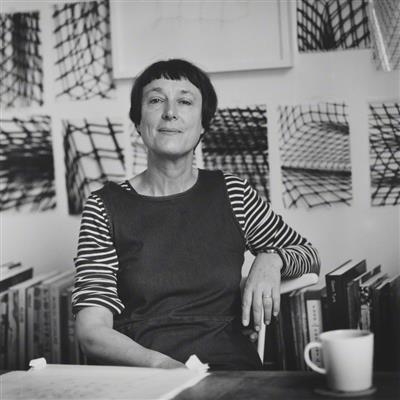
Biography
Born in Cheshire in 1956, Parker studied at Wolverhampton Polytechnic and Reading University. She frequently uses objects that have a history or cultural resonance, subjecting them to processes like crushing, burning, or stretching. For Bullet Drawing (2010), she melted lead bullets into wire, which she then used to draw. This work directly addresses the material's previous, violent purpose.
Parker is also known for her collaborations and interventions. In 1995, she invited actress Tilda Swinton to sleep inside a glass vitrine for The Maybe, a performance at the Serpentine Gallery. She later created The War Room (2015), an installation of red paper strips from a poppy factory, resembling a tent or a large, fragile archive. These projects show her interest in shared experience and collective memory.
Her practice consistently questions value, temporality, and the unseen forces that shape our world. Parker's work encourages viewers to reconsider the ordinary, finding unexpected beauty and meaning in the aftermath of transformation. She was appointed an OBE in 2010 and later a CBE in 2017 for her contributions to art.
Timeline
- 1956Born in Cheshire, England
- 1991Created 'Cold Dark Matter: An Exploded View' by blowing up a shed.
- 1995Collaborated with Tilda Swinton on 'The Maybe' at Serpentine Gallery.
- 2010Created 'Bullet Drawing' from melted lead bullets.
- 2010Appointed an OBE for contributions to art.
- 2015Created 'The War Room' installation from poppy factory paper.
- 2017Appointed a CBE for contributions to art.
Notable Works
Tap to view larger.
Next stop
Contemporary →
Explore the artists and ideas of Contemporary.
Related Artists

_%E2%80%93_LOC.jpg)


Frequently Asked Questions
What is Cornelia Parker known for?
Cornelia Parker is known for her large-scale installations and her exploration of fragility and transformation. She frequently uses objects with a history, subjecting them to processes such as crushing or burning.What is Cornelia Parker's most famous work?
It is difficult to identify Cornelia Parker's single "most famous work" with certainty, as fame is subjective and fluctuates. However, her large-scale installations have received considerable attention. Parker is known for her transformation of objects through explosion, crushing, or other processes. One notable example is "Cold Dark Matter: An Exploded View" (1991), in which she suspended the fragmented remains of a garden shed, detonated by the British Army, to create an arresting visual display. The work plays with ideas of destruction, reconstruction, and the suspension of time. Another well-known piece is "Thirty Pieces of Silver" (1988-89), composed of flattened silver objects, such as teapots and cutlery, suspended from wires. This installation explores themes of value, loss, and transformation. These works, and others like them, have cemented Parker's reputation for thought-provoking and visually arresting art.What should I know about Cornelia Parker's prints?
Cornelia Parker's prints, like those of many artists, are often produced in limited editions. The size of an edition is the artist's decision, not a technical requirement. A limited edition is defined by a written claim, typically in pencil, at the foot of each print. These claims follow informal conventions widely respected by printmakers. Each print is marked with a fraction, such as 12/25, indicating the print number and the total edition size. The print's title is usually written in the centre of the bottom margin, and the artist's signature appears on the right. These descriptions are always signed in pencil. Additional markings may include 'A/P' for artist's proof, identical to the edition, or 'T/P' for early proofs made during the block's development. 'V2' (or V3, etc.) indicates a variant edition with colour changes or block alterations. 'V/E' signifies a variable edition, where parts are constant but backgrounds are hand-coloured. 'Hors de Commerce' denotes a non-commercial print, identical to the edition but not for sale. These conventions help ensure clarity and value for collectors.What style or movement did Cornelia Parker belong to?
Cornelia Parker emerged as an artist in Britain during the late 1980s. Her practice aligns with aspects of several movements, but she is not easily categorised. Parker's methods connect to the readymades of the early 20th-century Dada art movement; she transforms existing objects through alteration. Like Dada artists, Parker embraces chance and humour. Her large-scale installations relate to the concerns of Minimalism. However, unlike Minimalist sculptors, Parker uses narrative and representational elements. Cold Dark Matter: An Exploded View (1991) is a good example; Parker gathered the remains of a garden shed destroyed by the British Army, suspended the fragments, and illuminated them with a single light. The work retains traces of its prior existence, and the title suggests themes beyond pure form. Parker also shares concerns with artists associated with the Young British Artists (YBAs). Like Damien Hirst and Tracey Emin, Parker came to prominence in London during the 1990s, and she adopts unconventional materials and addresses contemporary issues. While associated with the YBAs, Parker's work maintains a distinct sensibility, characterised by poetic transformations of ordinary objects.What techniques or materials did Cornelia Parker use?
Cornelia Parker is known for large-scale installations and sculptures that explore transformation and the nature of materials. She often alters existing objects through destruction or suspension, changing how viewers perceive them. In 1988, Parker hired a steamroller to flatten silver-plated items acquired from flea markets. She then suspended the flattened pieces from the ceiling using wires, creating thirty separate pools of hovering objects in an installation titled Thirty Pieces of Silver. Similarly, she suspended defaced coins with wire to create floating human figures in Matter and What It Means (1989). For Cold Dark Matter: An Exploded View (1991), Parker had the British Army blow up a garden shed filled with tools and household items. She collected the debris and suspended it in the gallery space, reconstructing the moment of explosion. She has also worked with charred wood from fires, creating suspended reconstructions of burned churches, such as Mass (Colder Darker Matter) (1997) and Anti-Mass (2005). In 2015, she produced Magna Carta (An Embroidery), a 13-metre-long embroidery stitched by over 200 people.What was Cornelia Parker known for?
Cornelia Parker, born in north-west England in 1956, is known for her large-scale installations and sculptures. Her art explores themes of fragility, transformation, and the performance of materials. She often uses existing materials or established artworks, transforming both physical and conceptual ideas. Parker's installations frequently involve the suspension of transformed objects. For example, Thirty Pieces of Silver (1988) features silver-plated items crushed by a steamroller and then suspended in a gallery. Cold Dark Matter: An Exploded View (1991), now on long-term display at the Tate Modern, reconstructs an exploded garden shed, with the fragments suspended from wires. She has also worked with charred remains, such as in Hanging Fire (Suspected Arson). This work uses the remains of a suspected arson case to create a visual explosion. In 2015, she produced Magna Carta (An Embroidery), a 13-metre long embroidery stitched by over 200 people. In 2016, she created Transitional Object (PsychoBarn) for the Metropolitan Museum of Art's Roof Garden Commission. Parker was shortlisted for the Turner Prize in 1997 and elected to the Royal Academy of Arts in 2010.When did Cornelia Parker live and work?
Cornelia Parker was born in Cheshire, England, in 1956. She is known for her sculpture and installation art. Parker often uses processes of destruction and transformation in her work, such as crushing objects or suspending them in space. One of her well-known pieces is "Cold Dark Matter: An Exploded View" (1991), which consists of the exploded remains of a garden shed, suspended as if frozen in the moment of explosion. Another is "Thirty Pieces of Silver" (1988-99), where flattened silver objects are suspended from wires. Parker was nominated for the Turner Prize in 1997. She was elected to the Royal Academy of Arts in 2009. She continues to live and work in the United Kingdom.Where can I see Cornelia Parker's work?
Cornelia Parker (born 1956) is a British sculptor and installation artist. Her works are held in many public collections. These include the Tate, the British Museum, and the Victoria and Albert Museum in London. Internationally, Parker's art can be found at the Museum of Modern Art and the Metropolitan Museum of Art in New York. Her work is also held at the Hirshhorn Museum and Sculpture Garden, part of the Smithsonian Institution in Washington, D.C. In Canada, the National Gallery of Canada in Ottawa has examples of her pieces. Parker has been featured in solo and group exhibitions worldwide. Major solo shows include those at the Serpentine Gallery (1998), the ICA Boston (2000), and the Whitworth Art Gallery in Manchester (2017). She represented Britain at the 2011 Venice Biennale. For current exhibitions, it is best to check museum websites or art publications for up-to-date information.Where was Cornelia Parker from?
Cornelia Parker was born in north-west England in 1956. Known for her large-scale site-specific installations, Parker explores the fragility of life, how materials perform, and transformations. These transformations can be violent or slow, and she considers both natural changes and those caused by humans. Parker studied art in Gloucestershire and Wolverhampton. In 1997, she was shortlisted for the Turner Prize. She was elected to the Royal Academy of Arts and, in 2010, appointed an Officer of the Order of the British Empire. Parker works with varied materials and has collaborated with respected institutions in Britain. Her art appears in numerous international collections, and she participates in many worldwide exhibitions. In 2015, Parker produced *Magna Carta (An Embroidery)*, a 13-metre long embroidery stitched by over 200 people. That year, she also created *One More Time*, an installation for St Pancras International station in London. In 2016, Parker became the first woman given the Roof Garden Commission at the Metropolitan Museum of Art, New York, where she created *Transitional Object (PsychoBarn)*. In 2017, she was the UK’s official election artist for the general election.Who did Cornelia Parker influence?
Cornelia Parker's art explores themes of fragility and transformation; her practice involves large-scale installations and manipulation of existing materials. Parker has stated that she was inspired by artists who deal with fragments and immateriality, such as Marcel Duchamp. Parker's method often involves altering objects through violent means, then reconstructing them. For example, she hired the British Army to blow up a shed filled with household detritus; she then reassembled the fragments, suspending them in the gallery space as Cold Dark Matter: An Exploded View (1991). She steamrollered silver-plated items bought at flea markets, suspending the flattened pieces in mid-air as Thirty Pieces of Silver (1988). She has also used charred remains from fires, such as in Hanging Fire (Suspected Arson). Parker was shortlisted for the Turner Prize in 1997. In 2010, she was elected to the Royal Academy of Arts. She became the first woman to be given the Roof Garden Commission at the Metropolitan Museum of Art, New York, in 2016.Who influenced Cornelia Parker?
Cornelia Parker's inspirations include artists who engage with the fragment and the immaterial, such as Marcel Duchamp. Parker is known for large-scale installations that explore the fragility of life and material transformations. These transformations can be violent or gradual, encompassing both natural processes and human actions. Her work often involves transmuting disregarded or degraded objects into something remarkable. For example, Thirty Pieces of Silver (1988) used silver-plated items crushed by a steamroller. The pieces were then suspended to create a hovering field of circles. Cold Dark Matter: An Exploded View (1991) involved exploding a garden shed and suspending the debris. Parker's work also explores themes of mortality and time. In 2013, she set up The Maybe at the Serpentine Gallery in London, where Tilda Swinton slept in a glass case. This installation, focusing on people sleeping in galleries, invited questions about these complex themes.Who was Cornelia Parker?
Cornelia Parker, born in 1956, is an English artist known for large-scale installations and sculptures. Her work often involves transforming existing materials and exploring themes of fragility, destruction, and change. She draws inspiration from artists such as Marcel Duchamp, who worked with found objects and immaterial concepts. Parker's practice involves manipulating objects through violent means, such as crushing or exploding them, and then reassembling the fragments into new forms. One example is Cold Dark Matter: An Exploded View (1991), for which she exploded a garden shed and suspended the debris to reconstruct the moment of explosion. Thirty Pieces of Silver involved a steamroller crushing silver-plated items from flea markets. She also uses materials altered by external forces; Hanging Fire (Suspected Arson) uses the charred remains of a suspected arson case. Parker was shortlisted for the Turner Prize in 1997 and elected to the Royal Academy of Arts in 2010. She has created site-specific installations for institutions such as St Pancras International station in London and the Metropolitan Museum of Art in New York. In 2015, she created Magna Carta (An Embroidery), a 13-metre-long embroidery stitched by over 200 people. In 2017, she was the UK’s official election artist.
Sources
Editorial draws on the following primary and tertiary references for Cornelia Parker.
- [1] book Susie Hodge, Artistic Circles Used for: biography.
- [2] book Hodge, Susie, 1960- author, The short story of women artists : a pocket guide to movements, works, breakthroughs, & themes Used for: biography.
Editorial overseen by Solis Prints. Sources verified 2026-10-07. Click a source for details, or hover over [N] in the page above to preview.
Editorial standardsMethodologyCorrectionsAI disclosureAbout the editorial team