



Consuelo Hernández
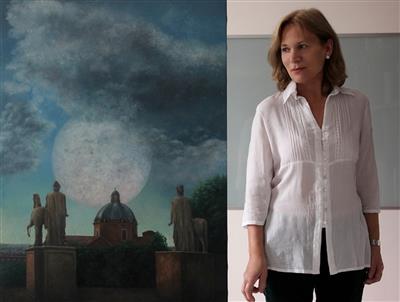
For nearly three decades, Consuelo Hernández balanced a career as a Spanish[1] language professor against her compulsion to paint. Born in 1948[1] in Tornavacas, a small town in Extremadura, she trained in the figurative tradition, absorbing lessons from Monet, Renoir, and Cézanne before discovering the quieter intensity of Antonio López. She finally left teaching behind in 2008 to paint full-time.
Biography
Between 1997 and 2003, she lived in Tangier, where she became transfixed by the crumbling Cervantes Theatre, a once-magnificent Spanish[1] colonial venue falling into decay. The resulting series, exhibited in *Un escenario en ruinas* (2013), brought her international attention. Her work moved across continents from there: solo exhibitions at the Shanghai Pudong National Library (2012), the Beijing Bridge Gallery (2013), and a retrospective at the Palace of La Salina in Salamanca (2015).
Her poetic realism, unhurried, precise, emotionally restrained, has earned repeated recognition from Paris. The Académie Française awarded her the Médaille d'Argent in 2019 and the Médaille Vermeil in 2022, and she was included in Forbes Spain's Top 50 Awarded Spaniards in 2021. Works are held in private collections across Spain, Morocco, France, Italy, China, Switzerland, and the United States. She is based in Extremadura.
Timeline
- 1948Born in Tornavacas, Extremadura.
- 1997Moved to Tangier; lived there until 2003.
- 2008Left her position as a Spanish language professor to paint full-time.
- 2012Solo exhibition at the Shanghai Pudong National Library.
- 2013Solo exhibition at the Beijing Bridge Gallery.
- 2013Exhibited the series *Un escenario en ruinas*, which gained her international attention.
- 2015Retrospective at the Palace of La Salina in Salamanca.
- 2019Awarded the Médaille d'Argent by the Académie Française.
- 2021Included in Forbes Spain's Top 50 Awarded Spaniards.
- 2022Awarded the Médaille Vermeil by the Académie Française.
Notable Works
Tap to view larger.
Next stop
Browse the movements →
Every movement in the collection, from the Renaissance to Pop art.
Related Artists



Frequently Asked Questions
What is Consuelo Hernández known for?
Consuelo Hernández is known for her poetic realism. Her series of paintings of the decaying Cervantes Theatre in Tangier, exhibited in *Un escenario en ruinas* (2013), brought her international attention.What is Consuelo Hernández's most famous work?
It is difficult to name Consuelo Hernández's single most famous work. However, her 2008 painting, *Orange Blossom*, is considered among her best recent works. It depicts two figures, probably a couple, given that orange blossoms are a symbol of marriage. The figures' facial features are slightly misaligned because of their difference in height. Despite this, they appear in harmony. The tonal values and distribution of light and dark contribute to the image's structure. The woman's dark hair contrasts with the lighter colours around it, establishing tonal balance. The dark colour of her dress, though a cool blue-violet, echoes the warmth of her brown hair because of the black in both. The colour of the woman's hair, despite its warmth, contrasts with the orange background, aided by the small amount of light blue in the shirt and the green of the eyes.What should I know about Consuelo Hernández's prints?
When considering Consuelo Hernández's prints, bear in mind some key aspects of fine art printmaking. An original print is conceived as a print and executed solely as a print. Each impression in a limited edition is regarded as an original, produced from a plate, stone, screen or block created specifically for that purpose. The artist typically signs and numbers each print, often in pencil. The numbering indicates the print's place in the edition, such as 12/25, where 25 is the total number of prints, and 12 is the specific print number. Some artists create a small number of artist's proofs, marked AP. By contrast, a reproduction is a copy of a work initially created in another medium, like painting or watercolour, and made using photomechanical means. Numbering and signing a reproduction does not make it an original print. When buying prints, it is advisable to check the publisher's catalogue and examine the colours to ensure high quality. Visiting galleries, frame shops, and furniture stores can provide insights into where the art fits within the broader market. Examining prints in museums and galleries can also help one understand the conventions of signing and numbering editions.What style or movement did Consuelo Hernández belong to?
Consuelo Hernández is associated with Chicana art, a movement that emerged in the United States as part of the broader Chicano Movement of the 1960s and 1970s. This artistic expression is rooted in the experiences, culture, and sociopolitical concerns of Mexican-Americans. Chicana art often explores themes of identity, gender, and social justice, drawing inspiration from Mexican heritage, indigenous cultures, and contemporary life. Artists frequently incorporate traditional symbols, such as images of the Virgin of Guadalupe, and address issues like immigration, cultural hybridity, and the challenges faced by women in patriarchal societies. Like other Chicana artists, Hernández uses clothing and dress to explore gendered, social and cultural activities. Her work, like Ester Hernandez's Immigrant Woman's Dress, speaks to the reality and power of that which is partially disembodied, on the level of the social (female, queer, and minorities), the intellectual (non-patriarchal histories), and the religious (non-Christian and non-patriarchal spiritualities).What techniques or materials did Consuelo Hernández use?
Although specific details regarding Consuelo Hernández's techniques are not available, some general information about artistic techniques may be useful. Artists often make choices that exist independently of their chosen materials. The interaction between the qualities of a medium, the techniques used, and the artist's aesthetic decisions is essential to understanding art history. Pencil techniques include hatching (filling an area with parallel strokes), crosshatching (layering parallel strokes at different angles), applying heavy pressure for dark shading, gradating (creating values from dark to light by varying pressure), blending (smoothing transitions between strokes), and creating textured shading with small, uneven strokes. With pencils, artists can achieve varied effects through different hand positions and shading methods, producing diverse strokes. Acrylic techniques offer numerous possibilities for creating textures and effects. A flat wash, for example, involves diluting acrylic paint with water and applying overlapping strokes across the surface.What was Consuelo Hernández known for?
Consuelo Hernández, also known as Consuelo Jiménez Underwood, is known for her mixed media artwork, including weaving and painting. Her work addresses themes of ancestry, nationhood, and the U.S.-Mexico border. Hernández's art often undermines distinctions between art and craft, specifically those that demote weaving as feminine or less artistically developed. Her pieces include the Heroes Burial Shroud series, which honours figures such as Joan of Arc, Martin Luther King, Jr., and César Chávez. Each shroud uses specific dimensions, threads, weaving patterns, and stencilled images to reflect the individual's life. A significant aspect of Hernández's work involves weaving barbed wire into pieces that meditate on the U.S.-Mexico border. One such piece, Virgen de la frontera, uses multi-hued threads of linen and barbed wire, overlaid with a veil silk-screened with Virgen de Guadalupe images. The barbed wire symbolises the border, as well as the pain and suffering associated with crossing it. Another work, The Sacred Jump, features images taken from road signs near the border, cautioning drivers about migrant families crossing.Where can I see Consuelo Hernández's work?
Consuelo Hernández's work can be viewed in a variety of settings, although not usually in major mainstream public museums. Prints of her work, such as Sun Mad and La Ofrenda, are better known than her larger pieces. Hernández primarily exhibits in group shows at Chicana/o community centres, galleries, museums, and international exhibitions of Latin American or U.S. Latina/o art. She has had one-woman shows, but none at major mainstream public museums. Mainstream and U.S. Latina/o museums and collectors most often purchase prints of her work. Her pieces have also been included in Days of the Dead exhibitions at mainstream museums. However, some critics suggest that featuring Chicana artists only on "Hispanic" occasions risks marginalising their contemporary art forms.Who did Consuelo Hernández influence?
Consuelo Hernández is a Chicana artist whose work, along with that of other Chicana artists, has had some exposure in Latin American and US Latina/o art histories, exhibition catalogues, and compilations. The work of Hernández, along with that of artists such as López and Mesa-Bains, is perhaps best known in mainstream feminist art writing. These artists have shown their work predominantly in Chicana/o community centres, galleries, museums, international exhibitions of Latin American and/or US Latina/o art, and mainly through group shows. All have had one-woman shows, but none at major mainstream public museums. Chicana artists have played a central part in recirculating and redefining indigenous cultural worldviews through Days of the Dead celebrations and creating an art form of the domestic altar tradition.Who was Consuelo Hernández?
Consuelo Hernández (born 1947) is a Spanish[1] painter and printmaker. She is known for her still lifes and interior scenes. Hernández was born in Salamanca. She studied at the Escuela Superior de Bellas Artes de San Fernando in Madrid. Hernández's work often features domestic objects: vases, fruit, and textiles. These items are rendered in a muted colour palette. Her compositions explore light and shadow. They create a sense of quiet contemplation. Hernández has exhibited widely in Spain and internationally. Her work can be found in various public and private collections. These include the Museo Español de Arte Contemporáneo in Madrid. She has received several awards for her artistic contributions. These distinctions acknowledge her skill in capturing the subtle beauty of everyday life. Hernández continues to live and work in Spain. She remains an active figure in the contemporary art world. Her prints and paintings offer a modern take on traditional subjects.Why are Consuelo Hernández's works important today?
Consuelo Hernández's work gains importance from its connection to Mexican social movements and its contribution to discussions about women's roles in politics and art. Hernández is associated with a generation of women who participated in shaping social change through teaching, journalism, and activism, often connected to the Mexican Communist Party and organisations such as the Unión Nacional de Mujeres Mexicanas (UNMM). Her art can be viewed alongside the work of other artists and activists who linked art with social causes, offering a counterpoint to better-known figures. Hernández's work prompts questions about how knowledge is produced, transferred, and gendered, challenging traditional historical narratives. The artist's relationship with feminism is complex. While she recognised the legacy of pre-1970s feminism, she also saw divisions between the early women's suffrage movement and later feminist thought. Her work engages with figures such as Concha Michel, a post-revolutionary activist who, despite working to improve women's lives, did not identify as a feminist. Hernández's art invites consideration of the diverse and sometimes contradictory ways women have engaged with political and social issues in Mexico.What was Consuelo Hernández's art style?
Consuelo Hernández trained in the figurative tradition, absorbing lessons from Monet, Renoir, and Cézanne before discovering the quieter intensity of Antonio López. Her style is described as poetic realism.When was Consuelo Hernández born?
Consuelo Hernández was born in 1948[1].
Sources
Editorial draws on the following primary and tertiary references for Consuelo Hernández.
- [1] wikipedia Wikipedia: Consuelo Hernández Used for: biography, birth dates, death dates, identifiers, movement attribution, nationality.
- [2] book Pérez, Laura Elisa., Chicana Art Used for: biography, stylistic analysis.
- [3] book guggenheim-newimagesfromspa00ro Used for: biography.
- [4] book guggenheim-twopri00weis Used for: biography.
- [5] book Landauer, Susan, The not-so-still life : a century of California painting and sculpture Used for: biography.
Editorial overseen by Solis Prints. Sources verified 2026-10-15. Click a source for details, or hover over [N] in the page above to preview.
Editorial standardsMethodologyCorrectionsAI disclosureAbout the editorial team