



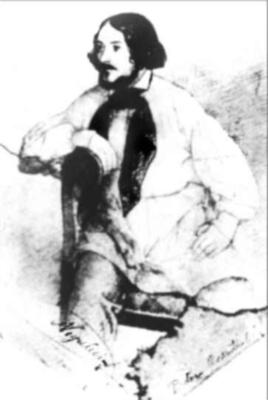
Biography
Born in 1820[1] into a Jewish merchant family in Pest, Rosenthal left at seventeen to study at the Vienna Academy of Fine Arts, where he graduated in 1839[1] and first met the Romanian painter Ioan Negulici. He arrived in Bucharest around 1842 on a commission to paint portraits of the boyar class, and was drawn into the liberal and radical political circles around C.A. Rosetti.
Dissatisfied with his technique, he left for Paris in late 1844[1] to attend art courses and immerse himself in the community of Wallachian and Moldavian students gathering there. His painting developed alongside his politics. When the 1848 revolution briefly took hold in Wallachia, Rosenthal applied for Romanian citizenship on June 18, his application noting "his talent and the active part he played in the revolution." The Provisional Government assigned him to design a triumphal arch for Bucharest and, possibly, a Statue of Liberty.
That government collapsed within months. Rosenthal was arrested when he travelled to Pest-Buda, his Paris correspondence having been read by agents of Louis-Napoléon's administration. He is remembered for a small body of portraits and Romantic nationalist subjects, including allegorical images of Romania that became icons of the 1848[1] generation.
Timeline
- 1820Born in Pest to a Jewish merchant family.
- 1837Left Pest at 17 to study at the Vienna Academy of Fine Arts.
- 1839Graduated from the Vienna Academy of Fine Arts. He met Ioan Negulici there.
- 1842Arrived in Bucharest to paint portraits of the boyar class.
- 1844Left for Paris to attend art courses.
- 1848Applied for Romanian citizenship on June 18, noting his role in the Wallachia revolution.
- 1848The Provisional Government assigned him to design a triumphal arch for Bucharest.
- 1851Died in an Austrian prison in Pest-Buda, aged 31, after being arrested and tortured.
Notable Works
Tap to view larger.
Next stop
Romanticism →
Explore the artists and ideas of Romanticism.
Constantin Daniel Rosenthal prints
Hand-finished archival prints from Constantin Daniel Rosenthal's body of work.
 Scene at a Fountain - Constantin Daniel Rosenthal
From £28.00
Scene at a Fountain - Constantin Daniel Rosenthal
From £28.00
 Maria Rosetti - Constantin Daniel Rosenthal
From £28.00
Maria Rosetti - Constantin Daniel Rosenthal
From £28.00
 Portrait of an Elderly Woman - Constantin Daniel Rosenthal
From £28.00
Portrait of an Elderly Woman - Constantin Daniel Rosenthal
From £28.00
 Romania Breaking off Her Chains on the Field of Liberty - Constantin Daniel Rosenthal
From £28.00
Romania Breaking off Her Chains on the Field of Liberty - Constantin Daniel Rosenthal
From £28.00
 Revolutionary Romania - Constantin Daniel Rosenthal
From £28.00
Revolutionary Romania - Constantin Daniel Rosenthal
From £28.00
 Doctorul Grunau - Constantin Daniel Rosenthal
From £28.00
Doctorul Grunau - Constantin Daniel Rosenthal
From £28.00
Related Artists


Take Constantin Daniel Rosenthal home.
See all Constantin Daniel Rosenthal prints →Frequently Asked Questions
What is Constantin Daniel Rosenthal known for?
Constantin Daniel Rosenthal is remembered for his portraits and Romantic nationalist subjects, including allegorical images of Romania that became icons of the 1848[1] generation.What style or movement did Constantin Daniel Rosenthal belong to?
Constantin Daniel Rosenthal belonged to the Romantic movement. Arising roughly between 1800 and 1850[1], Romanticism[1] followed the Neoclassic period. Romantic artists chose emotion, intuition, and a sense of wonder over rational objectivity. As Caspar David Friedrich wrote, the artist should paint 'not only what he sees before him, but also what he sees in him.' Romanticism takes its name from the vogue for medieval tales called romances. This period saw a revived interest in the Gothic, the macabre, and the occult. In addition, Romanticism involved a cult of nature worship. Artists gave natural scenes heroic overtones, seeing both man and nature as touched by the supernatural. The artists believed one could tap into this inner divinity by relying on instinct.What was Constantin Daniel Rosenthal known for?
Constantin Daniel Rosenthal was a Romanian painter who worked in the mid-19th century. He is best known for portraiture and his involvement with the 1848[1] Wallachian Revolution. Born in Bucharest in 1820[1], Rosenthal studied art in Vienna and Paris. His artistic style combined elements of Romanticism[1] and Neoclassicism. Like many artists of the period, he produced both autonomous drawings, and preparatory sketches. Rosenthal's portraits often depicted members of Bucharest high society. However, he also created works with political undertones, reflecting his liberal views. One example is his painting *Romania Breaking Her Chains* (1847), a nationalistic and revolutionary statement. Rosenthal actively participated in the 1848 Wallachian Revolution, which sought to overthrow Prince Gheorghe Bibescu and establish a more progressive government. After the revolution was suppressed, Rosenthal fled to Hungary, where he was eventually captured and killed in 1851[1]. His death cemented his image as a Romantic hero and a symbol of Romanian national aspirations.When did Constantin Daniel Rosenthal live and work?
Constantin Daniel Rosenthal was a Romanian painter who lived from 1820[1] to 1851[1]. He was born in Bucharest and died at only 31 years of age. He is known for his portraits and historical paintings, with a focus on subjects related to Romanian history and national identity. Rosenthal's career took place during a period of significant political and social change in Romania, as the country sought to establish its independence and modernise. His art reflects these concerns, often depicting figures and events that were important to the Romanian national movement. Although his life was short, Rosenthal made a contribution to Romanian art and is remembered as one of the early figures in the development of modern Romanian painting.Where can I see Constantin Daniel Rosenthal's work?
I am unable to provide a specific list of locations where Constantin Daniel Rosenthal's work is on display. However, I can offer a list of museums that may be of interest for general art deco and design research. These include institutions in the United States, Canada, the United Kingdom, and Germany. In the United States, you might check the Charles Hosmer Morse Museum of American Art (Winter Park, Florida), the Los Angeles County Museum of Art (Los Angeles), the Metropolitan Museum of Art (New York), the Minneapolis Institute of Arts (Minneapolis), the Museum of Modern Art (New York), the Virginia Museum of Fine Arts (Richmond), and the Wolfsonian at Florida International University (Miami Beach). Museums in Europe include the Bauhaus Archive-Museum für Gestaltung (Berlin), the Bauhaus Dessau Foundation (Dessau), the Bröhan-Museum (Berlin), the Kunstgewerbe Museum of Decorative Arts (Berlin), the MAK Austrian[1] Museum of Applied Art/Contemporary Art (Vienna), the Museum beim Markt (Karlsruhe), and the Museum für Kunst und Gewerbe (Hamburg).Where was Constantin Daniel Rosenthal from?
Constantin Daniel Rosenthal was from the Romanian region of Moldavia. He was born in Bucharest in 1820[1], though some sources claim 1819. His father, a merchant, was German; his mother was Romanian. Rosenthal began his art studies in Bucharest, then travelled to Vienna in 1839[1], where he enrolled at the Academy of Fine Arts. He continued his studies in Munich and Paris, becoming known for portraiture and history painting. Rosenthal's background and education placed him in a cosmopolitan, artistic world. The Habsburgs, for example, relied on wealthy Jewish families to finance railroads and factories, and honoured them with aristocratic titles. This created a diverse society, where Jewish barons could intermarry with Catholic aristocrats. Vienna became a centre of intellectual life, attracting figures such as Sigmund Freud, Gustav Mahler and Ludwig Wittgenstein.Who did Constantin Daniel Rosenthal influence?
It is difficult to identify specific artists who were directly influenced by Constantin Daniel Rosenthal. He died young, and his artistic output was relatively small. However, Romanian art represented, above all, the realistic trend of Expressionism. N.N. Tonitza (1886-1940[1]) studied humble people and discovered the tragic sense of the world. Aurel Mărculescu (1884-1946) prolonged the experiment in Expressionist graphic art until after World War II. Nicolae Cristea (1908-1936) commented on social drama. Aurel Jiquidi (1896-1962) added the type of an age. Gheza Vida moulded shapes in a violent movement, and Béla Gy. Szabó approached Expressionist aesthetics in his illustrations for Toller's Schwalbenbuch. Mattis-Teutsch of Brasov was one of the prominent figures in certain Expressionist circles of Western Europe. Expressionism manifested itself primarily in the sense of a militant attitude with broad social implications, founded on a distinctive stylistic structure, or else, as in the case of Ion Ţuculescu, there is an assimilation of the philosophical meanings of folklore.Who influenced Constantin Daniel Rosenthal?
It is difficult to summarise Constantin Daniel Rosenthal's influences with certainty. However, some context can be provided. Expressionism, as a movement, placed great emphasis on the individuality of the artist. The Romanian artists who studied in Germany before World War I were among the first to introduce Expressionist ideas to their home audience. Expressionism in Romanian art leaned toward a realistic trend, often incorporating anti-bourgeois and anti-militarist ideologies. Artists such as N.N. Tonitza, Aurel Mărculescu, and Nicolae Cristea engaged with Expressionism through their art. Tonitza, for instance, depicted the lives of ordinary people, commenting on social issues in socialist periodicals. Mărculescu created engravings that reflected both provincial life and indictments of Fascism. Cristea's drawings portrayed the harsh realities of working-class life, sometimes with Impressionist influences. These artists used Expressionist devices to express social criticism and political views, reflecting a broader European movement.Who was Constantin Daniel Rosenthal?
Constantin Daniel Rosenthal (1820[1]-1851[1]) was a Romanian painter and revolutionary. Born in Bucharest, he showed artistic talent early, leading to studies in Vienna and later Munich. Rosenthal's art initially reflected Biedermeier portraiture, a style popular among the middle classes. However, his travels exposed him to Romantic and revolutionary ideas. He became involved in the 1848[1] Wallachian Revolution, advocating for social reform and national unity. His most recognised works include portraits and genre scenes with social or nationalistic themes. "Romania Revoluţionară" (Revolutionary Romania), an allegorical depiction of Romania, is among his best known. Another is his portrait of Elena Ghica, also known as Dora d'Istria, a writer and feminist figure. Rosenthal's revolutionary activities led to his arrest and death in 1851, at the age of 31. His artistic output was cut short, but he remains a significant figure in Romanian art and national history, embodying both artistic skill and political ideals.Why are Constantin Daniel Rosenthal's works important today?
Constantin Daniel Rosenthal (1820[1]-1851[1]) was a Romanian painter and revolutionary. He is remembered today for his contribution to Romanian national identity and his Neoclassical portraits of the Wallachian elite. Rosenthal's importance stems partly from his political activism. He participated in the 1848[1] Wallachian Revolution, which sought social reform and national unity. His painting *Romania Breaking off Her Chains* became an iconic representation of the nation's aspirations for independence. This association with a key historical moment makes his work relevant to discussions about Romanian history and identity. His portraits also provide insight into the social and cultural context of 19th-century Wallachia. They offer a glimpse into the lives of prominent figures and the prevailing aesthetic tastes of the period. Though his career was cut short by his death during imprisonment for revolutionary activities, Rosenthal's artistic output and political involvement have secured his place in Romanian cultural history.How did Constantin Daniel Rosenthal die?
Constantin Daniel Rosenthal died in 1851[1] at the age of 31.
Sources
Editorial draws on the following primary and tertiary references for Constantin Daniel Rosenthal.
- [1] wikipedia Wikipedia: Constantin Daniel Rosenthal Used for: biography, birth dates, death dates, identifiers, movement attribution, nationality.
- [2] book Bénédicte Savoy, Charlotte Guichard, Christine Howald, Acquiring Cultures Used for: biography.
- [3] book German expressionism : documents from the end of the Wilhelmine Empire to the rise of national socialism Used for: biography.
- [4] book Shalev-Eyni, Sarit, Jews among Christians : Hebrew book illumination from Lake Constance Used for: stylistic analysis.
- [5] book Masterpieces of western art : a history of art in 900 individual studies from the Gothic to the present day Used for: biography.
- [6] book Neoclassicism and romanticism : architecture, sculpture, painting, drawings, 1750-1848 Used for: biography.
- [7] book Elliott, Bridget;Windover, Michael;, The Routledge Companion to Art Deco Used for: biography.
Editorial overseen by Solis Prints. Sources verified 2026-09-30. Click a source for details, or hover over [N] in the page above to preview.
Editorial standardsMethodologyCorrectionsAI disclosureAbout the editorial team