



Claricia
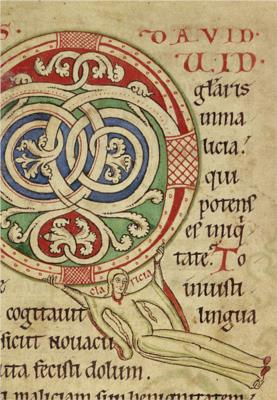
Almost nothing is known about Claricia except what she chose to show us: a small self-portrait tucked into the tail of a letter Q in a South German[1] psalter, painted around 1200[1]. She swings from the initial like an acrobat, her name written above her head in the margin. In a world where manuscript illuminators almost never signed their work, the gesture is both personal and bold.
Biography
The psalter is now held at the Walters Art Museum in Baltimore. Scholars have used Claricia's depiction to infer her status: her hair is uncovered and braided, her tunic close-fitting rather than monastic. These details suggest she was a lay student at the convent scriptorium in Augsburg rather than a professed nun, possibly from a family wealthy enough to place her there for education. The image places her at work in an institution where women produced manuscripts of considerable quality, though rarely left their names behind.
Feminist art historians including Dorothy Miner and Whitney Chadwick brought Claricia back to wider attention in the twentieth century, tracing her through the evidence she left in a single letter. She is cited as one of the few named women illuminators in the medieval period, her self-portrait appearing at Psalm 51 in the Vulgate sequence. That she inscribed her name without apology, in the very margin of a devotional book, says something about how she understood her own place in the work.
Timeline
- 1200Born circa 1200. Details of her birth and family are unknown.
- 1200Painted a self-portrait in the tail of the letter Q in a South German psalter.
- 1200Inscribed her name above her self-portrait in the margin of the psalter.
- 1200Worked as an illuminator at a convent scriptorium, possibly in Augsburg.
- 1200Her self-portrait appears at Psalm 51 in the Vulgate sequence of the psalter.
- 1200Died circa 1200. Details of her death are unknown.
Notable Works
Tap to view larger.
Next stop
Browse the movements →
Every movement in the collection, from the Renaissance to Pop art.
Related Artists


Frequently Asked Questions
What is Claricia's most famous work?
Claricia was a Bavarian illuminator of the late twelfth century. She is known today for a single initial letter in a psalter. The manuscript originated from the scriptorium of Augsburg's St Ulrich and St Afra Abbey. The psalter itself is held at the Walters Art Museum in Baltimore (W.14). The initial 'Q', opening Psalm 68, contains an image of Claricia herself. She is suspended upside down within the letter's tail. An inscription next to her reads 'Claricia mulier' (Claricia, a woman). This is a rare example of a named female artist from the medieval period. The image provides insight into the role of women in medieval art production. While nuns often created illuminated manuscripts, their contributions were usually anonymous. Claricia's inclusion of her name and image suggests a degree of self-awareness and artistic agency. The psalter is a valuable source for understanding medieval art and female artists.What style or movement did Claricia belong to?
Claricia was a medieval artist, working around the turn of the 13th century. She is known for a single signed self-portrait in a manuscript called the Psalter of Mainz (c. 1200[1]). The Psalter of Mainz is an example of Romanesque art, a style that predominated in Europe from approximately 1000 AD to the rise of Gothic art in the 12th century. Romanesque painting is characterised by simplified forms, strong lines, and hierarchical compositions. Manuscript illumination was a major element of Romanesque artistic production. Claricia's self-portrait appears in the initial letter 'Q' of Psalm 52. She is depicted swinging from the letter's tail, a playful and individualistic touch. The drawing is executed in red ink, with details added in brown. Her depiction offers a rare glimpse into the world of female artists in the Middle Ages, as well as illustrating the Romanesque aesthetic.What techniques or materials did Claricia use?
Unfortunately, specific details about Claricia's artistic techniques and materials are scarce. However, we can discuss the general practices of manuscript illumination during her time, the late 12th century. Manuscript illumination typically involved applying pigments to parchment. Artisans often used a white ground layer to create a reflective surface. They would then apply colours, sometimes using glazes to achieve a luminous effect, especially when depicting fabrics like silk. Recipes from the period mention techniques such as *matizare* or *illuminare* ("to lighten") and *incidere* or *umbrare* ("to shade"), which involved applying light and dark colours over a base to create the illusion of depth and form. Theophilus's *Schedula* describes these methods for modelling drapery on various surfaces, including wood and walls. While the exact pigments and tools Claricia employed remain unknown, it is likely she used similar methods common in medieval manuscript production, including layering colours and using techniques to create highlights and shadows.What was Claricia known for?
Claricia was a 12th-century illuminator, or possibly a lay student, at the Bavarian scriptorium of St. Emmeram in Regensburg. She is known for a single initial 'C' in a manuscript (MS Clm. 10058) made at St Emmeram around 1164. Within the letterform, Claricia depicted herself swinging on the ascender of the letter. Her image is labelled "Claricia ancilla Dei", which translates to "Claricia, servant of God". This is the only known signed image made by a woman artist in the Romanesque period. The manuscript containing Claricia's initial is a compilation of theological and philosophical texts. The scriptorium at St. Emmeram was a significant centre for manuscript production during the Middle Ages. The image provides rare evidence of female artistic activity during this period. It offers insight into the role of women in monastic communities, and questions about whether she was a nun, or a lay student at the abbey school.When did Claricia live and work?
Claricia was a medieval artist working in a south German[1] scriptorium. Her illustrated initial 'C' appears in a Psalter, now held at the Walters Art Museum (MS W.26, fol. 11v). The manuscript is dated to around 1200[1]. Claricia was likely a laywoman, rather than a nun. Her image is a self-portrait, showing her swinging from the letter 'C' (for 'Cantate'). Inscriptions on the image give her name and identify her as a *puella*, or girl. This Psalter originated at the Benedictine monastery of St Emmeram in Regensburg, Bavaria. The scriptorium produced elaborate presentation manuscripts, illuminated with gold leaf and vivid colours. The scriptorium was active from the late tenth century to the early thirteenth.Where can I see Claricia's work?
Claricia was a 12th-century Bavarian illuminator. As a female member of a religious order, she would have created her art within a monastic setting. Locating her work today involves understanding where medieval illuminated manuscripts are held. Many major museums and libraries now catalogue their treasures online, often including digital images. The British Library, the Pierpont Morgan Library, and the Hague are in the process of creating complete electronic catalogues of their illuminated manuscripts. These digital surrogates offer a valuable alternative to viewing objects in person, especially when only one page of a book can be displayed at a time. Physical examples of medieval art are displayed on a permanent or semi-permanent basis in many locations. National and international loans programmes between repositories mean that special temporary exhibitions gather treasures representative of a particular period or theme. Some of the museums that hold collections of medieval art include the Israel Museum in Jerusalem, the Biblioteca Ambrosiana in Milan, and the Walters Art Gallery in Baltimore.Where was Claricia from?
Claricia was a German[1] artist working during the medieval period. Although specific details of her life are scarce, her artistic activity can be dated to the 12th century. Some researchers include Claricia among notable women artists of that time, such as Hildegard of Bingen and Herrad of Landsberg; however, this remains a topic of debate among scholars. During the Middle Ages, religious and secular women were involved in book production. Women demonstrated self-assurance in this area. Besides book production, women were frequently active in textile arts. However, there is a lack of written source material in this area, so very little can be deduced about the self-awareness of an embroiderer or a weaver.Who did Claricia influence?
Claricia was a Bavarian illuminator of the late twelfth century. She is known for a single signed initial in a Psalter, now held at the Walters Art Museum in Baltimore. The initial 'D' contains a self-portrait of Claricia, posed on a ladder, swinging from the letterform. It is difficult to assess Claricia's direct influence on later artists, due to the limited number of attributed works. However, her image provides important insights into the role of women in medieval art production. Claricia's signed self-portrait challenges conventional assumptions about anonymous female labour during the period. She asserted her individual identity as an artist. The image has had a notable impact on later art historians and feminist scholars. They often cite Claricia as an example of female agency in the Middle Ages. Her playful self-representation has become an important symbol for discussions about women's creativity and self-expression within religious institutions. The initial continues to be reproduced in surveys of art history, medieval history, and women's studies.Who influenced Claricia?
Claricia was a Bavarian illuminator of the late twelfth century. She is known for a single signed initial in a Psalter, now held at the Walters Art Museum in Baltimore. As a woman working in a scriptorium, Claricia would have been trained by male members of a religious order. Manuscript illumination was a collaborative process. Several artists, scribes, and binders contributed to the finished book. It is difficult to identify specific influences on Claricia's style. However, she would have been familiar with the conventions of Romanesque art. The twelfth century saw the production of many elaborate illuminated books. These included Bibles, Psalters, and liturgical texts. Scriptoria across Europe developed their own regional styles. Claricia's work reflects the artistic traditions of southern Germany. Her initial contains both animal and human figures. This type of decorated initial was common in Romanesque manuscripts. The inclusion of a self-portrait is unusual, but not unprecedented. Other female artists also included their likenesses in their work.Who was Claricia?
Almost nothing is known about Claricia, except for a small self-portrait she included in a South German[1] psalter around 1200[1]. She depicted herself swinging from the tail of a letter Q, with her name inscribed above. Scholars believe she was likely a lay student at the convent scriptorium in Augsburg, rather than a professed nun.Why are Claricia's works important today?
Claricia was a medieval artist, active in the late 12th or early 13th century. She is known for a single signed initial "C" in a Psalter manuscript (Walters Art Museum, Baltimore, W.139). Within the letterform, she depicted herself swinging from the ascender of the letter. Her work is significant because it provides a rare example of a female artist's self-portrait from this period. Few women artists are identifiable by name in the Middle Ages, and even fewer left visual representations of themselves. Claricia's inclusion of her own image suggests a degree of self-awareness and artistic agency not commonly documented for women at the time. The inscription next to her image, "Claricia puella," identifies her as a young woman, possibly a student or novice in a religious community. This gives insight into the educational opportunities available to some women during the medieval era, as well as their potential roles in artistic production within religious contexts. Her work offers a valuable glimpse into the lives and creative contributions of women in the Middle Ages.
Sources
Editorial draws on the following primary and tertiary references for Claricia.
- [1] wikipedia Wikipedia: Claricia Used for: biography, birth dates, death dates, identifiers, movement attribution, nationality.
- [2] book 4<8=8AB@0B>@, A companion to medieval art _ Romanesque and Gothic in Northern Europe Used for: stylistic analysis.
- [3] book Clare Vernon, Clare Vernon - From Byzantine to Norman Italy_ Mediterranean Art and Architecture in Medieval Bari (New Directions in Byzantine Studies) Used for: biography.
- [4] book Clare Vernon, Clare Vernon - From Byzantine to Norman Italy_ Mediterranean Art and Architecture in Medieval Bari (New Directions in Byzantine Studies) Used for: biography.
- [5] book Giotto Used for: biography.
- [6] book Penelope J.E. Davies, Walter B. Denny, Frima Fox Hofrichter, Joseph Jacobs, Ann S. Roberts, David L. Simon, Janson's History of Art_ The Western Tradition (8th Edition) Used for: biography.
- [7] book Masterpieces of western art : a history of art in 900 individual studies from the Gothic to the present day Used for: biography.
- [8] book MMS6.indb Used for: biography, stylistic analysis.
Editorial overseen by Solis Prints. Sources verified 2026-10-15. Click a source for details, or hover over [N] in the page above to preview.
Editorial standardsMethodologyCorrectionsAI disclosureAbout the editorial team