



Christian Eckart
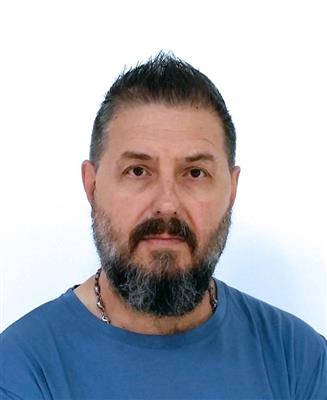
Christian Eckart was born in Calgary in 1959[3] and studied sculpture at the Alberta College of Art before moving to New York to complete an MFA at Hunter College in 1986, where Robert Morris was among his teachers. The shift from sculpture to painting was not a retreat so much as a redirection of the same conceptual ambitions.
Biography
Eckart describes his practice as working in a tradition of the icon, a phrase that locates him at the intersection of Malevich's reduction and the devotional object. His paintings are formally Neo-Minimalist, built from precise geometry, hand-polished automotive lacquer, dichroic glass, and aluminium, but their orientation is towards the spiritual rather than the purely optical. The altarpiece format, the cruciform shape, the Renaissance and Baroque colour palette: these are not stylistic affectations but structural commitments.
His major series include the Eidolon paintings, the Sacra Conversazione works, the White Paintings, and the Power-Chord Cycle. Each takes a different angle on the same questions about how a secular age inherits the visual language of devotion. The production is meticulous; surfaces are often built up over extended periods.
Works by Eckart are held at MoMA and the Guggenheim in New York, the Art Institute of Chicago, the Detroit Institute of Arts, the Museum Moderner Kunst Vienna, and the Art Gallery of Ontario. He taught at the School of Visual Arts in New York from 1994 to 2002, later joining the Glassell School of Art in Houston. He was inducted into the Royal Canadian[3] Academy of Arts in 2009 and lives and works in Houston, Texas.
Timeline
- 1959Born in Calgary.
- 1986Completed an MFA at Hunter College in New York; Robert Morris was among his teachers.
- 1994Began teaching at the School of Visual Arts in New York.
- 2002Stopped teaching at the School of Visual Arts.
- 2009Inducted into the Royal Canadian Academy of Arts.
- 2009Created the series of Eidolon paintings.
- 2009Created the Sacra Conversazione works.
- 2009Created the White Paintings series.
- 2009Created the Power-Chord Cycle.
Notable Works
Tap to view larger.
Next stop
Browse the movements →
Every movement in the collection, from the Renaissance to Pop art.
Related Artists
_%E2%80%93_LOC.jpg)


Frequently Asked Questions
What is Christian Eckart known for?
Christian Eckart is known for his Neo-Minimalist paintings that incorporate precise geometry, hand-polished automotive lacquer, dichroic glass, and aluminium. He works in a tradition of the icon, locating him at the intersection of Malevich's reduction and the devotional object.What is Christian Eckart's most famous work?
It is difficult to name one single work as Christian Eckart's "most famous". His practice involves modular, serialised artworks that often rework historical designs through minimalist aesthetics. Eckart is known for his engagement with the visual languages of modernism, minimalism, and the sacred geometries found in religious art. He frequently employs materials like polished metal and lacquered surfaces to create works that explore perception and reflection. These pieces often take the form of wall-mounted panels or sculptural objects. Without a singular, iconic piece to point to, it is more accurate to say that Eckart is recognised for his distinctive approach to abstraction and his ongoing investigation into the intersection of art, architecture, and spirituality. His work invites contemplation on the nature of light, space, and the viewing experience itself.What should I know about Christian Eckart's prints?
Expressionist artists in Germany, such as Max Beckmann, Erich Heckel, and Karl Schmidt-Rottluff, eagerly used printmaking techniques. The woodcut form influenced their painting style, with its flatness, angularity, and summary treatment of form. Printmaking became a direct, symbolic language for inner agitation. The "Brücke" group's graphic style had a significant impact on German art. During the hyperinflation period in Germany (1922-1923[3]), prints became a more affordable art form, accessible to a wider population. Publishers like Cassirer, Gurlitt, and Neumann produced larger, more uniform print editions, sometimes exceeding one hundred. Some artists, like Kirchner, preferred to print their works themselves, valuing the personal touch. Critics embraced the woodcut as a quintessentially German means of expression, rooted in the nation's past. Printmaking allowed artists to express the human condition and offer a document of their time.What style or movement did Christian Eckart belong to?
It is difficult to assign Christian Eckart to a single style or movement, as his career has spanned several decades and explored diverse approaches. The concept of 'style' itself is complex. Style emerges through limitations and systems; it requires a consensus on social ideals. The absence of such agreement results in artists feeling isolated, as their ideas may not be understood or shared. Some argue 'style' is merely the expression of conventional content, its variations simply 'taste'. Some art historians see the early 20th-century Bauhaus movement as grappling with modernity, including irrational elements. Others view art produced during the Third Reich as an integral component of modernity, not an exception. These debates suggest the challenges in categorising artists within rigid stylistic boundaries. Artists play an active role in deepening our knowledge, seeking the highest perception of totality. Selectivity is not an option, as it is imperative to penetrate the whole cosmic law of rhythm, power, and matter, which is the true world.What techniques or materials did Christian Eckart use?
Artists have always employed a range of materials and techniques. Traditional artists used materials such as wood, marble, bronze, and clay. They also used painting materials such as natural and chemical pigments in fresco, egg tempera, watercolour, and oil. Contemporary artists expanded this palette, incorporating acrylics, household emulsions, and mixed media, combining diverse materials in a single work. They also adopted non-art materials like cardboard, plastic, and everyday household items. Techniques range from painting methods such as impasto, glazes, and varied brushwork to sculptural processes like carving, modelling, casting, assemblage, and the use of found objects. The selection of materials and techniques significantly influences the final form and effect of an artwork, with artists often combining different materials to achieve symbolic or aesthetic goals. The interplay between material and technique allows artists to express their vision and create new forms.When did Christian Eckart live and work?
Unfortunately, the provided texts do not contain information about the life and work of Christian Eckart. Instead, they detail events in German art and culture, primarily during the Weimar Republic and the rise of Nazism, with some references to earlier Expressionist movements. The passages cover a range of topics, including art exhibitions, publications, and political events from 1905 to 1933. They mention key figures such as Ernst Ludwig Kirchner, Käthe Kollwitz, George Grosz, and Otto Dix, and movements such as the Brücke and Neue Sachlichkeit. The texts also reference the suppression of modern art by the Nazis and the emigration of many artists. Without specific information about Christian Eckart, I cannot provide an answer to your question.Where can I see Christian Eckart's work?
To view artworks, visit museums in Germany, Austria, the UK, Canada, and the United States. In Germany, see the Bauhaus Archive-Museum für Gestaltung (Berlin), Bröhan-Museum (Berlin), Kunstgewerbe Museum of Decorative Arts (Berlin), Museum beim Markt (Karlsruhe), and Museum für Kunst und Gewerbe (Hamburg). Other German museums include the Brucke Museum (Berlin), Nationalgalerie (Berlin), Kunsthalle (Bremen), Sammlung Bottcherstrasse (Bremen), Ludwig Museum (Cologne), Wallraf-Richartz Museum (Cologne), Folkwang Museum (Essen), Gesellschaft Kruppsche Gemaldesammlung (Essen), Niedersachsisches Landesmuseum (Hanover), Stadtische Kunsthalle (Mannheim), Bayerische Staatsgemaldesammlungen (Munich), Stiftung Ada und Emil Nolde (Seebüll), and Von der Heydt Museum (Wuppertal). The MAK Austrian Museum of Applied Art/Contemporary Art is located in Vienna, Austria. In the UK, visit the Bakelite Museum, Brighton Museum & Art Gallery, Geffrye Museum, Manchester Art Gallery, National Museums of Scotland-Royal Museum, and the Victoria & Albert Museum (London). North American venues include the Charles Hosmer Morse Museum of American Art, Los Angeles County Museum of Art (LACMA), Metropolitan Museum of Art, Minneapolis Institute of Arts, Museum of Modern Art, Royal Ontario Museum, Virginia Museum of Fine Arts, and the Wolfsonian at Florida International University.Who did Christian Eckart influence?
It is difficult to identify specific artists who were directly influenced by Christian Eckart. Art history sources do not discuss Eckart's direct influence on other artists. However, it is possible to discuss related movements and artists who explored similar ideas. Eckart's work engages with abstraction, light, and spirituality, themes that also appear in the work of earlier artists. Wassily Kandinsky, a pioneer of abstract art and a member of Der Blaue Reiter group, explored the connection between art and spirituality. Kandinsky aimed to evoke spiritual states through non-representational forms and colour. Similarly, the American Abstract Expressionists, such as Barnett Newman and Mark Rothko, used large colour fields to create contemplative experiences. These artists shared an interest in transcendentalism, seeking to express emotions and ideas beyond the material world.Who influenced Christian Eckart?
It is difficult to summarise the influences on an artist. However, Expressionism, as a movement, was affected by philosophical currents that generated around the turn of the century. These currents can be called neo-Romantic, because many of their exponents referred back to Romantic philosophy. They gave expression to a world view similar to that of the Romantic period, while aiming at the dissolution of the systematic body of thought of mid-nineteenth-century philosophy. The "founding father" of neo-Romantic philosophy was Friedrich Nietzsche. Nietzsche denounced the materialistic natural science of his time as superficial. He looked for the principle of the "higher life" in the spiritual realm. In opposition to the deterministic world of matter, he emphasised the creative force of the spirit, which gives free play to the will. The turn to the "spiritual" found its expression in Nietzsche's philosophy. Expressionist art aimed at essences. The early abstractionists gave their pictures the title "Eidos" (essence) and Walter Meckauer studied Wesenhafte Kunst (Essential Art) in 1920.Who was Christian Eckart?
Christian Eckart was born in Calgary in 1959[3] and studied sculpture at the Alberta College of Art before completing an MFA at Hunter College in 1986. Robert Morris was among his teachers.Why are Christian Eckart's works important today?
It is difficult to assess Christian Eckart's importance based on the passages provided. They concern the reception of Friedrich Nietzsche's philosophy among German Expressionist intellectuals before and after the First World War. Expressionists initially embraced Nietzsche's cultural critique, individualism, and concept of *Geist* (spirit). Journals such as *Die Aktion* and *Der Sturm* debated Nietzsche's legacy, especially his internationalism versus interpretations by German nationalists. However, the war and the November Revolution caused many Expressionists to shift from Nietzschean individualism towards Marxism. They saw Marxism as a path to social revolution and communal society, prioritising class struggle over cultural renewal. Figures like Ludwig Rubiner and Johannes Becher turned away from Nietzsche and towards figures such as Tolstoy and Lenin. Those who resisted Marxism and maintained a focus on cultural revolution, such as René Schickele, retained Nietzsche's appeal. The documents suggest Expressionism's internal tensions regarding political engagement and ideological rigidity.What was Christian Eckart's art style?
His paintings are formally Neo-Minimalist, built from precise geometry, hand-polished automotive lacquer, dichroic glass, and aluminium. The altarpiece format, the cruciform shape, and the Renaissance and Baroque colour palette are structural commitments in his work.
Sources
Editorial draws on the following primary and tertiary references for Christian Eckart.
- [1] museum Harvard Art Museums Used for: museum holdings.
- [2] museum Victoria and Albert Museum Used for: museum holdings.
- [3] wikipedia Wikipedia: Christian Eckart Used for: biography, birth dates, death dates, identifiers, movement attribution, nationality.
- [4] book Beard, Lee, 1973- author, Butler, Adam, author; Van Cleave, Claire, author; Fortenberry, Diane, author; Stirling, Susan, author, Beard, Lee, 1973- author, Butler, Adam, author; Van Cleave, Claire, author; Fortenberry, Diane, author; Stirling, Susan, author - The Art Book_ New Edition, Mini Format Used for: biography, stylistic analysis.
- [5] book German expressionism : documents from the end of the Wilhelmine Empire to the rise of national socialism Used for: biography, stylistic analysis.
- [6] book guggenheim-refigur00kren Used for: biography.
- [7] book Taylor, Seth, Left-Wing Nietzscheans_ The Politics of German Expressionism 1910-1920 (Monographien und Texte zur Nietzsche-Forschung, 22) Used for: biography, stylistic analysis.
Editorial overseen by Solis Prints. Sources verified 2026-08-31. Click a source for details, or hover over [N] in the page above to preview.
Editorial standardsMethodologyCorrectionsAI disclosureAbout the editorial team