

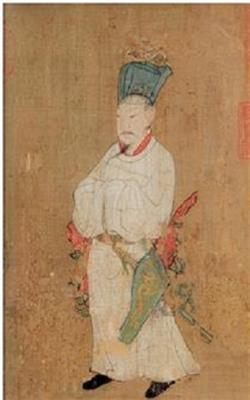
Chen Hong
Few artists from the Tang court left as clear a mark on Chinese[1] equine painting as Chen Hong, who flourished during the 8th century under the patronage of an empire that prized horses above almost every other subject. A student of Cao Ba, the celebrated court painter whose horse portraits Tang artists measured themselves against, Chen Hong absorbed and extended a tradition in which animals were not merely decorative but carriers of political and military prestige.
Biography
Horse painting at the Tang court was a fiercely competitive discipline. The emperor Xuanzong kept vast stables and expected his painters to capture individual animals with precision and personality. Within that tradition Chen Hong held his own alongside Han Gan and Wei Yan, forming a quartet of horse masters whose names later critics regularly grouped together. His surviving work includes 'Eight Noble Officials', a figure composition that shows his range extended well beyond the stable yard.
Chang'an's cosmopolitan court demanded painters fluent in both figure and animal subjects, and Chen Hong answered both calls. His precise brushwork in figure painting carried the same attention to physiognomy that made his horses convincing, and his training under Cao Ba gave him a lineage that lent authority to his position. The scarcity of biographical records beyond his studio associations and surviving attributions is typical for Tang artists of his rank: the works outlasted the life.
Chen Hong's place in the canon rests less on individual masterpieces than on his role in codifying the conventions of Tang court horse painting. Later generations of Chinese[1] painters treated the Tang horse masters as a benchmark, returning to their compositions when they wanted to reconnect with a period when equine art carried genuine cultural weight.
Notable Works
Tap to view larger.
Next stop
Browse the movements →
Every movement in the collection, from the Renaissance to Pop art.
Related Artists



Frequently Asked Questions
What is Chen Hong known for?
Chen Hong is known for his role in codifying the conventions of Tang court horse painting. Later generations of Chinese[1] painters treated the Tang horse masters as a benchmark, returning to their compositions when they wanted to reconnect with a period when equine art carried genuine cultural weight.What is Chen Hong's most famous work?
It is difficult to identify one single "most famous work" by Chen Hong, as fame is subjective and varies across audiences and time. However, Chen Hong was a court painter during the reign of Emperor Qianlong (1735-1796[1]) in the Qing dynasty. He is best known for figure painting and portraits. Without specific titles or further information, it is impossible to determine his single most recognised piece. His artistic output would have included many works created for the imperial court, likely depicting emperors, empresses, and court officials. These paintings would have served specific political and ceremonial purposes. To identify Chen Hong's best known work, one would need to examine museum collections, auction records, and academic catalogues of Qing dynasty painting. Further research into the Qianlong Emperor's court and its artistic patronage would also be beneficial.What should I know about Chen Hong's prints?
Chen Hong (陳洪; active early 1800s) was a Chinese[1] seal carver, painter, and ceramic artist. In 1802, he passed his capital-level examinations and was awarded the title of presented scholar (jinshi). This led to his first official posting in Guangdong province. However, he delayed taking up his post due to the death of his father, Chen Jing, and the associated Confucian mourning period. This decision stalled his political career for several years. Chen's seal carving reached its peak in 1802, when he carved over twenty seals for friends and acquaintances. Around this time, Chen's artistic focus shifted from seal carving to painting and the creation of custom teapots. His painting output increased significantly in the fifteen years following his ascension to presented scholar. His work with teapots began around 1811, when he was posted as a district magistrate in Liyang, Jiangsu Province. Like his seal carving, Chen's approach to painting and teapots was guided by a tactile engagement with the materials.What style or movement did Chen Hong belong to?
Chen Hong (1768-unknown) was a Qing dynasty artist who worked in diverse media. He is known for calligraphy, seal carving, painting, and teapot design. Chen's calligraphy style was a hybrid one, mixing orthography from several sources. These included ancient bricks, early bronze inscriptions, and carved steles from the late Han era and early Six Dynasties period. The long, diagonal strokes in some characters came from cliff-carved calligraphy. His brother-in-law Gao Rijun noted Chen's interest in epigraphy, feeling other literary forms were exhausted. Chen made connections between his brush painting and seal carving. He saw both as skills illuminated by spirit that could sustain the body and lead to awakening, like Chan Buddhist instruction. He believed process-oriented discovery was more important than skills training. He thought one could approach a manner of painting comparable to the past by working slowly, stroke by stroke, without rote method. Chen's seal carving peaked in 1802. That year, he passed his capital-level exams, was awarded the title of presented scholar, and received his first official posting to Guangdong. He also produced paintings and customised teapots.What was Chen Hong known for?
Chen Hong (born 1768) was known for his seal carving, painting, calligraphy, and work with teapots. Chen's seal carving reached its peak in 1802; in that year, he carved over twenty seals. He passed exams, was awarded the title of presented scholar (jinshi), and received his first official posting to Guangdong. Around the start of the 19th century, Chen's involvement with other art forms grew. While seal carving helped him secure a network, painting and teapots eventually supplanted seals in Chen’s practice. His painting output increased, seemingly most prolifically during the fifteen-year period after he became a presented scholar. His teapot production began after his 1811 posting as district magistrate in Liyang, Jiangsu Province. Chen's artistic output spanned a broad spectrum, including stone seals carved in the style of Han-dynasty inscriptions and calligraphy in clerical scripts derived from steles. He also produced finger paintings. Seal carving was less common than calligraphy, and finger painting and teapot crafting were even less common.Where can I see Chen Hong's work?
Chen Hong's work can be viewed in museums worldwide. Within China, the Palace Museum in Beijing houses an extensive collection of treasures from the Ming and Qing dynasties. The Shanghai Art Museum has twelve galleries displaying Chinese[1] artefacts. The Chinese Silk Museum in Hangzhou City specialises in silk and textiles. The National Palace Museum in Taipei also holds Chinese classical art. Outside Asia, the Art Gallery of New South Wales in Sydney has a dedicated Asian collection. In the UK, the British Museum in London has a large collection of Chinese antiquities, paintings, and porcelain. The Ashmolean Museum at the University of Oxford has early Chinese ceramics and contemporary paintings. In the United States, the Art Institute of Chicago has an Asian collection spanning five millennia. The Asian Art Museum of San Francisco has a collection of Asian art. The Boston Museum of Fine Arts has Chinese paintings, sculpture, and ceramics. The Cleveland Museum of Art has a collection of Chinese art, some of which is viewable online.Where was Chen Hong from?
Chen Hong was born in 1616 in Huating, Jiangsu province. He was active as a painter during the late Ming dynasty (1368 to 1644) and early Qing dynasty (1644 to 1912). Chen's father held a government position, but after his death, the family became impoverished. He failed to pass the civil service examinations, so he made his living as a professional painter. He was associated with a group of artists known as the 'Eight Eccentrics of Yangzhou', who rejected traditional artistic styles in favour of more individualistic approaches. Chen Hong's work often featured historical figures and scenes, and he was known for his bold brushwork and expressive use of colour. He died in 1652.Who influenced Chen Hong?
Chen Hong was drawn to tradition and the passing of knowledge from one school to the next. He was particularly interested in Jackson Pollock's work, which he said 'seemed to resonate' with him. Pollock 'opened the way' for Chen, freeing him to make his own contribution. Chen wanted to investigate and understand Pollock's methods. He also expressed interest in Old Masters, Cubists, Manet, Monet, Miró, and Gorky, wondering how they made their paintings. Chen also stated that artists, actors, and architects understood his work, particularly how his jackets were constructed and that the suits he designed were meant to be non-restrictive. He found inspiration in photographs of Picasso from the 1930s, as well as the young Gary Cooper, whose style Chen found 'very sexy' and 'relaxed'. Matisse also gave him the chance to use colour in a very important way. Chen also found early Picasso important, admiring the purity, clarity, spirit and modernity of his drawings.Who was Chen Hong?
Chen Hongshou (1598-1652[1]) was a Chinese[1] artist of the late Ming dynasty. Though from a family of scholar-officials, Chen did not find success in government work. He instead supported himself through painting. Chen Hongshou's art often carried literary themes. His handscroll *Returning Home* illustrates scenes inspired by Tao's homecoming poems. One scene depicts the poet meditating before inscribing two painted fans. The inscription speaks of yearning for familial roots. Chen also produced portraits and figures. These designs were sometimes used for woodblock-printed playing cards; one example is a woodblock print of Qu Yuan. His *Self-Portrait, Artist Inebriated* (1627) captures his emotional state. The inscription mentions the Manchus threatening the Ming dynasty, his fears, and finding solace in drinking with a friend.Why are Chen Hong's works important today?
Chen Hong's art is important because it reflects a shift in Chinese[1] art towards social relevance and cultural specificity. After a period of political unrest and market reforms, artists like Chen Hong began focusing on their immediate surroundings. This focus represented a move away from grand philosophies and towards a more mundane, quiet observation of life. This artistic direction allowed Chinese artists to assert their position in the world on their own terms, rather than feeling pressured to conform to international trends dictated by Western art centres. Referencing their own lives and environments validated their place in a specific time and place. The underlying impulse for social relevance distinguished Chinese art from Western art, highlighting an earnestness and connection to social reality.What was Chen Hong's art style?
His precise brushwork in figure painting carried the same attention to physiognomy that made his horses convincing. His training under Cao Ba gave him a lineage that lent authority to his position.When was Chen Hong born?
Chen Hong was born in 750[1]. Chen Hong died in 750, aged 0.
Sources
Editorial draws on the following primary and tertiary references for Chen Hong.
- [1] wikipedia Wikipedia: Chen Hong Used for: biography, birth dates, death dates, identifiers, movement attribution, nationality.
- [2] book Yan Zhou, A History of Contemporary Chinese Art Used for: biography, stylistic analysis.
- [3] book Charlotte Mullins, A Little History of Art Used for: biography.
- [4] book Zhu, Ying;Rosen, Stanley;, Art, Politics, and Commerce in Chinese Cinema Used for: biography, stylistic analysis.
- [5] book Beard, Lee, 1973- author, Butler, Adam, author; Van Cleave, Claire, author; Fortenberry, Diane, author; Stirling, Susan, author, Beard, Lee, 1973- author, Butler, Adam, author; Van Cleave, Claire, author; Fortenberry, Diane, author; Stirling, Susan, author - The Art Book_ New Edition, Mini Format Used for: biography.
- [6] book Masterpieces of western art : a history of art in 900 individual studies from the Gothic to the present day Used for: biography.
- [7] book Jörg Huber, Zhao Chuan (eds.), The Body At Stake_ Experiments In Chinese Contemporary Art And Theatre (image) Used for: biography, stylistic analysis.
Editorial overseen by Solis Prints. Sources verified 2026-08-31. Click a source for details, or hover over [N] in the page above to preview.
Editorial standardsMethodologyCorrectionsAI disclosureAbout the editorial team