



Charles Conder
Charles Conder arrived in Australia at sixteen, trained briefly as a surveyor, and then talked himself into painting full-time with a speed that suggested he already knew his own mind. By 1889[2] he was co-organising the *9 by 5 Impression Exhibition* in Melbourne alongside Tom Roberts and Arthur Streeton, one of the defining moments of Australian[2] impressionism. He contributed 46 works, most of them painted on cigar-box lids, and sold the lot. He was twenty years old.
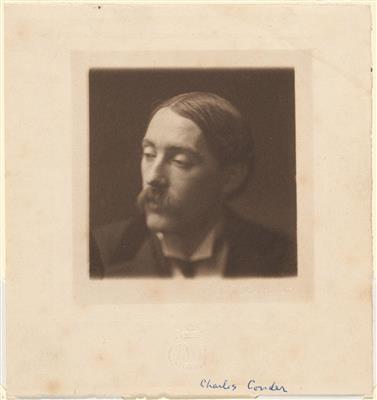
Biography
The following year he left for Paris, enrolled at the Académie Julian, and embedded himself in the circle around Toulouse-Lautrec, Oscar Wilde, and William Rothenstein. It was there he found his most distinctive medium: decorative work on silk, particularly folding fans and small screens, painted with a translucent, jewel-like touch that no contemporary quite replicated. Wilde admired him. Pissarro and Degas praised his work. He occupied a position that was genuinely unusual, equally at home in the Heidelberg School's plein-air realism and the fin-de-siècle Symbolist world, yet reducible to neither.
His Australian[2] pictures, especially the harbour and beach scenes from around Sydney, are now considered his finest work: *A Holiday at Mentone* (1888[2]) and *Departure of the Orient, Circular Quay* (1888) have a directness and warmth that his later Parisian pieces sometimes lacked. The decorative silk work earned him devoted collectors in Britain and France but divided opinion among critics who felt he was trading a real gift for a fashionable one.
Conder died in February 1909[2], aged forty, of general paresis resulting from syphilis. The compression of his career, twenty years of serious work, two continents, two utterly different idioms, gives it an unusual intensity.
Timeline
- 1868Born in Britain.
- 1884Arrived in Australia at sixteen and trained briefly as a surveyor.
- 1888Painted *A Holiday at Mentone* and *Departure of the Orient, Circular Quay*.
- 1889Co-organised the *9 by 5 Impression Exhibition* in Melbourne with Tom Roberts and Arthur Streeton; he contributed 46 works, at 20.
- 1890Left for Paris and enrolled at the Académie Julian.
- 1890Embedded himself in the circle around Toulouse-Lautrec, Oscar Wilde, and William Rothenstein in Paris.
- 1909Died in February, aged forty, of general paresis resulting from syphilis.
Notable Works
Tap a work to read about it, or to view it larger.
Where to See Charles Conder
2 museums worldwide.
-
7 works
Art Gallery of South Australia
Adelaide, Australia
10:00–17:00 daily, closed Christmas Day · Free
-
1 works
The Atkinson
Southport, United Kingdom

Next stop
Browse the movements →
Every movement in the collection, from the Renaissance to Pop art.
Related Artists



Frequently Asked Questions
What is Charles Conder known for?
Charles Conder is known for his involvement in Australian[2] impressionism, decorative work on silk (particularly fans and screens), and his harbour and beach scenes from around Sydney. He co-organised the *9 by 5 Impression Exhibition* in Melbourne and found success with his decorative silk work in Britain and France. However, some critics felt that he was exchanging genuine talent for fashionable work.What was Charles Conder's art style?
Charles Conder's art style encompassed both plein-air realism, seen in his Australian[2] pictures, and fin-de-siècle Symbolism, evident in his decorative silk work. His Australian works, such as *A Holiday at Mentone* and *Departure of the Orient, Circular Quay*, display a directness and warmth. His silk pieces featured a translucent, jewel-like touch.How did Charles Conder die?
Charles Conder died in 1909[2] at the age of 41.
Sources
Editorial draws on the following primary and tertiary references for Charles Conder.
- [1] museum Art Gallery of South Australia Used for: museum holdings.
- [2] wikipedia Wikipedia: Charles Conder Used for: biography, birth dates, death dates, identifiers, movement attribution, nationality.
- [3] book Howard Simon, 500 Years of Illustration Used for: biography.
- [4] book Carol Belanger Grafton, Art Nouveau Used for: stylistic analysis.
- [5] book Anton Seder, Art Nouveau Objects and Artifacts Used for: stylistic analysis.
- [6] book Post-impressionism : cross-currents in European painting Used for: biography.
- [7] book Post-impressionism : cross-currents in European painting Used for: biography.
- [8] book Mary Greensted, The Arts and Crafts Movement in Britain (Shire History) Used for: stylistic analysis.
Editorial overseen by Solis Prints. Sources verified 2026-09-22. Click a source for details, or hover over [N] in the page above to preview.
Editorial standardsMethodologyCorrectionsAI disclosureAbout the editorial team